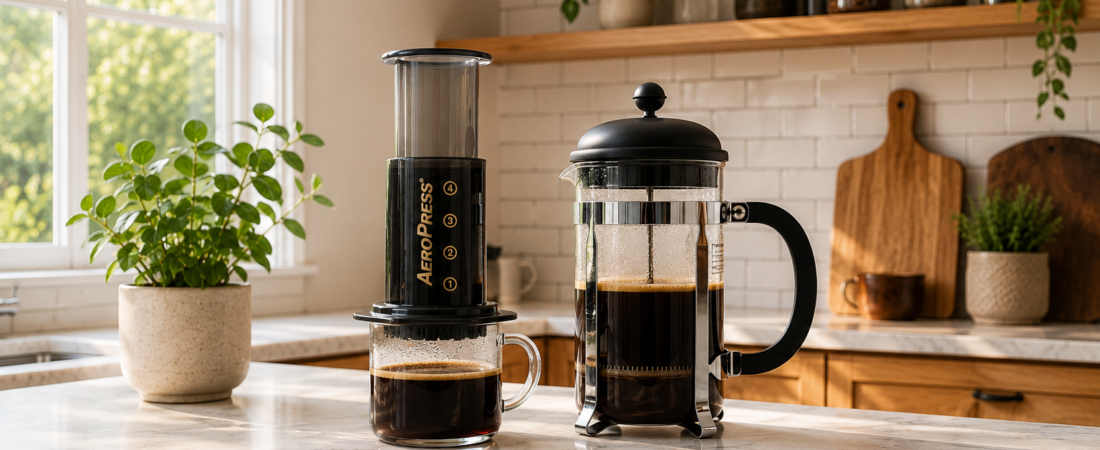
AeroPress vs French Press is one of the most common coffee brewing debates among beginners. If you’re trying to decide which brewer to buy, the answer depends largely on how many people you brew for and the type of coffee you enjoy. Both can make excellent coffee at home, but they produce very different results and suit different brewing styles. If you’re choosing between an AeroPress and a French press, you’re already making a good decision — both are affordable, beginner-friendly, and produce genuinely excellent coffee. But they produce very different cups and suit very different brewing habits. This comparison cuts through the noise and tells you exactly which one is right for your situation.
This article contains affiliate links. If you buy through them, I may earn a small commission at no extra cost to you.
⭐ Quick Answer
Choose the AeroPress if you want versatility, faster brewing, and a cleaner cup — especially if you brew for one person or travel frequently. Choose the French press if you want a rich, full-bodied cup and regularly brew for two or more people.
👉 AeroPress Original (~$35) — Check price & availability
👉 Bodum Chambord French Press (~$40) — Check price & availability
The Key Difference in One Sentence
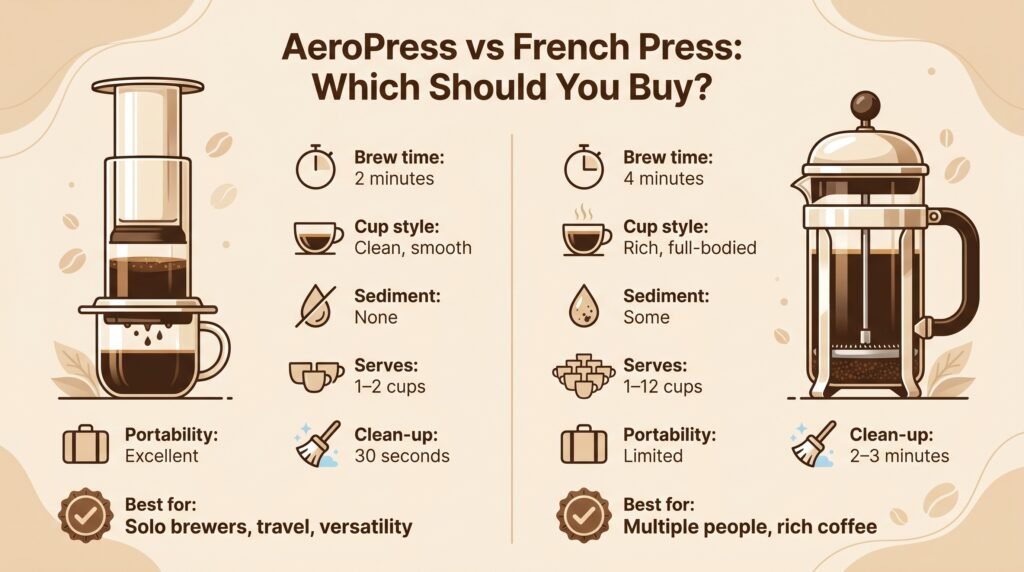
The AeroPress makes a clean, smooth, versatile cup in about 2 minutes. The French press makes a rich, full-bodied, oily cup in about 4 minutes. Neither is better — they’re genuinely different experiences.
Which Should You Buy? Quick Decision Guide
| Question | Answer | Pick |
|---|---|---|
| Do you usually brew for one person? | Yes | → AeroPress |
| Do you regularly brew for 2+ people? | Yes | → French Press |
| Do you travel or commute with coffee? | Yes | → AeroPress |
| Do you prefer rich, full-bodied coffee? | Yes | → French Press |
| Do you want the fastest clean-up? | Yes | → AeroPress |
| Do you want no ongoing filter costs? | Yes | → French Press |
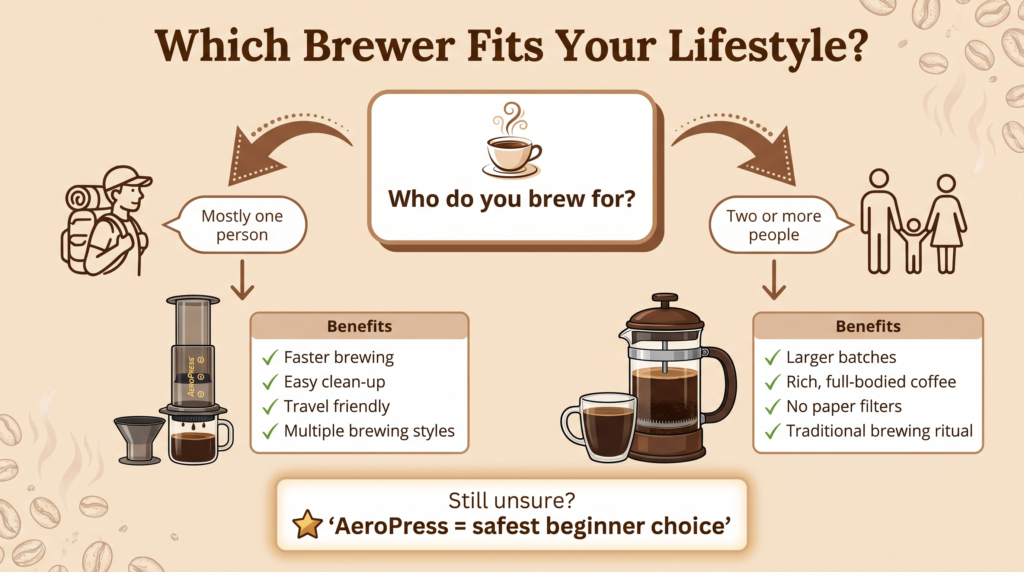
| Still unsure? | — | → AeroPress — more versatile starting point |
Side-by-Side Comparison
| Feature | AeroPress | French Press |
|---|---|---|
| Brew time | ~2 minutes | ~4 minutes |
| Cup style | Clean, smooth, low bitterness | Rich, full-bodied, oily |
| Sediment | None (with paper filter) | Some fine sediment |
| Bitterness | Very low | Low to medium |
| Versatility | ✅ Multiple styles — espresso, Americano, cold brew | One style |
| Serves | 1–2 cups per press | 1–12 cups depending on size |
| Portability | ✅ Compact, lightweight, nearly indestructible | Fragile glass — not ideal for travel |
| Cleaning | ✅ 30 seconds | 2–3 minutes |
| Ongoing cost | Paper filters ~$8/350ct | ✅ No ongoing cost |
| Price | ~$35 | ~$20–40 |
| Learning curve | Very low | Very low |
| Best for | Versatility, travel, clean cup, solo brewing | Rich cup, brewing for 2+, no filter cost |
How the Coffee Tastes
This is the most important difference and the one that determines which brewer is right for you.
AeroPress coffee is smooth, clean, and low in bitterness. The paper filter removes oils and fine particles — the result is a clear, bright cup with well-defined flavours and no grittiness. It’s often described as cleaner than French press but with more body than pour-over. The low acidity and bitterness make it one of the most approachable cups for people who find other methods too harsh.
French press coffee is rich, full-bodied, and oily. The metal mesh filter lets the natural coffee oils through — the result is a heavier, more textured cup with more complexity and body. There’s usually some fine sediment at the bottom which is normal for the method. If you’ve grown up drinking drip or pod coffee, French press often feels like a revelation — it’s significantly more flavourful and satisfying.
Think of it this way: AeroPress is like skim milk — clean and light. French press is like whole milk — rich and full. Same general thing, completely different texture and feel.
Neither is objectively better. It entirely depends on what you want in your cup.
Ease of Use
Both are very beginner-friendly — this isn’t a meaningful differentiator between the two.
AeroPress takes about 2 minutes. Add coffee, add water, stir, press. The pressing action takes about 30 seconds and is satisfying rather than difficult. Clean-up is 30 seconds — eject the puck, rinse, done.
French press takes about 4 minutes but most of that is passive waiting. Add coffee, add water, wait 4 minutes, press, pour. Slightly more clean-up than the AeroPress but still simple.
Both have a very low learning curve. Most beginners make a good cup from their first or second brew with either method.
Versatility
This is where the AeroPress has a clear advantage.
The French press makes one style of coffee — full immersion, full-bodied, traditional French press. That’s not a criticism — it does that one thing exceptionally well. But it’s limited to that style.
The AeroPress can make:
- Espresso-style concentrate — add water or milk for a latte or Americano
- American-style coffee — dilute with hot water
- Cold brew concentrate — brew with cold water
- Inverted method — full immersion, then flip and press
- Hundreds of community recipes available online
If you’re the kind of person who likes experimenting, the AeroPress is endlessly interesting. If you just want a reliable, consistent cup every morning without fuss, the French press is the simpler choice.
Brewing for One vs Multiple People
This is one of the most practical differences between the two.
AeroPress makes 1-3 cups per press. If you’re brewing for two people, you need to press twice. For larger groups it becomes impractical.
French press scales easily — from a 3-cup (12oz) for solo brewers to a 12-cup (51oz) for larger households or anyone who drinks multiple mugs in the morning. If you regularly brew for two or more people, the French press is significantly more practical.
Portability
The AeroPress wins clearly here.
The AeroPress is compact, lightweight, and nearly indestructible — it’s made from plastic that can survive being dropped, packed in a bag, and used outdoors. The AeroPress Go version even comes with a travel mug that the whole kit packs into.
Most French presses use borosilicate glass — fragile and not suitable for travel or outdoor use. Stainless steel French presses (like the Secura or Bodum Columbia) are more portable but still bulkier than an AeroPress.
If you travel frequently, camp, or want to make coffee at the office, the AeroPress is the obvious choice.
Cost and Ongoing Expenses
Both are affordable upfront — around $35 for the AeroPress and $20-40 for a quality French press.
The ongoing cost difference is filters:
- AeroPress requires paper filters — about $8 for 350 filters, which is roughly $0.02 per cup. Very cheap, but it’s an ongoing cost. Metal reusable filters are also available which eliminate this cost.
- French press requires no ongoing consumables — the metal mesh filter is built in and lasts indefinitely with normal care.
Over the long term the French press has a slight cost advantage, but the filter difference is minimal in practice.
Winner by Category
| Category | Winner |
|---|---|
| Best for beginners | AeroPress |
| Best for travel | AeroPress |
| Best for multiple people | French Press |
| Best for rich, full-bodied coffee | French Press |
| Easiest clean-up | AeroPress |
| Most versatile | AeroPress |
| Best value long term | French Press |
| Best for experimenting | AeroPress |
Which Should You Choose?
Choose the AeroPress if:
- You brew for one person most of the time
- You travel frequently or want something portable
- You want versatility — different brewing styles from one device
- You find coffee too bitter or harsh from other methods
- You want the fastest possible brew and clean-up
- You’re interested in experimenting with different recipes
Choose the French press if:
- You regularly brew for two or more people
- You want a rich, full-bodied, oily cup
- You don’t want to buy paper filters
- You prefer a more traditional, hands-off brewing ritual
- You mostly brew at home and don’t need portability
If you genuinely can’t decide — the AeroPress is the safer beginner choice. It’s more versatile, easier to clean, and produces a cup that most people enjoy immediately. You can always add a French press later.
Our Recommendations
⭐Best AeroPress:
👉 AeroPress Original (~$35) — best for home use
👉 AeroPress Go (~$35) — best for travel
⭐Best French Press:
👉 Bodum Chambord 34oz (~$40) — best overall
👉 Bodum Brazil 34oz (~$20) — best budget
👉 ESPRO P3 (~$40) — best for a clean cup without sediment
Frequently Asked Questions
Is AeroPress better than French press? Neither is objectively better — they produce different cups for different preferences. AeroPress makes a cleaner, smoother, more versatile cup. French press makes a richer, fuller-bodied cup. The right choice depends on what you want in your coffee and how you brew.
Can the AeroPress make the same coffee as a French press? Not exactly — the AeroPress can mimic some characteristics of French press coffee (especially with a metal filter instead of paper) but the two methods produce fundamentally different cups. AeroPress is always smoother and less oily than French press regardless of technique.
Which is easier to clean — AeroPress or French press? AeroPress is significantly easier — the whole clean-up takes about 30 seconds. Pop off the filter cap, eject the puck, rinse. French press takes 2-3 minutes and requires disassembling the plunger for a thorough rinse.
Which makes stronger coffee? Both can make strong coffee depending on your ratio. The AeroPress can make espresso-style concentrate that’s significantly stronger than a standard French press brew. For comparable strength, both methods produce similar results.
Can I use the same coffee beans in both? Yes — the same beans work in both. The grind size differs slightly — medium-fine for AeroPress, coarse for French press — but the same bag of beans can be used for both with appropriate grind adjustment.
Which is better for beginners? Both are very beginner-friendly. If you want our honest pick for most beginners — the AeroPress is slightly more forgiving, faster, and easier to clean. But the French press is simpler in concept and produces a more traditional coffee experience that most people recognise immediately.
Continue Learning
- AeroPress Review → full review of the AeroPress before you buy
- Best French Press for Beginners → how to choose the right French press
- Bodum Chambord Review → the most popular French press for beginners reviewed
- ESPRO P3 Review → best French press for a clean, sediment-free cup
- Beginner Coffee Brewing Methods Compared → how both methods compare to pour-over, moka pot, and more
- Best Coffee Beans for Beginners → which beans work well in both brewers