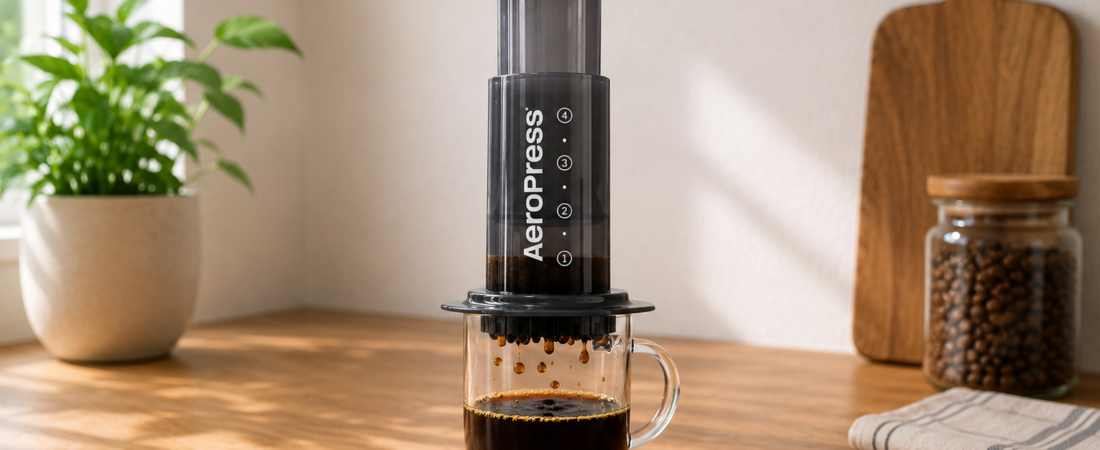
The AeroPress is one of the most talked-about coffee makers in the world — praised by baristas, beloved by travellers, and recommended on practically every coffee forum online. But does it actually live up to the hype for a beginner at home?
This AeroPress review covers what makes it different, how it compares to a French press, which version to buy, and whether the learning curve is worth it.
This article contains affiliate links. If you buy through them, I may earn a small commission at no extra cost to you.
⭐ Quick Verdict: AeroPress One of the most versatile, forgiving, and enjoyable coffee makers available. Produces excellent coffee with almost no learning curve. The best all-around beginner recommendation if you want to explore different brewing styles.
AeroPress at a Glance
| Category | Rating |
|---|---|
| Build Quality | ⭐⭐⭐⭐⭐ |
| Ease of Use | ⭐⭐⭐⭐⭐ |
| Brew Quality | ⭐⭐⭐⭐⭐ |
| Versatility | ⭐⭐⭐⭐⭐ |
| Cleaning | ⭐⭐⭐⭐⭐ |
| Portability | ⭐⭐⭐⭐⭐ |
| Value for Money | ⭐⭐⭐⭐⭐ |
| Beginner Friendly | ⭐⭐⭐⭐⭐ |
| 🏆 Best For | Beginners who want versatility and great coffee with minimal fuss |
| 💰 Price | ~$35 |
| ✅ Verdict | The most versatile beginner coffee maker available |
Who the AeroPress Is Best For
The AeroPress is the right choice if you:
- Want something versatile — the AeroPress can brew espresso-style, American-style, cold brew, and more
- Are a beginner who wants excellent coffee without a steep learning curve
- Travel frequently — the AeroPress is compact, lightweight, and nearly indestructible
- Want something quick — a full brew takes about 2 minutes
- Are curious about experimenting with different brewing recipes and techniques
- Want a forgiving brewer that produces good results even with imperfect technique
The AeroPress is probably not the right fit if you:
- Want to brew for more than 2-3 people at once — the Original makes 1-3 cups per press
- Want something that looks beautiful on your counter — the AeroPress is purely functional
- Want true espresso — the AeroPress produces espresso-style coffee but not true espresso at 9 bars
- Prefer a hands-off, passive brewing method — the AeroPress requires active pressing
What Is the AeroPress?
The AeroPress was invented in 2005 by Alan Adler — the same engineer who invented the Aerobie flying ring. It uses air pressure to push hot water through coffee grounds in about 2 minutes, producing a concentrated, smooth, low-acid cup of coffee.
It’s often described as a combination of French press, pour over, and espresso — which is both accurate and slightly misleading. The AeroPress uses pressure like an espresso machine, paper or metal filters like a pour over, and full immersion like a French press. The result is something genuinely unique — smooth, concentrated, and significantly less bitter than most other brewing methods.
The AeroPress community is one of the most enthusiastic in coffee — there are annual World AeroPress Championships where baristas compete with their best recipes. The range of brewing techniques and recipes available is enormous, which makes it one of the most interesting brewers to own.
The AeroPress Range: Which Version Should You Buy?
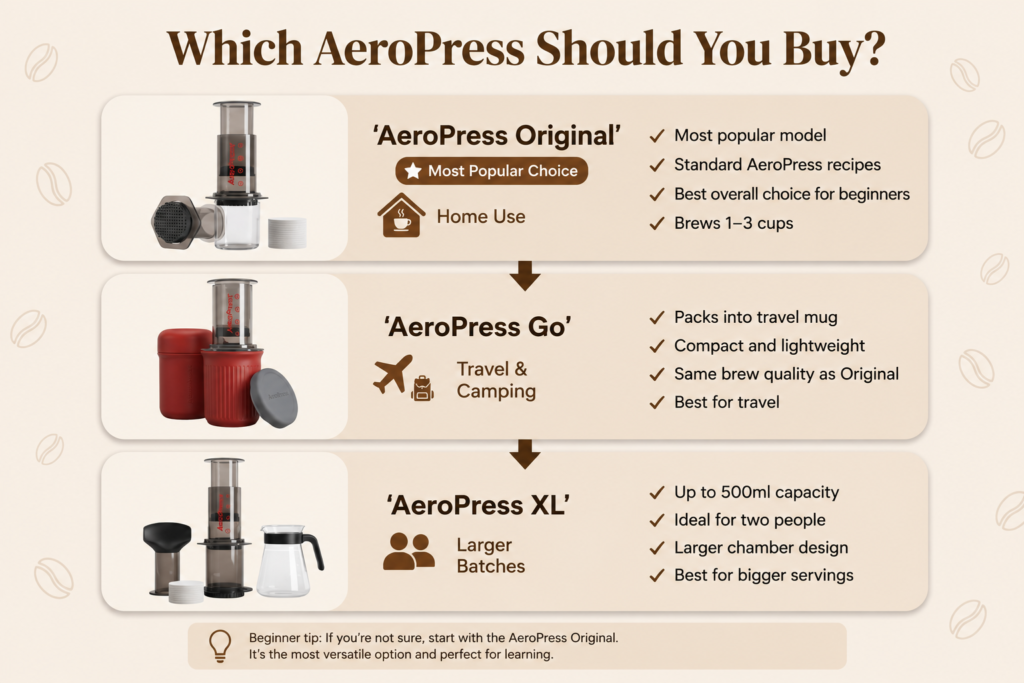
| Feature | AeroPress Original | AeroPress Go | AeroPress XL |
|---|---|---|---|
| Price | ~$35 | ~$35 | ~$45 |
| Capacity | 1–3 cups | 1–2 cups | 1–4 cups |
| Portability | Good | ✅ Best — includes travel mug | Good |
| Best for | Home use | Travel and camping | Larger batches |
| Includes | Chamber, plunger, 350 filters | Chamber, plunger, mug, lid, 350 filters | Chamber, plunger, 350 filters |
Choose the Original if you primarily brew at home and want the standard AeroPress experience. It’s the most widely used version and the one most recipes are written for.
Choose the Go if you travel frequently — it includes a compact travel mug that the whole kit packs into, making it genuinely portable. Same brewing experience as the Original, just slightly smaller capacity.
Choose the XL if you regularly brew for two people or want larger batches — it makes up to 500ml per press.
For most beginners at home, the Original is the right starting point.
Build Quality
The AeroPress is made from BPA-free copolyester plastic — lightweight, nearly indestructible, and completely taste-neutral. You can drop it on a tile floor and it won’t break. You can pack it in a bag without worrying about it. You can put it in the dishwasher.
It doesn’t look premium — it looks like a functional piece of brewing equipment. But the build quality is excellent for what it is. The seal between the plunger and chamber creates consistent pressure, the filter cap fits securely, and everything disassembles easily for cleaning.
The AeroPress has been in production since 2005 with minimal design changes because the original design works exceptionally well. The most recent versions use slightly clearer plastic but the core mechanism is identical.
How the Coffee Tastes
This is where the AeroPress genuinely surprises most beginners.
AeroPress coffee is smooth, rich, and significantly less bitter than French press or drip coffee. The combination of pressure, full immersion, and paper or metal filtration produces a concentrated cup with none of the harshness that can come from other brewing methods.
The low acidity and low bitterness make it one of the most approachable cups for people who find standard coffee too harsh — and one of the most enjoyable for experienced coffee drinkers who want a clean, concentrated result.
Versatility is the AeroPress’s defining characteristic. The same brewer can produce:
- Espresso-style concentrate — add water or milk for a latte or Americano
- American-style coffee — dilute with hot water to taste
- Cold brew — brew with cold water overnight
- Inverted method — brew upside down for full immersion, then flip and press
No other single brewer at this price point covers this much ground. If you’re curious about exploring different coffee styles, the AeroPress is the most interesting brewer you can own.
Ease of Use
The AeroPress is one of the most beginner-friendly brewers available. The standard method takes about 2 minutes and requires no special technique:
- Place a paper or metal filter in the filter cap and attach to the chamber
- Set the chamber on your mug
- Add medium-fine ground coffee — 15-18g for a standard cup
- Pour hot water (175-205°F) to the top of the number 4 line
- Stir for 10 seconds
- Press the plunger down slowly and evenly — takes about 30 seconds
- Done
The pressure from pressing takes about 20-30 seconds of gentle effort — it’s satisfying rather than difficult. The whole process is faster and more hands-on than a French press but no more technically demanding.
Unlike pour over methods, there’s no bloom pour, no precise pouring technique, and no need for a gooseneck kettle. A standard kettle works perfectly well.
Cleaning
The AeroPress is the easiest coffee brewer to clean of anything covered on this site.
After pressing, pop off the filter cap over the bin — the coffee puck and filter eject cleanly in one push. Rinse the chamber and plunger under the tap. Done in under 30 seconds.
Everything is dishwasher safe. No gaskets to replace, no glass to break, no filters to rinse separately. Just eject, rinse, done.
AeroPress vs French Press: Which Should You Choose?
This is the most common comparison for beginners deciding between the two most popular manual coffee makers.
| AeroPress | French Press | |
|---|---|---|
| Brew time | ~2 minutes | 4 minutes |
| Sediment | None (with paper filter) | Some fine sediment |
| Bitterness | Very low | Low to medium |
| Body | Medium, smooth | Full, rich, oily |
| Versatility | ✅ Espresso-style, Americano, cold brew | One style |
| Portability | ✅ Compact, lightweight | Fragile glass |
| Cleaning | ✅ 30 seconds | 2-3 minutes |
| Price | ~$35 | ~$20–40 |
| Learning curve | Very low | Very low |
| Best for | Versatility, travel, clean cup | Rich full-bodied coffee |
Choose the AeroPress if:
- You want versatility — different brewing styles from one device
- You travel frequently
- You want a faster, easier clean-up
- You find coffee too bitter or harsh from other methods
Choose a French press if:
- You want a rich, full-bodied, oily cup
- You prefer a more traditional brewing ritual
- You regularly brew for two or more people
- You don’t want to spend money on paper filters
Neither is better overall — they produce genuinely different cups. See our Beginner Coffee Brewing Methods Compared guide for a full comparison across all methods.
Pros and Cons
Pros:
- Exceptionally versatile — multiple brewing styles from one device
- Very beginner friendly — almost impossible to make a bad cup
- Quick — full brew in about 2 minutes
- Easiest coffee brewer to clean
- Nearly indestructible — no glass, no fragile parts
- Compact and lightweight — perfect for travel and camping
- Dishwasher safe
- Low acidity and bitterness compared to other methods
- Huge community of recipes and techniques to explore
- 350 paper filters included
Cons:
- Purely functional design — doesn’t look beautiful on a counter
- Makes 1-3 cups maximum per press — not ideal for larger groups
- Requires paper filters — ongoing cost (though metal filters available)
- Not true espresso — pressure is lower than a pump machine
- Active brewing — requires manual pressing, not hands-off like French press
AeroPress Review: Is It Worth It for Beginners?
Yes — the AeroPress is one of the best value coffee makers available at any price point.
At around $35 it’s comparable to the Bodum Chambord French press, but it offers significantly more versatility, faster brewing, easier cleaning, and a more portable package. The coffee it produces — smooth, low-acid, highly customisable — is genuinely excellent regardless of how experienced you are.
For beginners who want to explore different brewing styles, travel with their coffee, or just want something that consistently produces a great cup without fuss, the AeroPress is hard to beat.
👉 AeroPress Original (~$35) — Check price & availability
👉 AeroPress Go (~$35) — Check price & availability
Frequently Asked Questions
Is the AeroPress good for beginners? Yes — and this AeroPress review keeps coming back to the same conclusion: it’s one of the most beginner-friendly coffee makers available. The standard method takes 2 minutes and produces excellent coffee with almost no learning curve. It’s also very forgiving — imperfect technique still produces a good cup.
What’s the difference between the AeroPress Original and the AeroPress Go? The Go is slightly smaller and includes a compact travel mug that the whole kit packs into, making it more portable. The Original is the standard home version. The brewing experience is identical — choose Go for travel, Original for home.
Does the AeroPress make real espresso? No — the AeroPress produces espresso-style concentrated coffee but not true espresso. True espresso requires 9 bars of pressure from a pump machine. The AeroPress produces about 0.35 bars. The result is a concentrated, smooth cup that works well as an espresso substitute but lacks the crema of true espresso.
What grind size should I use for the AeroPress? Medium-fine for the standard method — similar to table salt. You can experiment with finer grinds for more concentrated espresso-style results or coarser grinds for a lighter cup. The AeroPress is very forgiving of grind variation compared to other methods.
Do I need a special kettle for the AeroPress? No — a standard kettle works perfectly well. Unlike pour over methods, the AeroPress doesn’t require precise pour control. A gooseneck kettle is a nice upgrade but not necessary.
How do I clean the AeroPress? Pop off the filter cap over the bin — the coffee puck and filter eject cleanly. Rinse the chamber and plunger under the tap. Everything is dishwasher safe. The whole process takes under 30 seconds.
What are AeroPress paper filters and do I need them? Paper filters produce a clean, sediment-free cup. Metal reusable filters are also available and eliminate ongoing filter costs — they let more oils through producing a slightly heavier cup. Both work well. Paper filters are included with every AeroPress. Metal filters are sold separately.
Continue Learning
- AeroPress vs French Press: Which Should You Buy? → full comparison if you’re deciding between the two
- Best AeroPress Accessories for Beginners → the upgrades worth buying once you have your AeroPress
- Beginner Coffee Brewing Methods Compared → how AeroPress stacks up against French press, moka pot, and pour over
- Best Beginner Coffee Grinders Under $150 → grind consistency makes the biggest difference to AeroPress results
- Best Coffee Beans for Beginners → which beans work best across all brewing methods
- Best French Press for Beginners → if you want a more traditional brewing method instead