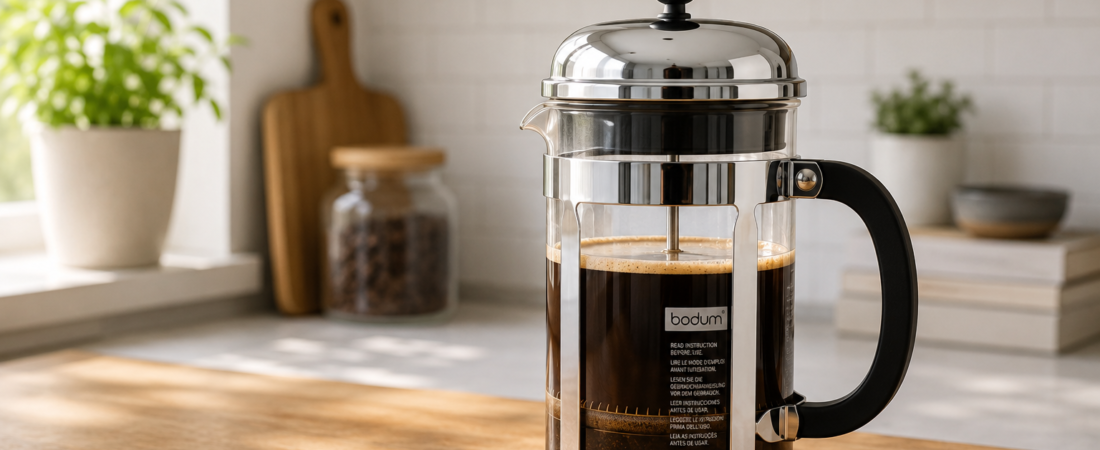
This Bodum Chambord review takes an honest look at one of the most recognised French presses in the world. It’s been around since the 1970s, it’s on nearly every beginner recommendation list, and it’s sitting in millions of kitchens. But is it actually worth buying in 2026 — or is it just coasting on reputation?
This review covers everything a beginner needs to know before buying: build quality, brew quality, ease of use, cleaning, and whether there’s something better at the same price. This article contains affiliate links. If you buy through them, I may earn a small commission at no extra cost to you.
⭐ Quick Verdict: Bodum Chambord A reliable, well-built French press that makes genuinely good coffee. Still one of the easiest beginner recommendations at this price. 👉 Check price & availability
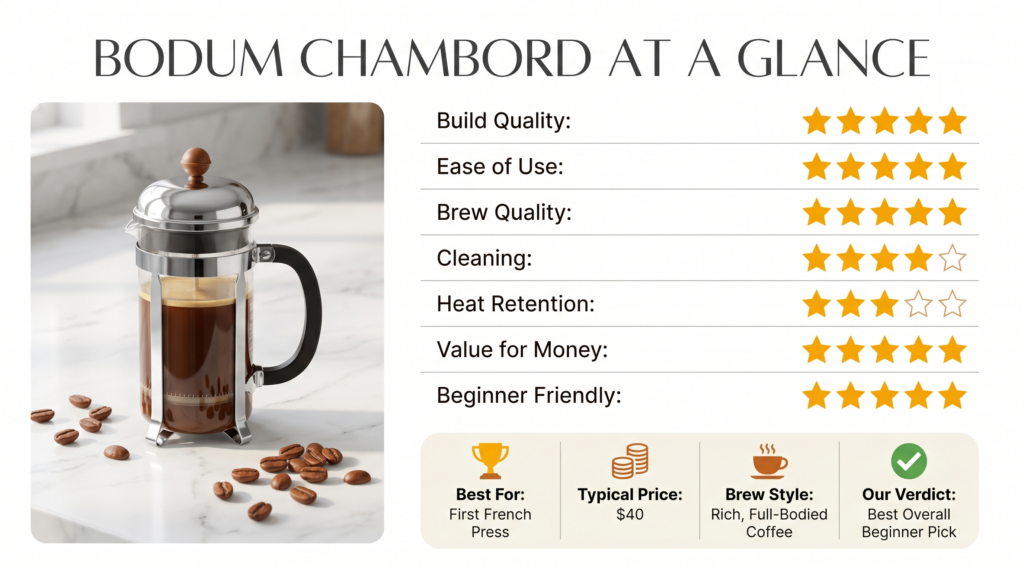
Bodum Chambord At a Glance
Who the Chambord Is Best For
The Chambord makes the most sense if you:
- Want a simple, reliable French press for everyday home use
- Care about how your coffee equipment looks on the counter
- Want to avoid paper filters and the ongoing cost that comes with them
- Are buying your first French press and don’t want to overthink it
- Like the idea of being able to replace parts if something breaks
The Chambord is probably not the right fit if you:
- Want something that keeps coffee hot for more than 30–40 minutes
- Are bothered by fine sediment at the bottom of your cup
- Have a history of breaking glass things in the kitchen
- Want to make coffee for 3+ people at once from a single press (consider the larger sizes)
Bodum Chambord Review: Key Features at a Glance
The Bodum Chambord is a glass French press with a stainless steel frame, first launched in 1974. The design has barely changed since — which tells you everything you need to know about whether it works.
It uses a borosilicate glass beaker, a chrome-plated stainless steel frame, a comfortable handle, and a three-part stainless steel plunger filter. It’s available in four sizes (3-cup, 4-cup, 8-cup, and 12-cup) and a handful of colours.
The most popular size for beginners is the 8-cup (34oz) — big enough for two generous mugs, manageable for one person brewing daily.
👉 Check price & availability — Bodum Chambord 8-cup
Build Quality
This is where the Chambord earns its reputation.
The stainless steel frame feels solid without being heavy. The handle is comfortable and well-positioned — you can pour from it easily without burning your hand. The borosilicate glass beaker is noticeably thicker and more heat-resistant than what you’d find in a cheap $15 press.
The three-part plunger filter fits snugly into the beaker and presses smoothly. There’s no wobbling, no grinding, no leaking around the edges. It feels like a well-made piece of equipment because it is one.
The one genuine vulnerability is the glass. Borosilicate glass handles heat well but it’s not unbreakable — drop it on a hard floor and it will likely shatter. It can also crack if you pour boiling water into a cold beaker, so always warm it first with hot water before brewing.
The good news: replacement beakers are easy to find on Amazon and inexpensive. A broken glass doesn’t mean replacing the whole press, which is more than you can say for most cheaper alternatives.
How the Coffee Tastes
French press coffee has a richer, fuller body than drip or pod coffee — and the Chambord does a good job of delivering that.
The three-part stainless steel filter keeps most grounds out of the cup. There’s still some fine sediment at the bottom, as there always will be with a French press — that’s not a Chambord problem, it’s just how the brewing method works. If sediment bothers you, the ESPRO P3 has a double micro-filter that reduces this significantly.
For most beginners the sediment is a non-issue, and the coffee you get from the Chambord is genuinely enjoyable — full-bodied, rich, and smooth when brewed correctly.
The key variables as always are grind size and brew time. Use a coarse grind, brew for four minutes, and pour immediately after plunging. Get those three things right and the coffee is excellent. Get them wrong and it won’t matter which press you’re using.
If you’re not sure which beans work best with French press brewing, our Best Coffee Beans for French Press guide covers beginner-friendly options.
Ease of Use
The Chambord is one of the most straightforward French presses you can buy. There’s no learning curve, no complicated assembly, and no settings to adjust.
The process is simple:
- Warm the beaker with hot water, then discard
- Add coarsely ground coffee
- Pour hot water (just off the boil) over the grounds
- Place the lid on top without pressing down
- Wait four minutes
- Press the plunger down slowly and evenly
- Pour immediately
That’s it. If you’ve never used a French press before, our How to Use a French Press guide walks through each step in detail.
Cleaning
Cleaning a French press is one of the most common beginner concerns — and it’s simpler than most people expect.
For the Chambord specifically:
- The plunger disassembles easily into three parts for a thorough rinse
- The glass beaker rinses clean quickly under the tap
- The stainless steel frame wipes down easily
- Most components are dishwasher safe, though Bodum recommends handwashing the glass
The main thing to avoid is leaving old grounds sitting in the press for extended periods — coffee oils go rancid quickly and will affect the taste of future brews. Rinse it out promptly after each use and it stays clean without much effort.
Our 7 French Press Mistakes That Ruin Your Coffee covers cleaning habits worth building early.
Sizing Guide
The Chambord comes in four sizes. Here’s how to choose:
| Size | Volume | Best For |
|---|---|---|
| 3-cup | 12oz / 350ml | One small cup, minimal counter space |
| 4-cup | 17oz / 500ml | One large mug or two small cups |
| 8-cup | 34oz / 1L | One or two people brewing daily |
| 12-cup | 51oz / 1.5L | Two or more people, or large mugs |
For most beginners the 8-cup is the right choice. It’s the most versatile size — enough for two mugs but not so large it feels wasteful when brewing for one.
👉 Chambord 3-cup 👉 Chambord 8-cup (most popular) 👉 Chambord 12-cup
Pros and Cons
Pros:
- Excellent build quality — solid stainless steel frame, thick borosilicate glass
- Classic, timeless design that suits most kitchens
- Smooth, consistent plunger action
- Easy to use with no learning curve
- Replacement parts readily available — beakers, filters, plungers
- No paper filters needed — better for the environment, cheaper long term
- Multiple sizes and colours available
- Widely available — Amazon, most kitchen retailers, Bodum direct
Cons:
- Glass can crack or break if dropped or thermally shocked
- Heat retention is average — coffee cools faster than stainless steel alternatives
- Fine sediment at the bottom of the cup (normal for French press)
- Not suitable for espresso
- Slightly more expensive than budget alternatives like the Bodum Brazil
How the Chambord Compares to Similar Options
Bodum Chambord vs Bodum Brazil (~$20) The Brazil uses the same glass beaker and filter system as the Chambord — the only difference is the frame. The Chambord has stainless steel; the Brazil has plastic. The coffee from both is essentially identical. Choose the Chambord if you want something that feels premium and lasts longer. Choose the Brazil if budget is the priority. See our Bodum Review for a full brand comparison.
Bodum Chambord vs ESPRO P3 (~$40) Both are priced similarly. The ESPRO P3 has a double micro-filter that produces a noticeably cleaner, less gritty cup. If sediment is your main concern, the ESPRO is worth the same price. If you’re fine with normal French press sediment, the Chambord is the more reliable long-term buy with better parts availability. We cover both in our Best French Press Under $50 guide.
Bodum Chambord vs Secura Stainless Steel (~$28) The Secura is fully stainless steel, cheaper, and better at heat retention. The trade-off is aesthetics — it looks more utilitarian and you can’t watch the brew. If heat retention and durability matter more than design, the Secura is the better value. If you want something that looks good on the counter and feels more refined, the Chambord wins. Our Glass vs Stainless Steel French Press guide covers this in more detail.
Frequently Asked Questions
Is the Bodum Chambord worth the money? Yes — for most beginners it’s one of the best value French presses available. The build quality, design, and brewing performance are all solid, and replacement parts are easy to find. It’s not the cheapest option, but it’s a better long-term investment than most budget alternatives.
What size Bodum Chambord should I buy? The 8-cup (34oz) is the right choice for most people — versatile enough for one or two people brewing daily. If you only ever make a single small cup, the 3-cup or 4-cup is more appropriate.
How long does the Bodum Chambord last? The stainless steel frame and filter components last indefinitely with normal care. The glass beaker is the only real vulnerability — it can crack if dropped or thermally shocked. Replacement beakers are inexpensive and widely available, so a broken glass doesn’t mean replacing the whole press.
Can I put the Bodum Chambord in the dishwasher? Most components are dishwasher safe, but Bodum recommends handwashing the glass beaker to extend its lifespan. The stainless steel frame and filter components are generally fine in the dishwasher.
Why is there sediment in my Bodum Chambord coffee? Fine sediment at the bottom of a French press cup is normal — it’s a feature of the brewing method, not a fault of the press. To reduce it, use a coarser grind and press the plunger slowly and evenly. If sediment bothers you, the ESPRO P3 is worth considering instead.
Does the Bodum Chambord keep coffee hot? Heat retention is average for a glass model — your coffee will stay warm for around 20–30 minutes. If you want longer heat retention, the Bodum Columbia (double-wall stainless steel) is a better option, or consider the Secura Stainless Steel at a lower price point.
Where can I buy replacement parts for the Bodum Chambord? Replacement glass beakers, filter meshes, and plunger assemblies are available on Amazon and directly from bodum.com. Search your model name plus “replacement beaker” or “replacement filter” — parts are well-stocked and inexpensive.
Final Verdict
The Bodum Chambord has been around for over 50 years and it’s still one of the easiest French press recommendations for beginners. That’s not nostalgia — it’s because the press is genuinely well-made, simple to use, and consistently produces good coffee.
Is it perfect? No. The glass can break, heat retention is average, and there’s sediment in the cup. But those are trade-offs you accept with any glass French press — not flaws specific to the Chambord.
At around $40, it hits the right balance of quality, value, and simplicity. If you want a French press you can trust to work every morning without overthinking it, the Chambord is still the right choice in 2026.
👉 Bodum Chambord 8-cup (~$40) — Check price & availability
Continue Learning
- Bodum Review: Which French Press Is Best? → full overview of the Bodum range beyond just the Chambord
- Best French Press Under $50 for Beginners → how the Chambord compares to other options at this price
- Glass vs Stainless Steel French Press → help deciding between glass and stainless steel
- How to Use a French Press → step-by-step brewing guide for your first cup
- Best Coffee Beans for French Press → beginner-friendly bean recommendations
- 7 French Press Mistakes That Ruin Your Coffee → avoid the most common beginner errors
- Best French Press for Beginners → broader guide if you’re still deciding which press to buy