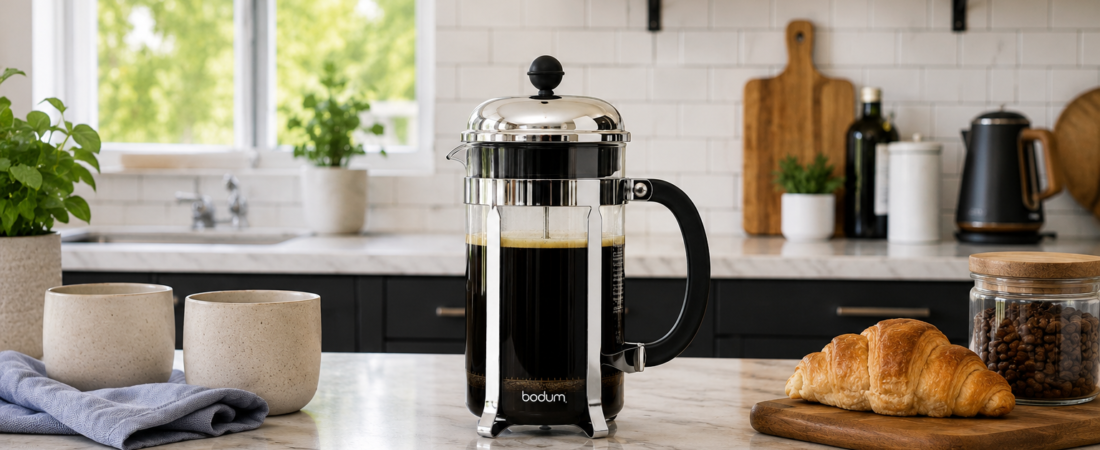
This Bodum review takes an honest look at one of the most recognised names in home coffee brewing — and if you’ve been looking at French presses for more than five minutes, you’ve almost certainly come across them. But is the brand actually worth buying, or are you paying for a name?
This article contains affiliate links. If you buy through them, I may earn a small commission at no extra cost to you.
⭐ Best Choice for Most People: Bodum Chambord The Chambord offers the best balance of build quality, durability, and value for most home brewers. 👉 Check price & availability
This review covers the Bodum range honestly, based on what matters most to beginners: build quality, ease of use, value for money, and whether the coffee actually tastes good.
Bodum Review: The Short Answer
Bodum is worth it for most home brewers. The Chambord French press in particular is one of the best beginner-friendly options you can buy, and the Brazil is the easiest recommendation at the budget end of the market.
If you want a simple, reliable French press that makes genuinely good coffee without overcomplicating things — Bodum delivers that consistently.
That said, Bodum isn’t the right fit for everyone. Keep reading and you’ll know quickly whether it’s right for you.
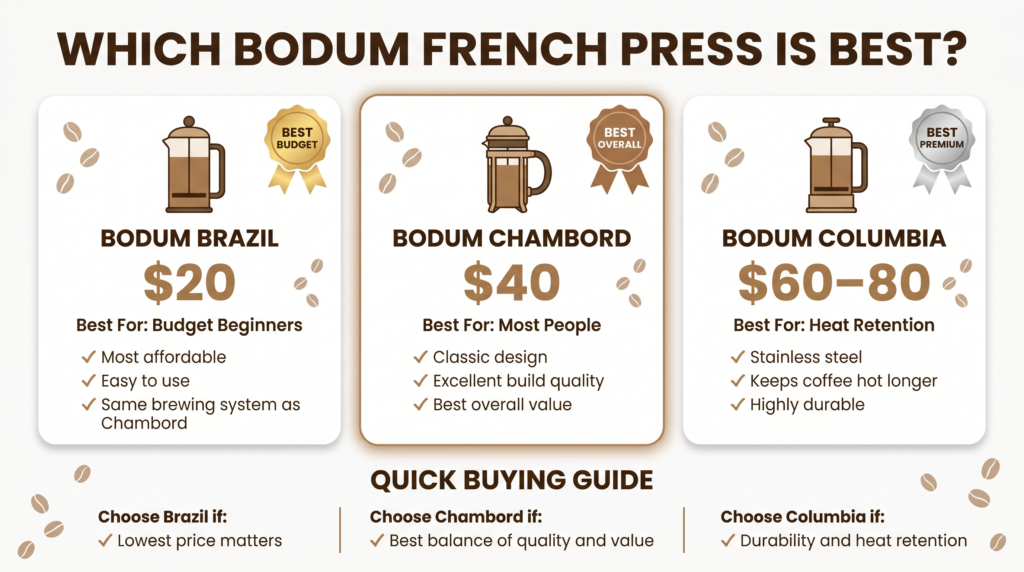
Short on time? Here’s the quick comparison.
Why Bodum Became So Popular
Bodum was founded in Copenhagen in 1944, but it was the CHAMBORD French press — launched in the 1970s — that put the brand on the map. The timing was right: home coffee culture was growing, people were looking for alternatives to percolators and instant coffee, and the French press was the simplest, most flavour-forward option available.
What made Bodum stand out wasn’t just the product — it was the price. A French press had historically been seen as a professional or specialty item. Bodum made it accessible. The CHAMBORD was well-made, well-designed, and cheap enough for anyone to buy. That combination built a loyal following that has held for over 50 years.
Today Bodum sells in more than 55 countries and has expanded well beyond French presses into grinders, kettles, pour-overs, and cold brew. But the French press is still the core of the brand — and the CHAMBORD is still the product most people associate with the Bodum name.
Bodum at a Glance
| Founded | 1944, Copenhagen |
| Best known for | French presses |
| Best model for most people | Chambord (~$40) |
| Price range | ~$20–$80 |
| Our verdict | Excellent value for beginners and casual home brewers |
Quick Overview: The Bodum Range
Bodum makes more than just French presses — the range includes pour-over drippers, electric kettles, cold brew systems, manual grinders, and travel mugs. But French presses are what they’re best known for, and that’s where they’re strongest.
The products most worth knowing about as a beginner:
- Bodum Chambord (~$40) — the classic glass French press with stainless steel frame 👉 Check price & availability
- Bodum Brazil (~$20) — the budget version, same glass and filter, plastic frame 👉 Check price & availability
- Bodum Columbia (~$60–80) — double-wall stainless steel, keeps coffee hot for up to 2 hours 👉 Check price & availability
- Bodum Pour Over (~$25–30) — glass carafe with permanent stainless steel filter, no paper filters needed 👉 Check price & availability
- Bodum BISTRO Blade Grinder (~$20) — compact entry-level grinder designed to pair with their French presses 👉 Check price & availability
- Bodum BISTRO Gooseneck Kettle (~$27) — basic electric gooseneck for more controlled pouring 👉 Check price & availability
For most beginners, the French press range is the starting point. The grinder and kettle are worth considering once you’re ready to step up your brewing setup.
Who Bodum Is Best For
Bodum makes the most sense if you:
- Want a French press that’s simple to use and easy to learn
- Care about how your coffee equipment looks on the counter
- Want to avoid paper filters and reduce waste
- Are on a budget but don’t want to compromise on quality
- Like the idea of being able to replace parts if something breaks
Bodum is probably not the right fit if you:
- Want to make espresso (Bodum doesn’t do this well)
- Are bothered by fine sediment at the bottom of your cup
- Want smart or app-connected coffee gear
- Need something that keeps coffee hot for hours (unless you go for the Columbia)
The French Press Range: Which Model Is Right for You?
⭐Bodum Brazil (~$20) — Best for beginners on a budget
The Brazil is Bodum’s most affordable French press and the easiest entry point into the range. It uses the same borosilicate glass beaker and stainless steel filter system as the more expensive Chambord — the only real difference is the plastic frame instead of stainless steel.
It doesn’t feel as premium as the Chambord, but it brews identically. If you’re not sure whether you’ll stick with French press brewing, or you just want to spend as little as possible to get started, the Brazil is a perfectly capable press.
Pros: Very affordable, lightweight, same filter system as Chambord, available in multiple colours Cons: Plastic frame feels less premium, glass can break if dropped, average heat retention
⭐Bodum Chambord (~$40) — Best for most beginners
The Chambord is the one most people picture when they think of Bodum, and for good reason. It has a classic stainless steel frame, borosilicate glass beaker, and a solid three-part plunger filter that has barely changed since the 1950s. It just works.
Build quality is noticeably better than the Brazil — the stainless steel frame feels solid, the handle is comfortable, and the overall construction is reassuringly sturdy. Replacement parts (glass beakers, filters, plungers) are easy to find on Amazon and inexpensive, which matters if something breaks down the line.
For most beginners, this is the one to buy. It’s the right balance of quality, value, and simplicity.
Pros: Excellent build quality, classic design, replacement parts readily available, beginner-friendly, multiple sizes and colours Cons: Glass can crack with rough handling, average heat retention on glass models, some sediment in cup (normal for French press)
⭐Bodum Columbia (~$60–80) — Best if heat retention matters to you
The Columbia is Bodum’s double-wall insulated French press — fully stainless steel, no glass, keeps coffee hot for up to two hours. It’s the answer if heat retention is the main reason you’ve been hesitating on a glass model.
It brews the same coffee as the Chambord. The difference is purely practical: no glass to break, better heat retention, and a more durable build overall. The trade-off is that you can’t see the brew, and it’s heavier than a glass model.
If you’re someone who brews a full press and sips slowly over breakfast, or if your kitchen runs cold, the Columbia is worth the extra cost over the Chambord.
Pros: Keeps coffee hot for up to 2 hours, fully stainless steel so no breakage risk, dishwasher safe, premium feel Cons: Can’t see the brew, heavier than glass models, more expensive
Beyond French Press: Other Bodum Products Worth Knowing
If you’re building out a home brewing setup, Bodum makes a few other products worth knowing about — though the French press range is where they’re strongest.
⭐Bodum Pour Over (~$25–30) — A borosilicate glass carafe with a permanent stainless steel mesh filter. Produces a cleaner, less sediment-heavy cup than French press. A reasonable entry point if you want to try pour-over without spending much. 👉 Check price & availability
⭐Bodum BISTRO Blade Grinder (~$20) — A compact blade grinder designed to pair with their French presses. Fine for a beginner, but blade grinders produce an uneven grind compared to burr grinders — if you get serious about coffee, a burr grinder will be the natural next step up. See our Best Beginner Coffee Grinders Under $150 and Best Coffee Grinders Under $100 guides for what we’d recommend instead. 👉 Check price & availability
⭐ Bodum BISTRO Gooseneck Kettle (~$27) — A basic electric gooseneck with no temperature control, but the spout shape makes a real difference to pouring accuracy for both French press and pour-over. One of the more affordable gooseneck options available. See our Best Gooseneck Kettles for Beginners guide if you want to compare more options first. 👉Check price & availability
Build Quality and Design
This is where Bodum consistently stands out. The Chambord in particular feels like a well-made piece of kitchen equipment — not a cheap import. The stainless steel frame is solid, the handle is comfortable, and the borosilicate glass beaker is noticeably higher quality than what you’d find on most budget presses.
The design has barely changed since the 1950s, which is either a good or bad thing depending on your perspective. For most people it’s a good thing — it’s a genuinely timeless look that suits most kitchen styles.
The Brazil is a step down in feel. The plastic frame is lightweight and a little less refined, but the glass beaker and filter system are the same as the Chambord. It doesn’t feel cheap exactly — it just feels like what it is: a budget product from a quality brand.
One thing worth knowing about both glass models: borosilicate glass can crack if you pour boiling water into a cold press. Always warm the glass with hot water first before brewing. It sounds fiddly but takes about 30 seconds and quickly becomes habit.
How the Coffee Actually Tastes
French press coffee has a richer, fuller flavour than drip or pod coffee — and Bodum’s filter system does a good job of preserving that.
The Chambord’s three-part stainless steel filter keeps most grounds out of the cup. There’s still some fine sediment at the bottom, as there always will be with a French press — that’s not a Bodum problem, it’s just how the brewing method works. If sediment bothers you, a French press probably isn’t the right brewing method full stop. If you’re fine with it, Bodum handles it as well as anything at this price.
The key variable — as always with French press — is your grind. Use a coarse grind, brew for four minutes, and pour immediately. Get those three things right and the coffee is genuinely excellent. Get them wrong and it won’t matter which press you’re using. If your coffee is coming out too strong or bitter, ourWhy Is My Coffee Too Strong? guide explains the most common causes and how to fix them.
If you’re not sure where to start with beans, our Best Coffee Beans for French Press guide covers beginner-friendly options that work well with this brewing method.
Pricing and Value
| Model | Price | Type | Best For |
|---|---|---|---|
| Bodum Brazil | ~$20 | Glass + plastic frame | Beginners on a tight budget |
| Bodum Chambord | ~$40 | Glass + stainless frame | Most beginners |
| Bodum Columbia | ~$60–80 | Double-wall stainless | Heat retention, durability |
| Bodum Pour Over | ~$25–30 | Glass + stainless filter | Trying pour-over cheaply |
| BISTRO Blade Grinder | ~$20 | Electric blade grinder | Entry-level grinding |
| BISTRO Gooseneck Kettle | ~$27 | Electric gooseneck | More control over pouring |
The Chambord at ~$40 is where Bodum hits its sweet spot. It’s not the cheapest French press you can buy, but it’s genuinely good quality, widely available, and replacement parts are easy to find and inexpensive. If you break the glass, you don’t need to replace the whole press.
The Brazil at ~$20 is excellent value if budget is a priority. The brewing experience is essentially the same as the Chambord; you’re just trading the stainless steel frame for plastic.
Pros and Cons
Pros:
- Excellent build quality, especially on the Chambord and Columbia
- Replacement parts genuinely available — glass beakers, filters, plungers
- Classic design that suits most kitchens
- No paper filters needed — better for the environment and cheaper long term
- Good value across the range, especially at the entry and mid-range levels
- Beginner-friendly: simple to use, simple to clean
- Wide range of products beyond just French press — grinder, kettle, pour-over
Cons:
- Glass can crack if mishandled or exposed to sudden temperature changes
- Fine sediment in the cup on French press models — normal for the method, but worth knowing
- Not suitable for espresso
- Heat retention is average on glass models — go for the Columbia if this matters
- BISTRO blade grinder is not as consistent as a burr grinder
- No smart features or temperature control on any product
Bodum Chambord vs Brazil: Which Should You Buy?
This is the most common question for beginners considering Bodum, so it’s worth addressing directly.
Choose the Chambord if:
- You want something that feels premium and well-made
- You care about how it looks on your counter
- You’re planning to use it daily for the long term
Choose the Brazil if:
- You’re on a tighter budget
- You want to try French press brewing without much financial risk
- You don’t mind the plastic frame
The coffee from both is essentially identical — the difference is purely in the frame material and feel. If you can stretch to $40, the Chambord is the better long-term buy. If $20 is what works right now, the Brazil is a perfectly capable press.
👉 Bodum Chambord — Check price & availability
👉 Bodum Brazil — Check price & availability
Is Bodum Worth It?
Yes — and this Bodum review keeps coming back to the same conclusion: it’s one of the safest recommendations in the French press category for most beginners.
The Chambord has been around for decades for good reason. It makes good coffee, it’s easy to use, replacement parts are available, and it looks genuinely nice on a counter. The Brazil offers essentially the same brewing experience at half the price. And if heat retention is the priority, the Columbia solves that problem cleanly.
Where Bodum falls short is sediment filtration compared to the ESPRO P3, heat retention on glass models compared to the Stanley or Secura, and grind consistency on the blade grinder. But for a brand that covers so much ground at accessible prices, those are reasonable trade-offs.
For the everyday home brewer who wants a reliable, good-looking setup that’s simple to use and easy to maintain — Bodum is hard to beat.
How Bodum Compares to Other Brands
If you’re deciding between Bodum and other popular options, here’s an honest side-by-side picture.
Bodum Chambord vs ESPRO P3 (~$40) These two are the most common comparison at the $40 price point. The Chambord is simpler, more classic-looking, and easier to find replacement parts for. The ESPRO P3 has a double micro-filter that produces a noticeably cleaner, less gritty cup — it’s genuinely better at reducing sediment. If sediment bothers you, the ESPRO is worth the same price. If you’re fine with it, the Chambord is the more reliable long-term buy. We cover both in our Best French Press Under $50 guide.
Bodum Chambord vs Secura Stainless Steel (~$28) The Secura is fully stainless steel and better at heat retention than the Chambord. It’s also cheaper. The trade-off is aesthetics — the Secura is more utilitarian and you can’t watch the brew. If you want durability and heat retention on a budget, the Secura wins. If design matters to you, the Chambord is the better choice. If you’re still deciding between glass and stainless steel more broadly, our Glass vs Stainless Steel French Press guide breaks down the differences in detail.
Bodum Columbia vs Stanley French Press (~$50–60) Both are double-wall stainless steel presses built for heat retention and durability. The Stanley has a stronger reputation for outdoor and travel use — it’s more rugged and better known for keeping coffee hot in cold environments. The Columbia is more refined-looking and better suited to home use. For everyday home brewing, either works well; the Stanley edges ahead if you want something more portable.
The honest summary: Bodum isn’t the best at any single thing — there are presses with better sediment filtration (ESPRO), better heat retention (Stanley), and lower prices (Secura). What Bodum does is hit a reliable standard across the board at a fair price, with the added benefit of brand longevity and easy replacement parts. That consistency is why it’s stayed popular for so long.
Frequently Asked Questions
Is Bodum good quality? Yes. Bodum uses borosilicate glass and stainless steel construction across most of their range, and the build quality is noticeably better than cheaper imitators. The Chambord in particular is a well-made press that holds up well with regular use.
How long does a Bodum French press last? The stainless steel frame and filter components last indefinitely with normal care. The glass beaker is the only real vulnerability — it can crack or break if dropped or exposed to sudden temperature changes. Replacement beakers are available directly from Bodum and Amazon, so a broken glass doesn’t mean replacing the whole press.
Does Bodum make espresso machines? Bodum makes a manual espresso press, but it doesn’t produce true espresso at the pressure levels you’d get from a pump machine. If espresso is your main goal, Bodum isn’t the right brand.
Why is there sediment in my Bodum coffee? Fine sediment at the bottom of a French press cup is normal — it’s a feature of the brewing method, not a fault of the press. To reduce it, use a coarser grind, press slowly and evenly, and let the grounds settle for 30 seconds before pouring. Our 7 French Press Mistakes That Ruin Your Coffee guide covers this in more detail.
Can I put a Bodum French press in the dishwasher? The glass beaker and filter components are dishwasher safe on most models. Bodum recommends handwashing the glass to extend its lifespan, but the occasional dishwasher run is fine. Always check the specific model instructions.
What’s the difference between the Bodum Chambord and the Brazil? The glass beaker and filter system are the same on both. The difference is the frame: the Chambord uses stainless steel, the Brazil uses plastic. The Chambord feels more premium and costs around $40; the Brazil feels more budget and costs around $20. The coffee from both is essentially identical.
Is the Bodum BISTRO blade grinder good enough for French press? Yes, for a beginner. It grinds quickly and produces a coarse enough grind for French press with a short 8–10 second burst. The limitation is consistency — blade grinders chop unevenly compared to burr grinders. For someone just starting out, it’s absolutely fine. As you get more serious about coffee, a burr grinder will be the natural next step.
Where can I buy replacement parts for my Bodum? Replacement glass beakers, filters, and plungers are available on Amazon and directly from bodum.com. Search for your model name plus “replacement beaker” or “replacement filter” — Bodum’s parts are well-stocked and reasonably priced.
Final Thoughts
Bodum makes genuinely good coffee equipment for home brewers, and the Chambord remains one of the easiest beginner recommendations in the French press category.
If you want a simple, well-built press that makes great coffee and looks good on your counter — the Chambord is the right choice. If budget is the priority, the Brazil gives you the same brewing experience for half the price. And if you’re ready to build out a full setup, the Columbia, pour-over, gooseneck kettle, and blade grinder are all solid, affordable options that fit naturally together.
👉 Bodum Brazil (~$20) — Check price & availability
👉 Bodum Chambord (~$40) — Check price & availability
👉 Bodum Columbia (~$60–80) — Check price & availability
👉 Bodum Pour Over (~$25–30) — Check price & availability
👉 Bodum BISTRO Blade Grinder (~$20) — Check price & availability
👉 Bodum BISTRO Gooseneck Kettle (~$27) — Check price & availability
Continue Learning
- How to Choose a French Press: Best Beginner Picks → broader guide covering all budgets and brewing styles
- Best French Press Under $50 for Beginners → how Bodum compares to other beginner-friendly options at this price
- Glass vs Stainless Steel French Press → which material is right for your brewing style
- Beginner Coffee Brewing Methods Compared → how French press stacks up against pour-over, drip, and more
- Best Dark Roast Coffee for Beginners → dark roast beans that work particularly well in a French press
- Best Beginner Coffee Grinders Under $150 → upgrade from the BISTRO blade grinder when you’re ready
- Best Gooseneck Kettles for Beginners → more kettle options if you want to compare before buying
- How to Use a French Press → step-by-step guide for your first brew
- Best Coffee Beans for French Press → beginner-friendly bean recommendations
- 7 French Press Mistakes That Ruin Your Coffee → avoid the most common beginner errors