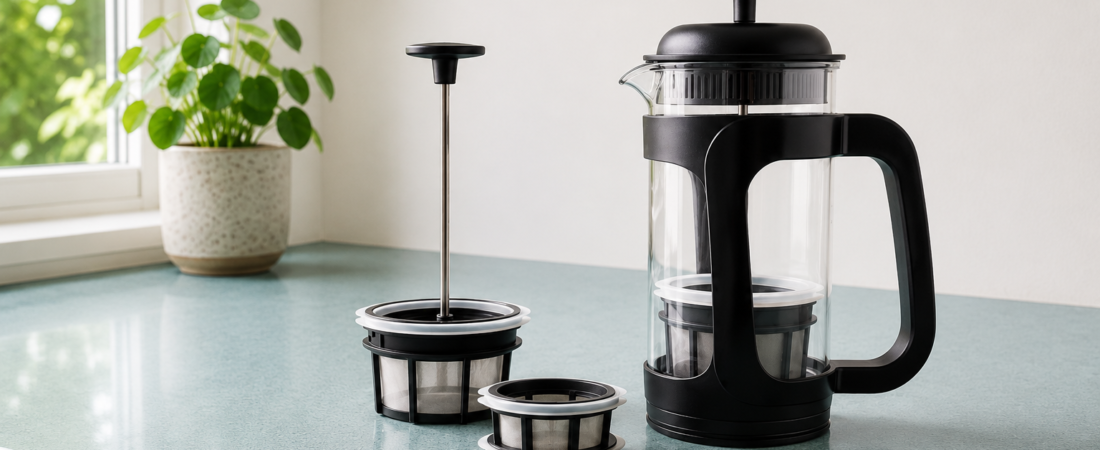
This ESPRO P3 review covers what makes this French press different from every other option at this price — and whether those differences actually matter for a beginner home brewer.
This article contains affiliate links. If you buy through them, I may earn a small commission at no extra cost to you.
The short version: the P3 is the cleanest-tasting French press you can buy at around $40. If sediment in your cup bothers you, this is the press that solves it.
⭐ Quick Verdict: ESPRO P3 The best French press for beginners who hate sediment. Wirecutter’s top pick. Worth every penny at ~$40.
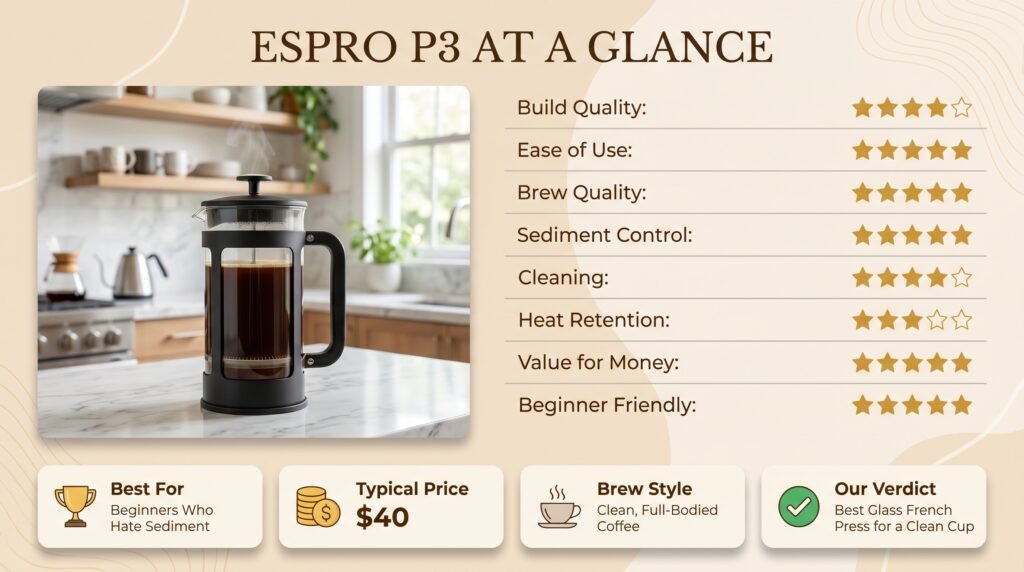
ESPRO P3 at a Glance
Who the ESPRO P3 Is Best For
The P3 makes the most sense if you:
- Find sediment and grit at the bottom of your French press cup unpleasant
- Want a cleaner, smoother cup than a standard French press delivers
- Are choosing between the P3 and the Bodum Chambord at a similar price
- Want Wirecutter’s top-recommended French press
- Are serious about your morning coffee but don’t want to spend a lot
The P3 is probably not the right fit if you:
- Don’t mind sediment — a standard Bodum Chambord or Brazil will serve you just as well for less money
- Want something that keeps coffee hot for longer — the P3 is a glass press with average heat retention
- Need a very large press — the P3 comes in 18oz and 32oz only
What Makes the ESPRO P3 Different
Most French presses use a single metal mesh filter. The P3 uses a patented double micro-filter — two ultra-fine mesh filters stacked together with a silicone seal around the edge.
This does two things no standard French press does:
1. It keeps almost all sediment out of your cup. The double micro-filter catches the fine coffee particles that pass through a standard single-filter press. The result is a noticeably cleaner, less gritty cup — closer to drip coffee in texture while keeping the full-bodied flavour of French press.
2. It stops extraction when you press. On a standard French press, even after you push the plunger down, the grounds continue to sit in contact with the brewed coffee and extraction continues. This is why French press coffee gets bitter and over-strong if you leave it sitting. The P3’s double filter with silicone seal stops extraction completely when pressed — so the last cup from the pot tastes the same as the first.
These are genuine improvements that make a real difference to the everyday brewing experience. They’re not marketing claims — they work.
Build Quality
The P3 is well-built but not in the same way as the Bodum Chambord.
The frame is a lightweight plastic cage rather than stainless steel — similar in feel to the Bodum Brazil rather than the Chambord. It’s functional and sturdy for daily use but doesn’t feel premium in hand.
Where the P3 genuinely stands out on build quality is the glass. ESPRO uses Schott-Duran borosilicate glass — the same German-engineered glass used in laboratory equipment — which is 40% thicker than standard French press glass. It feels noticeably more substantial and robust than the Chambord’s beaker.
The Safety Lock system is another practical feature worth noting. A twist-lock mechanism secures the glass carafe in the frame, preventing accidental slips when pouring. This is genuinely useful and something no Bodum press has.
The plunger and double micro-filter disassemble easily for cleaning — no tools needed, just a few small steps. It’s slightly more complex to clean than a standard single-filter press but not by much.
How the Coffee Tastes
This is where the P3 earns its reputation.
French press coffee is known for being rich and full-bodied, but also for leaving sediment at the bottom of the cup. For some people that’s fine — it’s just part of the experience. For others it’s genuinely off-putting.
The P3 solves the sediment problem without sacrificing flavour. The double micro-filter keeps the natural coffee oils in the cup — which is what gives French press its characteristic richness — while catching the fine grounds that create the gritty texture in a standard press.
The result is a cup that has the body and depth of French press but the clean finish closer to pour-over. It’s genuinely the best of both worlds and it’s the main reason the P3 has become so widely recommended.
The stopped-extraction feature is equally valuable in practice. If you brew a full pot and don’t finish it immediately, the coffee stays consistent rather than getting increasingly bitter as it sits. This matters more than most beginners expect.
ESPRO P3 vs Bodum Chambord: Which Should You Choose?
This is the most common comparison for anyone considering the P3, so it’s worth addressing directly.
| ESPRO P3 | Bodum Chambord | |
|---|---|---|
| Filter | Double micro-filter | Single mesh filter |
| Sediment | Minimal — almost none | Traditional French press sediment |
| Extraction | Stops when pressed | Continues extracting |
| Frame | Plastic | Stainless steel |
| Glass | 40% thicker Schott-Duran | Standard borosilicate |
| Price | ~$40 | ~$40 |
| Safety Lock | Yes | No |
| Best for | Clean, grit-free cup | Premium build and aesthetics |
| Verdict | Choose for cleanest cup | Choose for traditional French press feel |
Both presses are priced around $40. Both use borosilicate glass. Both are beginner-friendly and widely available. The differences are meaningful but specific:
Choose the ESPRO P3 if:
- Sediment bothers you — the double filter is a genuine solution
- You want stopped extraction — the coffee won’t get bitter sitting in the pot
- You want Wirecutter’s top pick
- You’re willing to trade a premium-feeling frame for a better cup
Choose the Bodum Chambord if:
- Sediment doesn’t bother you — the Chambord offers a more premium stainless-steel build
- You care about aesthetics — the Chambord’s stainless steel frame looks better on the counter
- You want easier replacement parts — Bodum’s parts are slightly more accessible
- You want a wider size range — the Chambord comes in 3, 4, 8, and 12-cup sizes
For most beginners who are bothered by sediment, the P3 is the better buy at the same price. For beginners who don’t mind sediment and want something that looks and feels more premium, the Chambord wins.
See our Best French Press Under $50 guide for a broader comparison across options at this price point.
👉 ESPRO P3 (~$40) 👉 Bodum Chambord (~$40)
Pros and Cons
Pros:
- Double micro-filter produces an exceptionally clean, grit-free cup
- Stops extraction when pressed — coffee doesn’t get bitter sitting in the pot
- 40% thicker Schott-Duran glass — more durable than standard French press glass
- Safety Lock system prevents accidental slips when pouring
- Wirecutter’s top-recommended French press
- Dishwasher safe
- BPA, BPS, and phthalate free
- Compatible with paper filters for an even cleaner cup
Cons:
- Plastic frame feels less premium than the Bodum Chambord’s stainless steel
- Slightly more complex to clean than a single-filter press
- Only available in 18oz and 32oz — no larger sizes
- Average heat retention on glass model
- Replacement parts less widely available than Bodum
Sizing Options
The P3 comes in two sizes:
| Size | Volume | Best For |
|---|---|---|
| 18oz | ~2 mugs | One person or small servings |
| 32oz | ~4 mugs | One or two people brewing daily |
For most beginners the 32oz is the right choice. It’s the more popular size and gives you flexibility to brew more or less depending on the day.
👉 ESPRO P3 18oz 👉 ESPRO P3 32oz
Is the ESPRO P3 Worth It?
Yes — especially if sediment is the reason you’ve been hesitating about French press brewing.
The double micro-filter is a genuine innovation that meaningfully improves the French press experience for people who find grit unpleasant. At the same price as the Bodum Chambord, the P3 offers a better cup in exchange for a less premium-feeling frame. That’s a trade-off worth making for most beginners.
The stopped-extraction feature is an underrated bonus. Coffee that doesn’t get bitter sitting in the pot is genuinely more forgiving for beginners who aren’t yet timing their pours perfectly.
If sediment doesn’t bother you, the Bodum Chambord is a perfectly good alternative at the same price. But if you’ve tried French press before and been put off by the gritty texture — the P3 is the press that solves that problem.
👉 ESPRO P3 32oz (~$40) — Check price & availability
Frequently Asked Questions
Is the ESPRO P3 worth it over a Bodum Chambord? At the same price, yes — if sediment bothers you. The double micro-filter produces a noticeably cleaner cup. If sediment doesn’t bother you, the Chambord’s stainless steel frame feels more premium and has better parts availability.
Does the ESPRO P3 really eliminate sediment? Almost entirely. The double micro-filter catches significantly more fine particles than a standard single-filter press. There may still be a very small amount of sediment, but it’s dramatically less than a standard French press.
Is the ESPRO P3 hard to clean? Slightly more involved than a standard French press — the double filter has more parts to rinse. But it disassembles easily without tools and is dishwasher safe, so it’s not a significant inconvenience.
What size ESPRO P3 should I buy? The 32oz is the right choice for most people — enough for two generous mugs and the most popular size. The 18oz suits someone who only ever brews a single small cup.
Why did Wirecutter pick the ESPRO P3? Wirecutter named it the best French press because of the double micro-filter’s performance — specifically the grit-free cup and stopped extraction after pressing. It’s been their top pick since 2024.
Can I use paper filters with the ESPRO P3? Yes — the P3 is compatible with paper filters for an even cleaner cup, closer to pour-over in texture. ESPRO sells their own paper filters for the press, though some third-party options also work.
How does the ESPRO P3 compare to the ESPRO P7? The P7 is the premium stainless steel version — double-wall insulated, keeps coffee hot for much longer, and has a more refined build. It costs significantly more (~$80-100). The P3 is the right starting point for most beginners. If heat retention is a priority, the P7 is worth considering.
Continue Learning
- Best French Press Under $50 for Beginners → how the P3 compares to other options at this price
- Bodum Chambord Review → the most common alternative to the P3 at the same price
- Bodum Chambord vs Brazil → if you’re deciding between Bodum options
- Glass vs Stainless Steel French Press → if you’re considering a stainless steel press instead
- Best French Press for Beginners → broader guide covering all budgets and brewing styles
- How to Use a French Press → step-by-step brewing guide once you’ve chosen your press
- Best Coffee Beans for French Press → what to brew with your new press
- 7 French Press Mistakes That Ruin Your Coffee → avoid the most common beginner errors
- Best French Press for One Person → if you’re buying for solo brewing