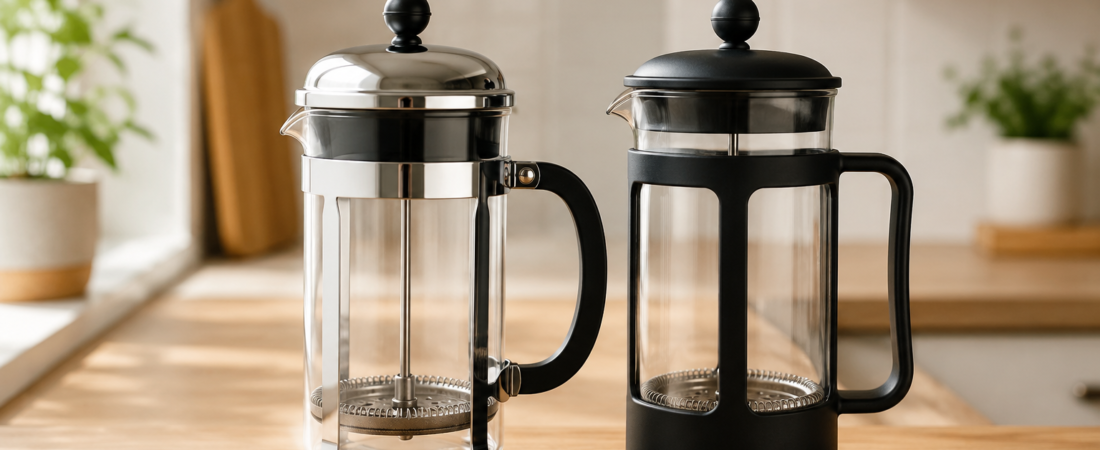
If you’re comparing the Bodum Chambord vs Brazil, the good news is that you’re already making a solid decision — both are reliable French presses that make genuinely good coffee. The question is just which one makes more sense for your situation.
This article contains affiliate links. If you buy through them, I may earn a small commission at no extra cost to you.
⭐ Quick Answer If you can stretch to ~$40, get the Chambord. Better build quality, better long-term value. If budget is tight, the Brazil at ~$20 brews identically — just with a plastic frame. 👉 Bodum Chambord — Check price & availability 👉 Bodum Brazil — Check price & availability
The Honest Summary First
Most comparison articles make this sound complicated. It isn’t.
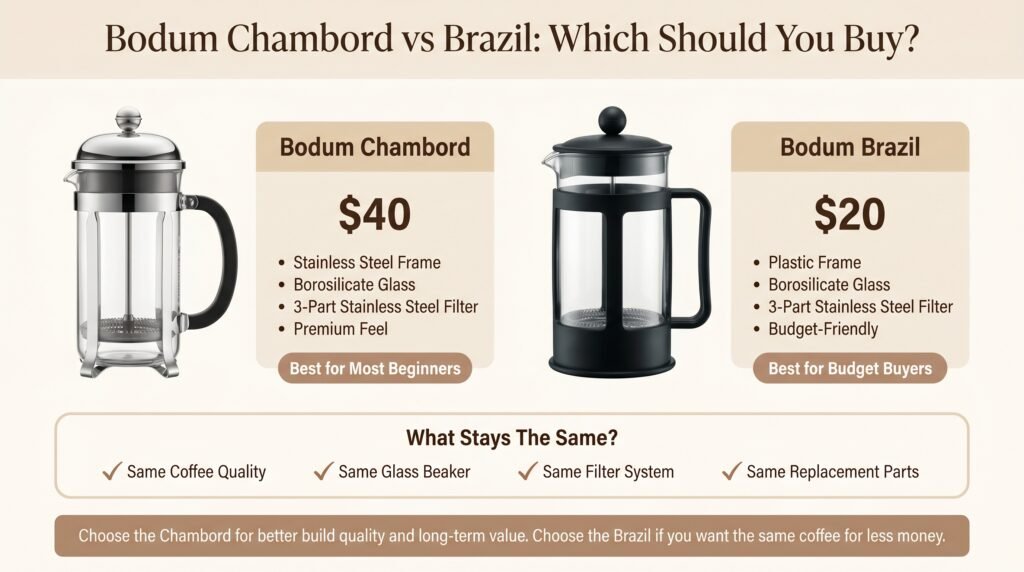
The Bodum Chambord and Brazil use the same glass beaker and the same filter system. The coffee they produce is essentially identical. The only real difference is the frame — stainless steel on the Chambord, plastic on the Brazil.
Everything else — the price gap, the feel, the longevity — flows from that one difference.
Side-by-Side Comparison
| Feature | Bodum Chambord | Bodum Brazil |
|---|---|---|
| Price | ~$40 | ~$20 |
| Frame material | Stainless steel | Plastic |
| Glass beaker | Borosilicate glass | Borosilicate glass |
| Filter system | 3-part stainless steel | 3-part stainless steel |
| Coffee quality | Excellent | Excellent |
| Heat retention | Average | Average |
| Build quality | Premium feel | Budget feel |
| Colours available | Multiple | Multiple |
| Sizes available | 3, 4, 8, 12 cup | 3, 8, 12 cup |
| Replacement parts | Readily available | Readily available |
| Best for | Most beginners | Budget-conscious beginners |
What’s Actually the Same
This is worth spending a moment on because it changes how you think about the decision.
The glass beaker is identical. Both presses use borosilicate glass — the same heat-resistant, non-staining material that holds up well to daily brewing. If you’ve heard that the Brazil uses cheaper glass, that’s not accurate. It’s the same beaker.
The filter system is identical. The three-part stainless steel plunger filter — the part that actually determines your coffee quality — is the same on both models. Same mesh, same fit, same performance.
The coffee tastes the same. This is the most important point. Blind taste tests between the two would be indistinguishable. If you’re buying a French press primarily to brew good coffee, both models deliver that equally well.
Replacement parts are the same. Glass beakers, plunger assemblies, and filter screens are interchangeable between the two models. If you break the glass on either press, replacement beakers are inexpensive and easy to find on Amazon.
What’s Actually Different
The frame material. The Chambord has a chrome-plated stainless steel frame — solid, refined, and noticeably premium in hand. The Brazil has a plastic frame — lightweight, functional, but less refined. This is the only meaningful difference between the two presses.
The feel. Pick up a Chambord and it feels like a well-made piece of kitchen equipment. Pick up a Brazil and it feels like a capable but budget product. Neither is wrong — they just feel different in your hand.
The price. Around $20 separates the two at most retailers. Whether that $20 is worth it depends entirely on your situation.
Bodum Chambord: Who It’s Best For
The Chambord is the right choice if:
- You want something that feels premium and well-made
- You care about how your coffee equipment looks on the counter
- You’re planning to use it daily and want it to last
- You can comfortably spend ~$40 without it being a stretch
- You want to buy once and not think about it again
The stainless steel frame holds up better over time than plastic — it won’t discolour, won’t feel flimsy after a year of daily use, and looks noticeably better on a kitchen counter. If you’re the kind of person who invests in their morning routine, the Chambord is the obvious choice.
👉 Bodum Chambord (~$40) — Check price & availability
Bodum Brazil: Who It’s Best For
The Brazil is the right choice if:
- Budget is a genuine priority right now
- You want to try French press brewing without a big financial commitment
- You’re buying it as a gift and want something affordable but reliable
- You don’t mind the plastic frame
- You just want the coffee, not the aesthetics
The Brazil is not a compromise on coffee quality — it’s a compromise on materials and feel. If those things don’t matter to you, you’ll save $20 and brew identically good coffee every morning.
👉 Bodum Brazil (~$20) — Check price & availability
Does the Price Difference Actually Matter?
Let’s put the $20 gap in perspective.
If you brew one cup of coffee per day, a French press replaces roughly $1-2 of café coffee daily. At that rate, the extra $20 for the Chambord pays for itself in 10-20 days of home brewing. In the context of a press that lasts several years, the price difference is negligible.
That said, $20 is $20. If it’s genuinely tight right now, the Brazil is a perfectly respectable choice that you won’t regret.
What About Heat Retention?
Both the Chambord and Brazil have average heat retention — glass loses heat faster than stainless steel, so your coffee will cool noticeably within 20-30 minutes of brewing.
If heat retention matters to you, neither press solves that problem. You’d want to look at the Bodum Columbia (~$60-80) — the double-wall stainless steel version that keeps coffee hot for up to two hours — or a stainless steel press like the Secura.
For most people though, brewing and drinking promptly isn’t an issue. Four minutes to brew and drink within 20-30 minutes is a perfectly normal morning routine.
Pros and Cons
Bodum Chambord
Pros:
- Premium stainless steel frame — solid and refined
- Looks genuinely good on a kitchen counter
- Better long-term durability than plastic
- Same great coffee as the Brazil
- Multiple sizes and colour options
Cons:
- ~$20 more than the Brazil
- Glass still vulnerable to breakage if dropped
- Average heat retention on glass models
Bodum Brazil
Pros:
- Half the price of the Chambord
- Same glass beaker and filter system
- Same coffee quality
- Lightweight and easy to handle
- Multiple colour options
Cons:
- Plastic frame feels less premium
- May discolour or feel less refined over time
- Still average heat retention
Our Verdict
For most beginners, the Chambord is the better long-term buy. The $20 difference buys you a meaningfully better feel, better materials, and something that looks and holds up better over years of daily use.
But if budget is the deciding factor — get the Brazil without hesitation. The coffee is the same, the filter is the same, and the glass is the same. You’re not compromising on the thing that matters most.
Either way, you’re buying a reliable, beginner-friendly French press from a brand that’s been making them for over 50 years. You won’t regret either choice.
👉 Bodum Chambord (~$40) — Check price & availability
👉 Bodum Brazil (~$20) — Check price & availability
Frequently Asked Questions
Is the Bodum Brazil as good as the Chambord? For coffee quality — yes, completely. The glass beaker and filter system are identical. The only difference is the frame material. If you’re judging purely on the coffee in your cup, both are equally good.
Which Bodum French press is best for beginners? The Chambord is the most common recommendation for beginners because it’s well-built, widely available, and strikes the right balance of quality and price. The Brazil is a great alternative if budget is a priority. Both are covered in our Best French Press for Beginners guide.
Can I use the same replacement parts for the Chambord and Brazil? Yes — the glass beakers and filter components are interchangeable between the two models. Replacement parts are available on Amazon and directly from bodum.com.
Does the Bodum Brazil break easily? The plastic frame is more durable than it looks — it’s the glass beaker that’s the vulnerable part on both models. The beaker can crack if dropped or thermally shocked (pouring boiling water into a cold press). Always warm the glass with hot water before brewing to reduce thermal shock risk.
What sizes does the Bodum Brazil come in? The Brazil is available in 3-cup (12oz), 8-cup (34oz), and 12-cup (51oz) sizes. The 8-cup is the most popular for everyday home use. The Chambord also has a 4-cup size that the Brazil doesn’t offer.
Is the Bodum Chambord worth the extra money? For most people, yes. The stainless steel frame feels significantly better than plastic, looks better on a counter, and holds up better over years of daily use. The $20 difference pays for itself quickly when you consider how long a well-maintained French press lasts.
Continue Learning
- Bodum Chambord Review → deeper dive into the Chambord specifically before you buy
- Bodum Review: Which French Press Is Best? → full overview of the Bodum range beyond just these two models
- Best French Press Under $50 for Beginners → how the Chambord and Brazil compare to other options at this price
- Glass vs Stainless Steel French Press → if you’re considering a stainless steel press instead of glass
- How to Use a French Press → step-by-step brewing guide once you’ve made your decision
- Best Coffee Beans for French Press → what to brew with whichever press you choose
- 7 French Press Mistakes That Ruin Your Coffee → avoid the most common beginner errors