The Bodum Brazil review starts with an honest question most people are actually asking: is it worth saving $20 by choosing the Brazil over the Chambord, or does the cheaper price mean a worse experience?
The short answer is — it depends on what you value. This review covers everything you need to know before buying.
This article contains affiliate links. If you buy through them, I may earn a small commission at no extra cost to you.
⭐ Quick Verdict: Bodum Brazil A genuinely capable budget French press that brews identically to the more expensive Chambord. The plastic frame is the only real trade-off. 👉 Check price & availability
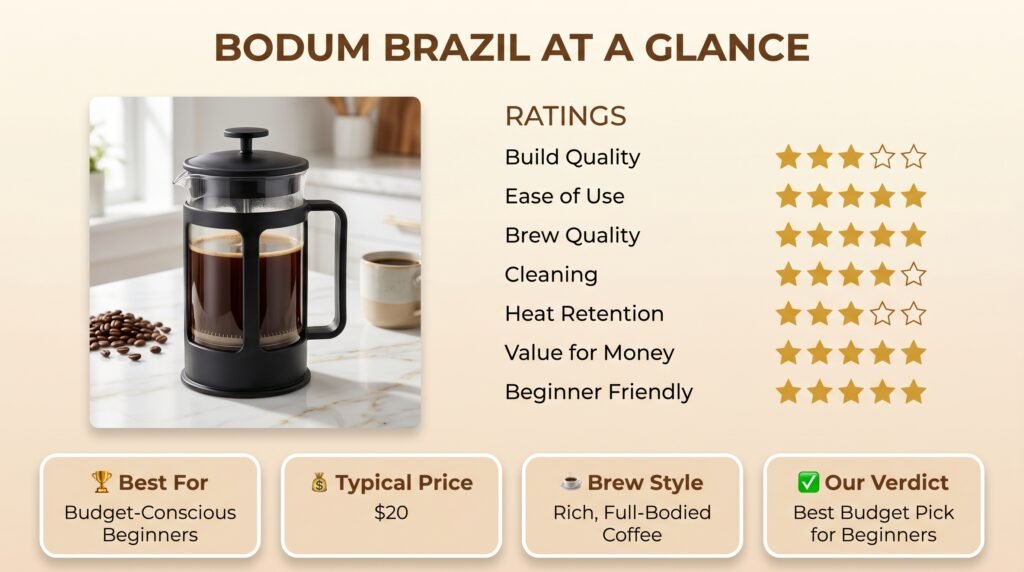
Bodum Brazil at a Glance
Who the Brazil Is Best For
The Brazil makes the most sense if you:
- Want to try French press brewing without spending much
- Are buying your first French press and want to keep the risk low
- Don’t mind plastic — you just want good coffee
- Are buying it as a gift and want something affordable but reliable
- Already know French press works for you and want a spare or travel option
The Brazil is probably not the right fit if you:
- Care about how your equipment looks on the counter
- Want something that feels premium in hand
- Are planning to use it daily for years and want the best long-term build
- Need something that keeps coffee hot for longer than 20-30 minutes
What Is the Bodum Brazil?
The Bodum Brazil is the entry-level French press in Bodum’s range — the affordable version of the more well-known Chambord. It was designed to bring French press brewing to people who want quality coffee without spending much.
It uses the same borosilicate glass beaker and three-part stainless steel filter system as the Chambord. The only meaningful difference is the frame — the Brazil uses plastic instead of stainless steel, which is how Bodum gets the price down to around $20.
It’s available in three sizes — 3-cup (12oz), 8-cup (34oz), and 12-cup (51oz) — and comes in a range of colours including black, white, red, and more.
The most popular size for everyday home use is the 8-cup (34oz).
👉 Bodum Brazil 8-cup — Check price & availability
Build Quality
This is where the Brazil shows its budget positioning most clearly.
The plastic frame is functional but lightweight. It doesn’t feel flimsy exactly — it’s solid enough for daily use — but it lacks the reassuring weight and refinement of the Chambord’s stainless steel frame. Pick up both and the difference is immediately obvious.
Over time, plastic can discolour slightly with heat and use. It’s unlikely to crack or break under normal conditions, but it won’t look as pristine after a year of daily use as the Chambord would.
The borosilicate glass beaker is the same as the Chambord — thick, heat-resistant, and non-staining. This is the part that actually matters for brewing, and Bodum hasn’t cut any corners here. The glass is noticeably better quality than what you’d find in a generic $10 French press.
The plunger filter — again, identical to the Chambord — presses smoothly and fits snugly. No wobbling, no leaking, no grinding. It works exactly as it should.
One important note on the glass: always warm the beaker with hot water before brewing. Pouring boiling water into cold glass can cause thermal shock and crack it. This applies to both the Brazil and Chambord — it’s a French press thing, not a Brazil-specific issue.
How the Coffee Tastes
Here’s the most important thing to know about the Bodum Brazil: the coffee is excellent.
Because the filter system and glass beaker are identical to the Chambord, the brewing experience is essentially the same. You get the same full-bodied, rich French press flavour — natural oils preserved in the cup, no paper filter stripping the flavour, the same slight sediment at the bottom that’s normal for the brewing method.
If you brewed a cup from the Brazil and a cup from the Chambord side by side using the same beans and the same technique, you’d struggle to tell the difference. The coffee is genuinely good.
The variables that affect flavour — grind size, water temperature, brew time, and bean quality — matter far more than which press you use. Get those right and the Brazil will consistently produce a cup that tastes every bit as good as coffee from a much more expensive press.
If you’re not sure where to start with beans, our Best Coffee Beans for French Press guide covers beginner-friendly options that work well with any French press.
Ease of Use
The Brazil is one of the simplest coffee makers you can own. There’s no setup, no programming, no complicated assembly. You add coffee, add water, wait four minutes, press, and pour.
The process:
- Warm the beaker with hot water, then discard
- Add coarsely ground coffee — about 1 gram per 15ml of water as a starting point
- Pour hot water just off the boil over the grounds
- Place the lid on without pressing down
- Wait four minutes
- Press the plunger slowly and evenly
- Pour immediately
That’s it. If you’ve never used a French press before, our How to Use a French Press guide walks through each step in detail.
One thing worth knowing: pour immediately after pressing. Leaving brewed coffee sitting in the press with the grounds continues extraction and can make the coffee bitter or over-strong. Pour into a separate cup or mug straight away.
Cleaning
Cleaning the Brazil is straightforward.
The plunger disassembles into three parts for a thorough rinse. The glass beaker rinses cleanly under the tap. The plastic frame wipes down easily.
Most components are dishwasher safe — though Bodum recommends handwashing the glass to extend its lifespan. For daily use, a quick rinse after each brew is enough. A more thorough clean once or twice a week keeps everything in good condition.
The main thing to avoid is leaving old grounds in the press. Coffee oils go stale quickly and will affect the flavour of future brews. Rinse it out promptly after use and it stays clean without much effort.
If you’re building good brewing habits from the start, our 7 French Press Mistakes That Ruin Your Coffee guide covers cleaning habits worth developing early.
Sizing Guide
| Size | Volume | Best For |
|---|---|---|
| 3-cup | 12oz / 350ml | One small cup |
| 8-cup | 34oz / 1L | One or two people brewing daily |
| 12-cup | 51oz / 1.5L | Two or more people, or large mugs |
For most beginners the 8-cup is the right choice. It’s versatile enough for one or two people without being wasteful when brewing for one.
Pros and Cons
Pros:
- Excellent value — one of the best budget French presses available
- Same glass beaker and filter as the more expensive Chambord
- Brews genuinely excellent coffee
- Beginner-friendly — simple to use and clean
- Replacement parts readily available
- No paper filters needed — better for the environment
- Multiple sizes and colours available
- Widely available on Amazon and in most kitchen retailers
Cons:
- Plastic frame feels less premium than stainless steel
- May discolour slightly with extended daily use
- Average heat retention — coffee cools within 20-30 minutes
- Glass can crack if dropped or thermally shocked
- Fine sediment in cup — normal for French press, but worth knowing
Bodum Brazil vs Chambord: Which Should You Choose?
This is the most common question when considering the Brazil, so it’s worth addressing directly.
The Brazil and Chambord brew identical coffee. The filter system and glass beaker are the same. The only difference is the frame — plastic on the Brazil, stainless steel on the Chambord.
Choose the Brazil if:
- Budget is the priority
- You want to try French press without much financial risk
- You don’t mind the plastic frame
Choose the Chambord if:
- You want something that feels premium
- You care about aesthetics on your counter
- You’re planning to use it daily long term
The coffee from both is essentially identical. See our full Bodum Chambord vs Brazil comparison for a deeper look at the differences.
Is the Bodum Brazil Worth It?
Yes — for most beginners on a budget, the Brazil is one of the best value French presses available.
At around $20, it’s hard to find a press that uses the same quality glass and filter system at this price point. Most alternatives at this price use cheaper materials throughout — the Brazil’s advantage is that Bodum only cut costs on the frame, not on the parts that actually affect your coffee.
If you’re new to French press brewing, unsure whether you’ll stick with it, or simply don’t want to spend $40 on your first press — the Brazil is a smart, low-risk choice that produces genuinely good coffee.
The only reason to spend the extra $20 on the Chambord is if build quality and aesthetics matter to you. If they don’t, save the money and brew the same coffee.
👉 Bodum Brazil (~$20) — Check price & availability
Frequently Asked Questions
Is the Bodum Brazil good quality? Yes — for the price it’s excellent. The glass beaker and filter system are the same quality as the more expensive Chambord. The plastic frame is the only area where Bodum cut costs, and it’s functional and durable for everyday use.
How long does the Bodum Brazil last? The glass beaker and filter components last indefinitely with normal care. The plastic frame is durable under regular use but may discolour slightly over time. Replacement beakers are inexpensive and available on Amazon, so a broken glass doesn’t mean replacing the whole press.
What’s the difference between the Bodum Brazil and Chambord? The glass beaker and filter system are identical on both. The Chambord has a stainless steel frame (~$40); the Brazil has a plastic frame (~$20). The coffee from both is essentially identical. See our Bodum Chambord vs Brazil guide for the full comparison.
Can I put the Bodum Brazil in the dishwasher? Most components are dishwasher safe. Bodum recommends handwashing the glass beaker to extend its lifespan. The plastic frame and filter components are generally fine in the dishwasher.
Why is there sediment in my Bodum Brazil coffee? Fine sediment at the bottom of a French press cup is normal — it’s the brewing method, not a fault of the press. To reduce it, use a coarser grind and press the plunger slowly and evenly. If sediment bothers you, a French press may not be the right brewing method — consider a pour-over instead.
Where can I buy replacement parts for the Bodum Brazil? Replacement glass beakers and filter components are available on Amazon and directly from bodum.com. Search “Bodum Brazil replacement beaker” and you’ll find them easily.
Is the Bodum Brazil good for beginners? Yes — it’s one of the best beginner French presses available at this price. Simple to use, easy to clean, and produces genuinely good coffee. If you’re new to French press brewing, the Brazil is a low-risk way to get started.
Continue Learning
- Bodum Chambord vs Brazil → full comparison if you’re still deciding between the two
- Bodum Chambord Review → if you’re considering stepping up to the Chambord
- Bodum Review: Which French Press Is Best? → full overview of the Bodum range
- Best French Press for Beginners → how the Brazil compares to other beginner options
- How to Use a French Press → step-by-step brewing guide for your first cup
- Best Coffee Beans for French Press → what to brew with your new press
- 7 French Press Mistakes That Ruin Your Coffee → avoid the most common beginner errors