Buying good coffee beans is only half the story. How your coffee tastes day to day depends heavily on freshness — and how you store your beans at home plays a surprisingly big role in that. Many beginners assume stale coffee comes from bad beans. In reality, it’s often caused by how the beans are stored after opening. This guide explains how to store coffee beans properly, what to avoid, and how to keep your coffee tasting fresh without turning it into a project.
This article contains affiliate links. If you buy through them, I may earn a small commission at no extra cost to you.
⭐ Quick Answer
Store coffee beans in an airtight, opaque container at room temperature in a dark cupboard. Keep them away from heat, light, and moisture. Never store in the fridge. Use within 2–6 weeks of the roast date for the best flavour.
⭐ Quick Picks — Best Coffee Storage Containers
| Pick | Product | Best For | Price |
|---|---|---|---|
| 🥇 Budget | Ohtomber 22oz Coffee Canister | Beginners who want simple and affordable | ~$15 |
| 🥈 Mid-range | Veken 22oz Coffee Canister with Window | Everyday use with handy window and date tracker | ~$22 |
| 🥉 Premium | Airscape Planetary Design Canister | Serious freshness — pushes oxygen out entirely | ~$35 |
What Makes Coffee Go Stale?
Once coffee is roasted, it slowly begins to lose flavour. This process speeds up when beans are exposed to:
- Air
- Light
- Heat
- Moisture
Good storage doesn’t stop this completely — it simply slows it down. Coffee doesn’t suddenly expire. Flavour fades gradually over time, and storage affects how fast that happens. This guide on how long coffee beans stay fresh explains what actually changes after roasting — and how much it really matters for beginners.
The Four Enemies of Fresh Coffee
Understanding what damages coffee helps you make simple decisions about where and how to store it.
1. Air (the biggest one)
Oxygen reacts with the oils and aromatic compounds in coffee and breaks them down. Once coffee is exposed to air, oxidation starts immediately — this is why freshly opened coffee smells so much stronger than a bag that’s been sitting open for a week.
The fix: use a container with a tight seal, not just a loose lid.
2. Light
Light — especially direct sunlight — accelerates the degradation of coffee oils and speeds up flavour loss. Even ambient kitchen light has an effect over time, which is why opaque containers outperform glass ones.
The fix: store coffee in a cupboard or pantry, away from windows and kitchen benches.
3. Heat
Heat speeds up chemical reactions inside coffee beans, including the ones that cause staling. Kitchens are full of heat sources — ovens, kettles, toasters, even the top of the fridge generates warmth from the compressor.
The fix: keep coffee away from appliances and heat sources. Room temperature, in a cool dark spot, is ideal.
4. Moisture
Moisture is particularly damaging because it can trigger mould and dramatically accelerate the breakdown of flavour. This is the main reason storing coffee in the fridge is a bad idea — fridges introduce humidity every time you open the door.
The fix: never store coffee near the sink, above a dishwasher, or anywhere with humidity. Keep it dry.
The Best Way to Store Coffee Beans at Home
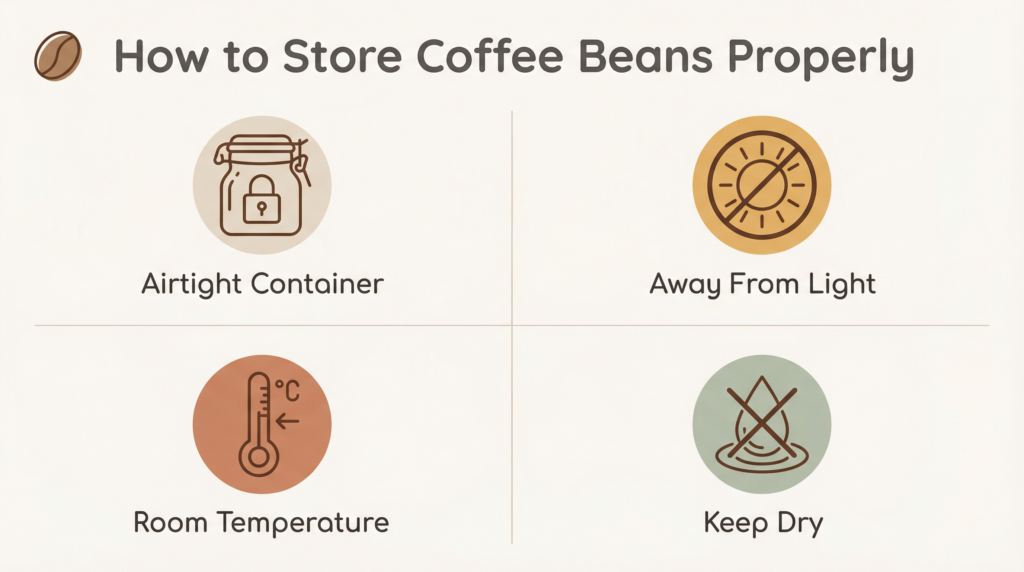
The method that works best for most beginners is also the simplest: an airtight container, in a dark cupboard, at room temperature.
Use an Airtight Container
Air is the biggest enemy of fresh coffee, so a container with a proper seal makes the most difference. Look for:
- A tight-fitting lid with a rubber or silicone seal
- An opaque or UV-blocking material (not clear glass)
- A one-way CO2 valve if possible — this lets gas escape without letting air in
Avoid decorative glass jars with loose lids — they look nice but let air in every time you open them.
For specific product recommendations at every price point, see our full guide to the best airtight coffee containers for home use.
Store in a Dark, Cool Cupboard
Once you have a good container, where you put it matters. A kitchen cupboard away from the oven and windows is ideal. A pantry works well too.
Avoid:
- On the kitchen bench (too much light and heat)
- Near the oven or kettle (heat)
- On top of the fridge (heat from the compressor)
- Above the dishwasher (steam and moisture)
- Near a window (direct light)
Keep Beans at Room Temperature
Coffee prefers stable, moderate conditions. Room temperature — roughly 18–22°C / 65–72°F — is the sweet spot. Avoid extremes in either direction.
Should You Store Coffee Beans in the Fridge?
No. This is one of the most common beginner mistakes.
Fridges introduce three problems for coffee:
- Moisture — every time you open the fridge, humid air gets in and condenses on the cold beans
- Odours — coffee is highly absorbent and will pick up the smell of other foods in the fridge
- Temperature fluctuation — repeatedly moving beans from cold to warm causes condensation and accelerates staling
The result is coffee that tastes muted, odd, or slightly off — even when the beans were high quality to start with. Room temperature storage is always better.
What About Freezing Coffee Beans?
Freezing can work in specific situations, but it’s not necessary for most beginners and it’s easy to do wrong.
When Freezing Makes Sense
- You bought too much coffee and can’t use it within 3–4 weeks
- You bought multiple bags to try over time
- You found a great deal on a large quantity and want to preserve it
How to Freeze Coffee Correctly
- Divide beans into single-use portions — enough for about one week each
- Use airtight freezer bags and squeeze out all air before sealing
- Label each bag with the roast date
- Take one portion out at a time and let it reach room temperature before opening — this prevents condensation forming on the beans
- Never refreeze — once thawed, keep at room temperature and use within 1–2 weeks
The biggest mistake people make is opening and closing the same freezer bag repeatedly. Each time you do, moisture gets in and damages the beans.
For everyday home brewing, room-temperature storage in a good airtight container is simpler and more reliable than freezing.
Does Storage Work the Same for Ground Coffee?
Yes — the same conditions apply — but the timeline is much shorter.
Once ground, coffee goes stale significantly faster because grinding dramatically increases the surface area exposed to air. What takes weeks for whole beans can happen in days for ground coffee.
If you’re using pre-ground coffee:
- Buy smaller bags more frequently
- Transfer to an airtight container immediately after opening
- Use within 1–2 weeks of opening
- Never leave the bag loosely folded on the bench
This is the main reason most coffee enthusiasts recommend grinding just before brewing. It’s not snobbery — grinding fresh is simply the most effective way to preserve flavour. If you’re thinking about making the switch, this guide explains whole beans vs ground coffee for beginners.
How to Tell if Your Coffee Has Gone Stale
You don’t need to taste it to know. Fresh and stale coffee show clear differences:
- Smell: Fresh beans smell rich, complex, and strong when you open the bag. Stale beans smell faint, dusty, or like cardboard.
- Appearance: Fresh dark roast beans have a slight oily sheen. Very dry, matte beans are often older.
- The bloom: When you pour hot water over freshly ground coffee, it puffs up and bubbles — this is CO2 releasing. Stale coffee barely blooms or doesn’t bloom at all.
- Taste: Flat, dull, or papery flavour rather than the complexity you’d expect.
If your coffee passes the smell test when you first open the bag, good storage will keep it that way for weeks longer.
How Long Do Coffee Beans Stay Fresh?
As a general guide:
- Whole beans: best within 2–6 weeks after the roast date
- Ground coffee: best within 1–2 weeks of grinding or opening
- Frozen beans (portioned correctly): up to 3–6 months
The roast date matters more than the best-before date. A bag with a roast date from six months ago is already well past its peak, regardless of the best-before date printed on the label. For a full explanation, see why freshness matters (roast date explained).
How Much Coffee Should You Buy at a Time?
A simple beginner rule: buy enough for one to two weeks and restock regularly.
Buying in bulk feels economical but often results in stale coffee for the last half of the bag. Smaller, more frequent purchases almost always produce better-tasting coffee — even if the beans themselves are cheaper.
For more guidance on quantities and buying habits, see how much coffee should you buy at a time.
A Common Beginner Scenario
You buy good-quality coffee. The first few cups taste great. But after a few days it starts to smell muted or taste strangely flat.
This is almost always a storage issue — not the beans.
It commonly happens when coffee is:
- Left in a loosely sealed or folded-over bag
- Stored on the kitchen bench in plain sight
- Kept near the kettle or oven
- Scooped out with a damp spoon
Moving the beans into a simple airtight container and storing them in a cupboard is often enough to noticeably improve taste — without changing beans, grind size, or brew method.
What Properly Stored Coffee Tastes Like
When coffee is stored properly, it tastes clean, balanced, and more alive.
When you open the container, the aroma hits you immediately instead of being faint. When you brew it, the flavour feels fuller and more rounded — not flat, dusty, or dull — even several days after opening the bag.
Good storage doesn’t change the flavour profile of your coffee. It simply helps the coffee taste closer to how it did when it was freshly roasted.
Recommended Storage Containers
You don’t need to spend a lot to store coffee well. Here are three solid options at different price points:
⭐ Budget pick — Ohtomber 22oz Coffee Canister (~$15)
Stainless steel, airtight seal, includes a date tracker and measuring scoop. Does everything a beginner needs without any unnecessary features.
👉 Check price on Amazon
⭐ Mid-range pick — Veken Coffee Canister 22oz with Window (~$22)
One of the bestselling coffee canisters on Amazon. Stainless steel with a window to check your supply, date tracker, CO2 valve, and a scoop included. A great everyday option.
👉 Check price on Amazon
⭐ Premium pick — Airscape Planetary Design Canister Medium (~$35)
Uses a patented inner plunger lid that physically pushes oxygen out of the canister rather than just sealing it in. The best option if you buy fresh, high-quality beans and want to preserve them as long as possible.
👉 Check price on Amazon
The most important features regardless of which you choose:
- An airtight seal (rubber or silicone gasket)
- Opaque material — ceramic, stainless steel, or dark plastic
- A size that matches how much coffee you buy (not too large)
- Easy to open and close daily without hassle
For a more detailed breakdown at every price point, see our full guide: Best Airtight Coffee Containers for Home Use.
Frequently Asked Questions
Should I keep coffee in the fridge to make it last longer?
No. Fridges introduce moisture, food odours, and temperature fluctuations that all damage coffee flavour. Room temperature storage in an airtight container is always better.
Is a glass jar okay for storing coffee beans?
Yes, if it has a proper airtight seal and is kept away from light. Clear glass jars left on the bench are not ideal — the light exposure accelerates staling. An opaque container in a cupboard is better.
Can I store coffee beans in the original bag?
Yes, if the bag has a one-way valve and a proper resealable zip. Roll the top down tightly after each use and clip it shut. This works reasonably well short-term. Once the zip seal weakens, transfer to a dedicated airtight container.
Does the roast level affect how quickly coffee goes stale?
Yes. Dark roasts go stale slightly faster than light roasts because the roasting process releases more CO2 and oils, which accelerate oxidation. If you drink dark roast, buying smaller bags more frequently makes even more of a difference.
Is a vacuum-sealed container worth it?
For most beginners, no. A good airtight container does 90% of the job at a fraction of the cost. Vacuum-sealed containers add complexity without a noticeable difference for home brewers going through coffee at a normal pace.
What’s the worst place to store coffee?
On top of the fridge. It gets heat from the compressor, light from the kitchen, and temperature fluctuations every time the fridge door opens. It’s the perfect environment for stale coffee.
Do expensive storage containers make a difference?
Not really. Airtight and light-proof matter far more than price. A $15 ceramic canister with a rubber seal outperforms a $50 decorative glass jar with a loose lid every time.
What to Read Next
- How Long Do Coffee Beans Stay Fresh? — what actually changes over time and when to restock
- Why Freshness Matters (Roast Date Explained) — how to read roast dates and what they actually mean
- Best Airtight Coffee Containers for Home Use — specific product recommendations at every price point
- Whole Beans vs Ground Coffee for Beginners — which option makes more sense for your routine
- Beginner Coffee Setup Checklist — the simple setup that ties freshness, storage, and brewing together