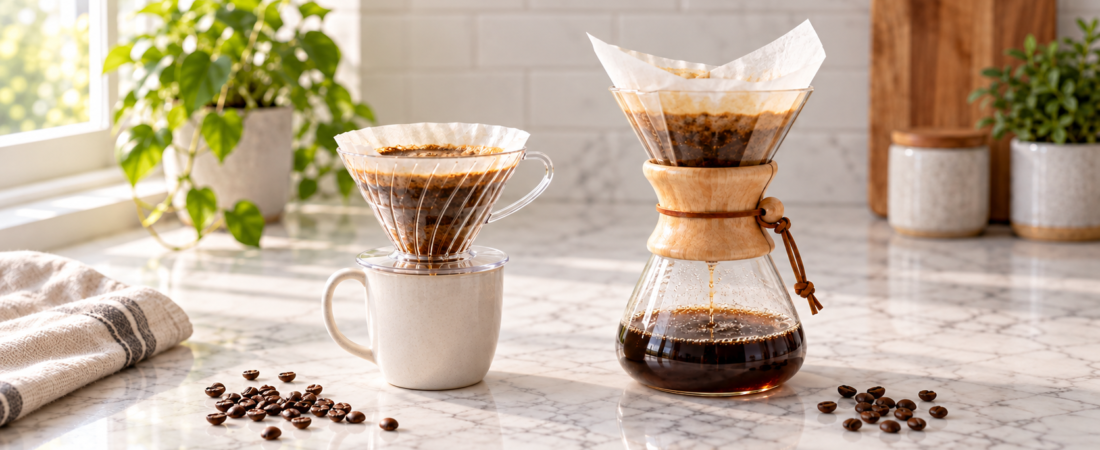
Comparing the Hario V60 vs Chemex? Both can make excellent pour-over coffee, but they suit different routines. The V60 is compact, inexpensive, and gives you plenty of control over a single cup. The Chemex combines a brewer and glass carafe, uses much thicker filters, and is better suited to making clean-tasting coffee for two or more people.
The choice comes down to serving size, flavor preference, budget, and how much control you want over the brewing process.
This article contains affiliate links. If you buy through them, I may earn a small commission at no extra cost to you.
⭐ Quick Verdict
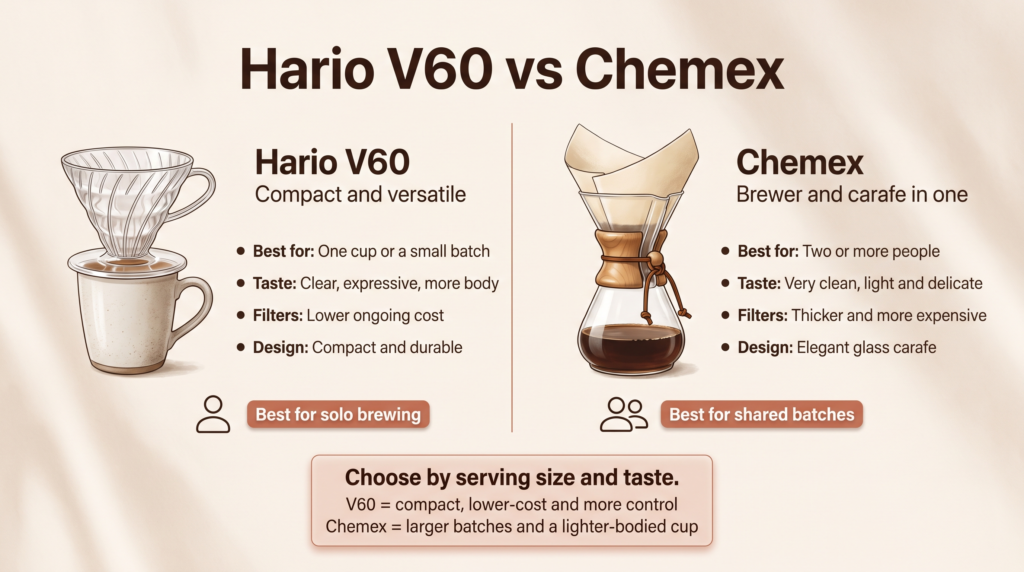
Choose the V60 if you usually brew one cup, want the lower-cost and more compact option, and enjoy adjusting your technique.
Choose the Chemex if you regularly brew for two or more people and prefer a very clean, light-bodied cup from a brewer that also serves as a carafe.
👉 Hario V60 (Plastic, Size 02) — Check current price & availability
The Core Difference
The Hario V60 is a cone-shaped dripper with spiral ribs and one large opening. Its open design gives you considerable control over flow through grind size and pouring technique. It sits on top of a mug or separate server.
The Chemex is an hourglass-shaped glass brewer and carafe in one. It uses thick Chemex Bonded filters, which retain more oils and fine particles than typical pour-over papers. The result is generally a lighter-bodied, highly clarified cup.
Both use the same basic method—pouring hot water over ground coffee—but they differ in filtration, capacity, portability, and the amount of technique they demand.
Hario V60 vs Chemex: Side by Side
| Feature | Hario V60 | Chemex |
|---|---|---|
| Best for | One cup or a small batch | Two or more people |
| Flavor profile | Clear and expressive, with more body | Very clean, light, and delicate |
| Filter type | Hario V60 cone filters | Thick Chemex Bonded filters |
| Filter cost | Generally lower | Generally higher |
| Technique | More responsive to pour rate | Still sensitive to grind and flow |
| Brew time | Usually shorter | Usually longer for a larger batch |
| Durability | Plastic version is light and hard to break | Glass body requires more care |
| Serving vessel | Mug or server required | Brewer and carafe in one |
| Storage | Compact | Taller and bulkier |
Choose the V60 If…
- You’re brewing mainly for yourself
- Budget is a priority—the plastic V60 is usually the less expensive way to start
- You want to develop your pour-over technique and don’t mind a slightly steeper learning curve
- You want a faster brew time and a brewer that uses less counter space
For a full breakdown, see our Hario V60 Review.
Choose the Chemex If…
- You regularly brew for two or more people
- You want a very clean, sediment-free cup with a lighter body
- You like having a brewer that doubles as a serving carafe
- Design matters to you—the Chemex is as much a kitchen centerpiece as a coffee brewer
For a full breakdown, see our Chemex Review.
Taste: What’s the Real Difference?
Compared with the Chemex’s much thicker paper, a V60 filter allows a little more oil and fine material into the cup. V60 coffee is still clean, but it can have slightly more body and texture, with clearly defined acidity and aroma when the recipe is dialed in.
The Chemex’s thick filter removes more oils and sediment, producing a particularly clear, light-bodied cup. That can make delicate flavors easier to notice, although some drinkers find the result too restrained compared with a V60.
Neither is objectively better. They represent different points on the same spectrum, and the right choice depends on whether you prefer more texture or maximum clarity.
Ease of Use
The V60 is simple to set up, but its large opening makes the result particularly responsive to grind size, pour rate, and pouring pattern. That control is part of its appeal, although it can take practice to reproduce the same cup consistently.
The Chemex is not automatically more forgiving. Its heavier paper can slow or stall if the grind is too fine, and the filter must be positioned correctly so it does not seal the pouring spout. Its larger neck and carafe are stable and pleasant to pour into, but you still need to control grind and water flow.
For beginners, the better choice is usually determined by volume: the V60 for a single cup and the Chemex for a shared batch.
Common Beginner Mistakes
With a V60
- Pouring too fast or unevenly: Because the cone can drain quickly, an inconsistent pour may lead to uneven extraction. A controlled circular pour is a good starting point.
- Using the wrong grind size: Too coarse and the coffee may taste weak or underextracted; too fine and the filter may clog or produce an overextracted taste. A medium grind is the usual starting point.
- Skipping the bloom: An initial pour helps release trapped gas and saturate the grounds before the main pour.
With a Chemex
- Forgetting to rinse the filter: Chemex filters are thick and may impart a papery taste if they are not thoroughly rinsed with hot water before brewing.
- Grinding too finely: The thick filter already slows the flow of water. An excessively fine grind can cause the brew to stall or take too long.
- Letting the filter seal the spout: Position the thicker three-layer side against the spout. This helps prevent the filter from blocking airflow and slowing the brew.
Cost Comparison
The plastic V60 is usually the cheaper entry point by a meaningful margin. Bear in mind that it is only a dripper: if you want to brew more than fits in your mug, you may also need a separate server.
The Chemex costs more upfront, but its glass body doubles as a carafe. Its proprietary filters also generally cost more than Hario V60 papers, so consider both the brewer and ongoing filter costs rather than comparing purchase prices alone.
Cleanup
Both brewers are relatively straightforward to clean.
The V60’s paper filter and grounds lift out easily, and the small dripper is quick to rinse.
The Chemex is also easy to empty, but its narrow waist can be harder to reach during cleaning. On Classic models, remove the wooden collar and leather tie before washing the glass.
Can You Own Both?
Plenty of pour-over enthusiasts do—the V60 for a quick solo morning brew and the Chemex for entertaining or making a larger batch to share.
They suit different volumes and occasions rather than directly competing. If you are torn between them, start with the brewer that matches your normal serving size and consider adding the other later.
How to Brew Each
Basic V60 Method
- Place a filter in the dripper and rinse it with hot water to remove any papery taste. Discard the rinse water.
- Add medium-ground coffee to the filter.
- Pour in a small amount of hot water to saturate the grounds and allow the coffee to bloom for about 30 seconds.
- Continue pouring in slow, controlled circles, keeping the water level reasonably consistent.
- A typical brew may take around 2½–3½ minutes, although the ideal time depends on your recipe, dose, and grind.
Basic Chemex Method
- Unfold the filter so the thicker three-layer side sits against the pouring spout.
- Rinse the filter thoroughly with hot water and discard the rinse water.
- Add medium-coarse ground coffee.
- Pour in enough hot water to saturate the grounds and allow the coffee to bloom for about 30–45 seconds.
- Continue pouring in controlled stages, allowing the water level to fall slightly between pours.
- A typical shared batch may take around 4–5 minutes, depending on the quantity, grind, and pouring technique.
Sizing: What Do the Numbers Mean?
Both brewers come in several sizes, and neither uses standard mug measurements, so it is worth checking the actual capacity before buying.
The V60 is commonly sold in sizes 01, 02, and 03. Hario rates the 01 for 1–2 cups and the 02 for 1–4 cups, although these are small coffee servings rather than large mugs.
Size 02 is the most versatile choice for most households because it can handle a solo drink and a modest batch. The larger Size 03 makes more sense if you regularly brew several servings into a server.
The Chemex uses a 5oz cup measurement, which is smaller than a typical mug. That makes a 3-cup Chemex approximately 15oz and a 6-cup approximately 30oz. Larger models are also available.
Importantly, you do not have to fill a Chemex to its maximum capacity. Chemex says you can brew a smaller quantity by adjusting the amount of coffee and water.
Does Roast Level Matter?
Both brewers work with any roast level, but their characteristics may suit certain coffees particularly well.
The V60’s control and clarity can work beautifully with light and medium roasts, but it is flexible enough for darker coffee too. With a dark roast, you may prefer slightly cooler water or a coarser grind to avoid excessive bitterness.
The Chemex also suits light and medium roasts, especially if you enjoy a delicate, tea-like presentation. Dark roasts can still work, but the thick filter produces less body than an immersion brewer such as a French press.
Neither pairing is a strict rule. Both brewers can produce good results with any roast once you adjust the recipe. Your preferred serving size and cup texture should carry more weight than roast level when choosing between them.
Hario V60 vs Chemex: Final Verdict
Choose the Hario V60 if you mainly make coffee for yourself, want to spend less, or enjoy experimenting with grind size and pouring technique.
The plastic Size 02 is the most practical all-round version. It is light, durable, and capable of brewing both a single cup and a small batch.
Choose the Chemex if you regularly make coffee for two or more people, prefer a very clean and delicate cup, or want a brewer that can go straight from the countertop to the table as a serving carafe.
The easiest decision rule is:
- V60: Better for compact, lower-cost solo brewing and greater control
- Chemex: Better for larger batches, lighter body, and presentation
Neither is universally better. For most beginners brewing one mug at a time, the V60 is the more sensible first purchase. For couples or anyone who routinely serves coffee, the Chemex is usually the more convenient fit.
👉 Hario V60 (Plastic, Size 02) — Check current price & availability
Frequently Asked Questions
Which Is Easier for a Beginner: V60 or Chemex?
Neither is automatically easier. The V60 is cheaper, lighter, and simpler to clean, but it responds strongly to pouring technique. The Chemex offers a stable brewing vessel and makes larger batches, although its thick filter can stall if the grind or filter placement is wrong.
Is Chemex Coffee Better Than V60 Coffee?
Not objectively—it is simply different. The Chemex produces a cleaner, lighter cup with less body, while the V60 produces coffee with slightly more texture and body. Which is better depends on your personal taste.
Can I Use V60 Filters in a Chemex or Vice Versa?
No. The two brewers use differently shaped and differently sized filters that are not interchangeable. Chemex filters are also notably thicker than Hario V60 filters.
Which Is Better for Brewing for a Group?
The Chemex, particularly in a 6-cup or larger size, is generally more convenient for a group because it doubles as both the brewer and serving carafe.
A V60 can also make a small batch when paired with a suitable server, but it is particularly convenient for one or two servings.
Do I Need a Gooseneck Kettle?
Not strictly, but a gooseneck kettle makes controlling your pour noticeably easier with both brewers. It is especially useful with the V60, where changes in pouring speed and placement can have a significant effect on extraction.
See our Best Gooseneck Kettles for Beginners guide for suitable options.
Continue Learning
- Hario V60 Review → our complete breakdown of the V60
- Chemex Review → our complete breakdown of the Chemex
- Best Pour Over Coffee Maker for Beginners → our buying guide covering the leading pour-over options
- Best Gooseneck Kettles for Beginners → options for improving pour control
- Do You Need a Gooseneck Kettle? → an honest guide to whether it is worth buying one