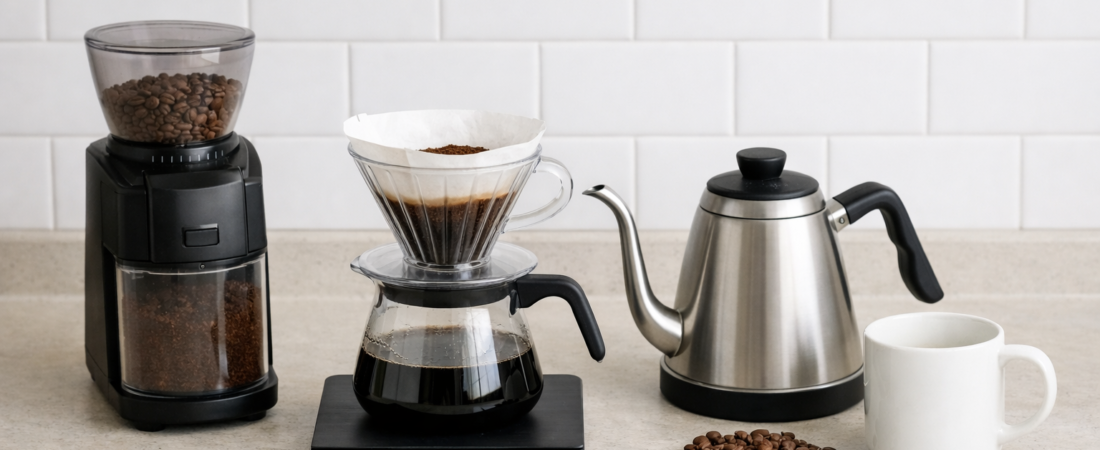
If you’re new to making coffee at home, coffee gear can feel overwhelming very quickly.
Grinders, kettles, machines, scales, accessories — suddenly it feels like good coffee requires a long shopping list and a lot of money. Many beginners worry about buying the wrong thing or wasting money on gear they don’t really need.
The good news is this:
you don’t need much equipment to make genuinely good coffee at home.
This guide to coffee gear basics for beginners explains what actually matters, what doesn’t, and what can safely wait – — so you can move forward with confidence instead of confusion.
Coffee Gear Basics for Beginners: The One Thing That Matters Most
Good coffee doesn’t come from gadgets.
It comes from fundamentals.
No piece of equipment can fix:
- stale coffee
- the wrong grind size
- an inconsistent brewing method
On the other hand, when the fundamentals are right, even very simple equipment can produce great results.
Before thinking about buying more gear, it helps to understand which tools support those fundamentals — and which ones don’t. For a calm, practical overview of what beginners actually need (and what can wait), this beginner coffee brewing gear checklist breaks it down step by step without pushing unnecessary upgrades.
Gear That Actually Matters (At a High Level)
This isn’t about brands or models.
It’s about roles — what each piece of gear actually does for your coffee.
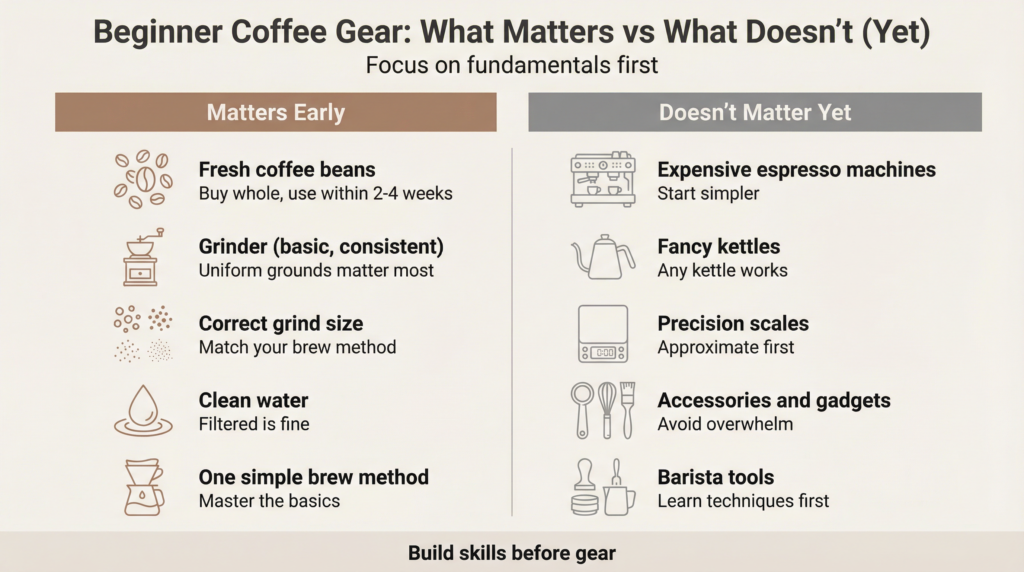
If you prefer a quick visual summary, this simple breakdown shows what matters early — and what can safely wait.
1. A Grinder (Why It Matters)
Grind size has a huge impact on flavour. Coffee that’s ground too fine can taste bitter; coffee that’s ground too coarse can taste weak or sour – If you’re unsure what different grind sizes actually look like, this simple grind size chart helps.
A grinder allows you to:
- control grind size
- adjust based on taste
- keep coffee fresher for longer
You don’t need the best grinder on the market to start — but understanding why grinding matters is important. This will be explained more clearly in later guides.
2. One Brewing Method (Not Many)
You don’t need multiple brewing devices.
Choose one brewing method and learn it well:
- pour-over
- French press
- AeroPress
- drip coffee machine
Every method can make good coffee when used consistently. Switching between methods too early often creates confusion, not better results.
Confidence comes from repetition, not variety.
3. A Way to Boil Water (Simple Is Fine)
You don’t need a specialised kettle to begin.
A basic kettle works perfectly well.
Pour control and temperature precision are helpful later, but they’re not required to get started or enjoy good coffee.
4. Something to Store Coffee Properly
Coffee freshness matters more than most beginners realise, especially when beans aren’t stored properly.
A simple airtight container, stored away from light and heat, protects flavour far more than many expensive accessories ever will.
Gear That Matters Less Than People Think
This is where many beginners feel relieved.
You do not need:
- expensive espresso machines
- advanced accessories
- “professional” tools
- large collections of equipment
Tools like coffee scales can help with consistency later, but they aren’t required to make good coffee at home. This guide explains whether you actually need a coffee scale as a beginner, and when it makes sense to add one.
These items don’t improve coffee if the fundamentals aren’t already in place. For beginners, they often add complexity without improving flavour.
Upgrades make sense later, once you know what you enjoy and why.
A Simple Beginner Setup (Conceptual)
At its simplest, a beginner setup looks like this:
- Fresh coffee beans
- A grinder
- One brewing method
- A kettle
- A way to store coffee properly
That’s enough to make coffee that tastes clean, balanced, and satisfying — without turning coffee into a project. This setup can evolve over time, but it doesn’t need to be perfect on day one.
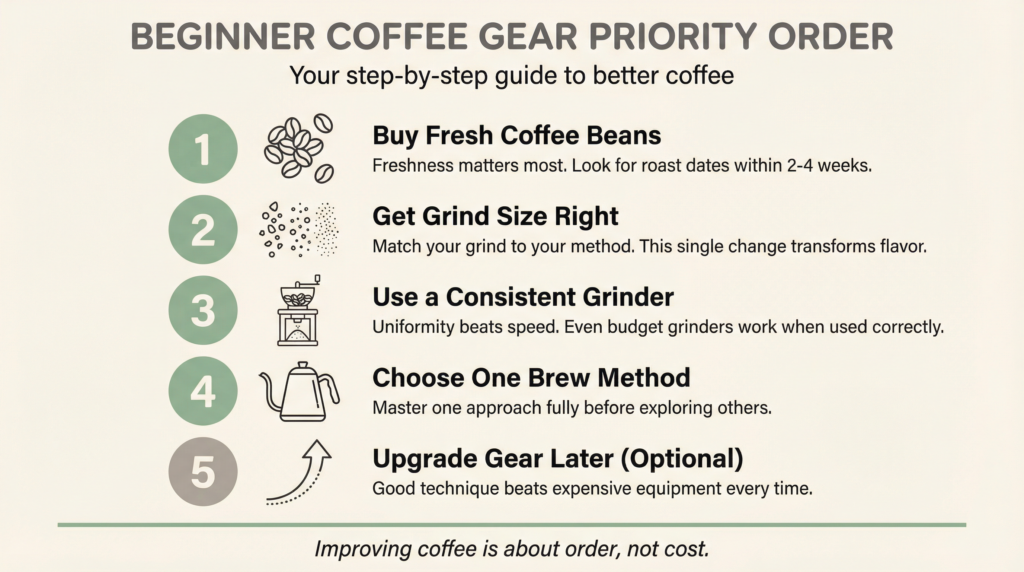
If you prefer a step-by-step visual, this shows the order beginners should focus on — without spending more than necessary.
A Simple Beginner Checkpoint
Before buying anything new, it helps to pause and ask a few simple questions:
- Do I have reasonably fresh coffee?
- Am I using a grind size that suits my brewing method?
- Am I sticking with one brew method long enough to learn it?
- Am I changing one thing at a time when the coffee tastes off?
If the answer to most of these is “yes,” you’re already set up well — even with very simple equipment.
If not, improving one of these areas will usually help more than buying new gear.
A Common Beginner Scenario
Many beginners buy good coffee and even invest in gear, yet the coffee still tastes disappointing.
In most cases, the issue isn’t missing equipment.
It’s usually something simpler:
- coffee isn’t fresh
- grind size doesn’t match the brew method
- too many things were changed at once
Understanding what actually matters helps you fix problems calmly — without buying more gear than necessary.
Did You Know?
Many cafés make excellent coffee using surprisingly simple equipment.
Consistency and fundamentals matter far more than complexity — a principle also emphasised by the Specialty Coffee Association (SCA).
Beginner FAQ
Do I need to buy everything at once?
No. It’s better to start simple and add things gradually as you learn what helps. We essentially just need the coffee gear basics for beginners.
Should I buy expensive gear first?
No. Expensive equipment doesn’t compensate for inexperience or poor fundamentals.
Can I upgrade later?
Absolutely. Once you understand what affects flavour, upgrades make more sense and feel far less risky.
What’s Next?
These coffee gear basics for beginners help you build confidence before spending more money. Now that you understand what actually matters, the next step isn’t buying more gear — it’s putting together a simple, beginner-friendly setup that supports the fundamentals you’ve just learned.
Read next: Beginner Coffee Setup Checklist