Looking for the best French press under $50? You don’t need to spend a fortune to make rich, full-bodied coffee at home. After reviewing beginner-friendly options across durability, filter quality, ease of cleaning, and value, these are the picks worth considering.
This article contains affiliate links. If you buy through them, I may earn a small commission at no extra cost to you.
Quick Picks: Best French Presses Under $50
- ⭐ Best pick for most beginners: Bodum Chambord French Press (~$40) — Check price & availability
- Best budget pick: Secura Stainless Steel French Press (~$28) — Check price & availability
- Best for smoother coffee: ESPRO P3 French Press (~$40) — Check price & availability
- Best affordable glass option: Bodum Brazil French Press (~$20) — Check price & availability
- Best value pick: Veken French Press (~$27) — Check price & availability
Who This Guide Is For
This guide is written specifically for beginners — people who are either buying their first French press or moving away from pod machines and drip coffee makers. You don’t need any special equipment or barista knowledge. If you can boil water and measure coffee, you can make a great cup. If you’re still deciding which type of French press suits you best, our Best French Press for Beginners guide compares additional beginner-friendly options beyond this under-$50 list. If you’re an experienced specialty coffee drinker looking for competition-grade brewing equipment, you’ll want to look beyond the $50 mark — but for everyone else, everything on this list is more than capable.
Side-by-Side Comparison
| French Press | Price | Material | Best For |
|---|---|---|---|
| Bodum Chambord | ~$40 | Glass + stainless | Most beginners |
| Secura Stainless Steel | ~$28 | Stainless steel | Durability on a budget |
| ESPRO P3 | ~$40 | Glass + plastic frame | Cleaner, smoother coffee |
| Bodum Brazil | ~$20 | Glass + plastic | Cheapest entry point |
| Veken French Press | ~$27 | Glass + stainless steel | Best value pick |
What Actually Matters in a French Press Under $50
Most beginners don’t need advanced brewing equipment. But there are a few things that genuinely make a difference between a French press you’ll love using daily and one that ends up gathering dust in a cupboard.
Filter Quality
The filter — also called the plunger or mesh screen — is the most important component in a French press. A well-designed, tight-fitting filter keeps coffee grounds out of your cup, makes plunging smooth and consistent, and is easy to rinse clean after each brew. Cheaper presses often have poorly fitted filters that let too much sediment through, producing gritty, murky coffee. It’s worth paying attention to this.
Heat Retention
French press coffee sits in hot water during the brewing process, so heat retention matters. Glass French presses lose heat faster than stainless steel ones — which can affect the final flavour if your kitchen is cold or if you brew larger batches. Stainless steel, especially double-wall insulated models, keeps your brew at the right temperature throughout.
Ease of Cleaning
This one is underrated. If your French press is annoying to clean, you’ll use it less. The best beginner-friendly options have simple, removable filters, dishwasher-safe components, and no fiddly parts that trap old coffee grounds. A French press that takes five minutes to properly clean every morning quickly becomes a chore.
Durability
Glass French presses look elegant, but some cheaper glass models crack or shatter more easily than you’d expect — especially when exposed to sudden temperature changes. If you’re someone who tends to be a bit clumsy in the kitchen, or if you want something that will last several years without worry, a stainless steel model is worth considering.
Capacity
Think about how much coffee you typically make at once. Most standard French presses come in 3-cup (12 oz), 4-cup (17 oz), or 8-cup (34 oz) sizes. If you’re brewing just for yourself, a 3-cup or 4-cup model is usually enough. If you often make coffee for two or more people, go for the 8-cup.
The 5 Best French Presses Under $50
1. Bodum Chambord French Press — Best Overall
Price: ~$40 | 👉Check price & availability
The Bodum Chambord is the safest recommendation for most beginners, and it’s been that way for years. It’s simple, well-made, widely available, and — importantly — it just works.
The Chambord has a classic stainless steel frame around a borosilicate glass beaker, a comfortable handle, and a solid three-part stainless steel plunger filter that does a decent job of keeping sediment out of your cup. There’s still some sediment, as there always will be with a French press, but it’s not excessive.
What makes it particularly beginner-friendly is how straightforward it is to use and clean. There are no complicated parts, no tricky assembly, and replacement parts — including the glass beaker and the filter mesh — are easy to find and inexpensive. If you accidentally break the glass, you don’t need to replace the whole press.
The Chambord is available in several sizes (from 3-cup to 12-cup) and a range of colours, so it’s easy to find one that fits your kitchen. Heat retention is average for a glass model, which is typical at this price point.
Pros:
- Beginner-friendly design, easy to learn
- Classic look that suits most kitchens
- Reliable filter with good plunge feel
- Easy to clean and maintain
- Replacement parts readily available
- Multiple sizes and colour options
Cons:
- Glass body can break if dropped
- Heat retention is average
- Some sediment in the cup (normal for French press)
Best for: Most beginners who want a reliable, everyday French press without overthinking it.
2. Secura Stainless Steel French Press — Best for Durability on a Budget
Price: ~$28 | 👉Check price & availability
If durability matters more to you than aesthetics, the Secura is one of the best-value French presses you can buy under $50. The fully stainless steel body means it’s far more resistant to knocks and drops than a glass model, and it retains heat noticeably better — your coffee will stay warmer for longer, which matters if you take your time finishing a cup.
The Secura comes with an extra set of replacement filters included in the box, which is a thoughtful bonus and a sign the brand is thinking about long-term use. The filter mesh is well-fitted and produces a reasonably clean cup for a press at this price. The plunger action is smooth without feeling too light or flimsy.
The main trade-off compared to the Chambord is aesthetics and weight. Stainless steel presses are heavier, and they don’t have the classic visual appeal of watching coffee brew through glass. But if you want something dependable that you can handle a little more roughly, the Secura is an excellent choice.
Pros:
- Very durable stainless steel construction
- Better heat retention than glass models
- Extra replacement filters included
- Great value for money
- Dishwasher safe
Cons:
- Heavier than glass models
- Can’t see the brewing process
- Less visually elegant
Best for: Beginners who prioritise durability, heat retention, and value over appearance.
3. ESPRO P3 French Press — Best for Smoother, Cleaner Coffee
Price: ~$40 | 👉Check price & availability
The ESPRO P3 sits at the top of the budget range here, but it earns its price with a meaningful upgrade: a double micro-filter system that produces noticeably cleaner, smoother coffee than most standard French presses.
Most French presses use a single mesh filter, which lets fine particles and sediment slip through into your cup. The ESPRO P3 uses two filters stacked together, which catches far more of those fine grounds. The result is a cup of coffee that has the full-bodied richness you get from a French press, but with significantly less silt and grittiness at the bottom.
The body uses thick borosilicate glass in a polypropylene plastic frame — so it’s not stainless steel, and heat retention is similar to other glass presses. What sets it apart is the double micro-filter system and a silicone-sealed plunger that slows extraction after plunging, which prevents the bitterness that develops when coffee keeps steeping.
If you’re someone who loves the convenience of a French press but has always been put off by the sediment, the ESPRO P3 is well worth the slightly higher price tag.
Pros:
- Double micro-filter produces much cleaner, grit-free coffee
- Sealed plunger slows extraction — no bitterness if you don’t pour immediately
- 40% thicker glass than most presses
- Safety lock secures the glass during brewing
- Premium feel at a still-reasonable price
Cons:
- Most expensive option on this list
- Glass body can still break if dropped
- Plastic frame feels less premium than full stainless options
Best for: Beginners who want cleaner, smoother coffee and don’t mind spending a little more to get it.
4. Bodum Brazil French Press — Best Affordable Glass Option
Price: ~$20 | 👉Check price & availability
If you want to spend as little as possible while still getting a decent French press experience, the Bodum Brazil is the answer. It’s the most budget-friendly option on this list, and it’s made by the same brand as the Chambord — so you’re getting Bodum’s reliable filter system and build quality at a lower price point.
The key difference from the Chambord is that the Brazil uses a polypropylene plastic handle and frame rather than stainless steel. This keeps the cost down and makes it slightly lighter, but it does look and feel less premium. The glass beaker itself is the same borosilicate glass used in more expensive Bodum models, which is reassuring.
For anyone who wants to try French press coffee without much financial commitment, or who needs a second press for a different room or office, the Bodum Brazil delivers solid performance at a very accessible price. Just handle it with a bit more care than a steel model.
Pros:
- Very affordable entry point (~$20)
- Bodum’s reliable filter system
- Lightweight and easy to handle
- Available in several colours
- Good beginner experience for the price
Cons:
- Plastic frame feels less premium
- Glass body can break
- Average heat retention
- Not as durable as stainless steel options
Best for: Absolute beginners who want to try French press coffee with minimal financial risk.
5. Veken French Press — Best Value Pick
Price: ~$27 | 👉Check price & availability
At around $27 for the 34oz model, the Veken is the best-value option on this list. It’s well-established in this price range and has built a strong reputation among buyers — which is unusual for a press at this price point.
The Veken uses thickened borosilicate glass inside a stainless steel frame, with a 4-level filtration system that does a good job of reducing sediment. One notable feature is the “no plastic touching” design — all brewing surfaces are 304 stainless steel and food-grade silicone, which matters if you’re particular about materials. The glass carafe is heat-resistant and lets you watch the brew, which you don’t get with fully stainless models.
For a beginner who wants something well-priced and easy to live with daily, this is a strong pick. Available in silver, copper, and a darker pewter colour.
Pros:
- Excellent value at ~$27
- No plastic touching the coffee
- 4-level filtration reduces sediment
- Borosilicate glass lets you see the brew
- Multiple colour options
Cons:
- Glass can still break if dropped
- Not fully insulated — heat retention is average for a glass model
Best for: Beginners who want a capable, well-priced press without spending close to $40.
Glass vs. Stainless Steel: Which Should You Choose?
This is the most common question beginners have when choosing a French press, so it’s worth addressing directly.
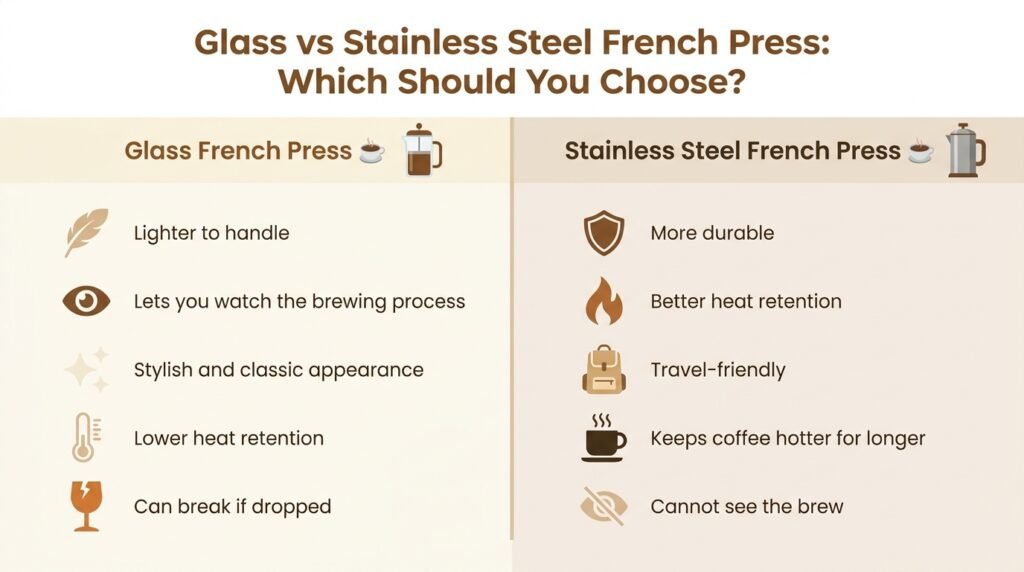
Choose glass if you:
- Prefer a lighter press that’s easy to handle
- Like watching the coffee brew (it really is satisfying)
- Care more about aesthetics and design
- Mainly brew at home on a stable surface
- Don’t mind being a little careful with it
Choose stainless steel if you:
- Want something more durable and worry-free
- Prefer coffee that stays hot for longer
- Travel with your press or use it outdoors
- Are prone to accidents in the kitchen
- Don’t mind not being able to see the brew
There’s no objectively better choice — it comes down to your priorities. Most beginners find glass perfectly fine for home use, but stainless steel is a more practical long-term investment if durability matters to you. Still deciding between glass and stainless steel? Our Glass vs Stainless Steel French Press guide explains the main differences for beginners.
Tips for Better French Press Coffee
Getting the most out of your French press is mostly about a few simple habits. These small adjustments make a bigger difference than most people expect.
Use a coarse grind. This is the single most important tip for French press beginners. Fine grinds create bitterness, produce muddy coffee, and make plunging difficult. Aim for a coarse grind — roughly the texture of coarse sea salt or raw sugar. If you’re buying pre-ground coffee, look for bags specifically labelled for French press. If you’re using pre-ground coffee, choosing the right type matters more than many beginners expect. Our Best Pre-Ground Coffee for French Press guide covers beginner-friendly options that work well with French press brewing.
Use the right coffee-to-water ratio. A good starting point is 1:15 — one part coffee to fifteen parts water by weight. For example, 30g of coffee to 450ml of water. Adjust from there to suit your taste: more coffee for a stronger brew, less for something lighter. Good coffee matters just as much as good technique. If you’re unsure what beans work best with French press, see our Best Coffee Beans for French Press guide for beginner-friendly recommendations.
Don’t over-brew. Leaving your coffee to steep for too long causes bitterness and harsh flavours. Four minutes is the standard starting point. Set a timer until you get a feel for it.
Watch your water temperature. Boiling water is slightly too hot for French press coffee and can scorch the grounds, leading to bitterness. Let the kettle sit for 30 seconds after boiling, or aim for around 200°F / 93°C. If you have a temperature-controlled kettle, that’s the ideal tool — but a brief rest off the boil works perfectly well.
Pour immediately after plunging. Once you’ve plunged, don’t leave the coffee sitting in the press. The grounds at the bottom continue to steep and will over-extract, making later cups bitter. Pour into a separate carafe or into your cups right away.
Clean your press thoroughly. Old coffee oils left in the filter or beaker turn rancid quickly and will affect the flavour of future brews. Rinse thoroughly after each use and do a deeper clean every few days.
Small brewing mistakes can completely change the flavour of your coffee — even when you’re using a good French press. Our 7 French Press Mistakes That Ruin Your Coffee guide covers the most common issues beginners run into and how to avoid them.
Frequently Asked Questions
Is a French press under $50 good enough? Yes, absolutely. You don’t need to spend more than $50 to make excellent French press coffee at home. The presses in this guide are all capable of producing genuinely enjoyable cups. Beyond $50, you’re mostly paying for premium aesthetics, specialty materials, or features that most beginners don’t need.
What is the best French press for a beginner? The Bodum Chambord is the most consistent recommendation for beginners because it balances simplicity, reliability, and price well. It’s also widely available and has good after-sales support with easy-to-find replacement parts.
Is stainless steel better than glass for a French press? Neither is objectively better — it depends on your priorities. Stainless steel is more durable and retains heat better. Glass is lighter, looks more elegant, and lets you watch the brew. Both make equally good coffee.
Why does my French press coffee taste bitter? Bitterness in French press coffee usually comes from one of four things: grinding too fine, brewing for too long, using water that’s too hot, or over-extraction from leaving coffee in the press after plunging. Start by checking your grind size and brew time — those are the most common culprits.
How much coffee should I use in a French press? A 1:15 ratio (coffee to water by weight) is a good starting point for most people. That’s roughly 1 tablespoon of coffee per 100ml of water. Adjust to taste from there.
Can I use pre-ground coffee in a French press? Yes, but make sure it’s ground coarsely. Most pre-ground supermarket coffee is ground for drip machines, which is too fine for French press and will result in over-extraction and bitterness. Look for coffee labelled specifically for French press, or grind your own beans coarsely at home.
Final Thoughts
You don’t need an expensive French press to make genuinely good coffee at home — and you especially don’t need to spend more than $50 as a beginner.
The best French press under $50 is simply the one that fits your routine: easy to use every morning, comfortable to clean, and reliable enough that you’ll actually reach for it daily.
For most beginners, the Bodum Chambord remains the easiest all-round recommendation. It’s the right balance of quality, value, and simplicity.
If durability and value matter more to you, the Secura or Veken are excellent alternatives that won’t break the bank. And if you want the cleanest, smoothest cup possible without jumping to a more expensive brewer, the ESPRO P3 is worth the extra few dollars.
Whichever you choose, a good French press and a few good brewing habits will get you much closer to great coffee than most people expect.
Continue Learning
- Best French Press for Beginners → broader guide comparing beginner-friendly French presses
- Best Coffee Beans for French Press → find beans that suit richer, full-bodied brewing
- How to Use a French Press → step-by-step guide for your first brew
- 7 French Press Mistakes That Ruin Your Coffee → avoid common beginner mistakes