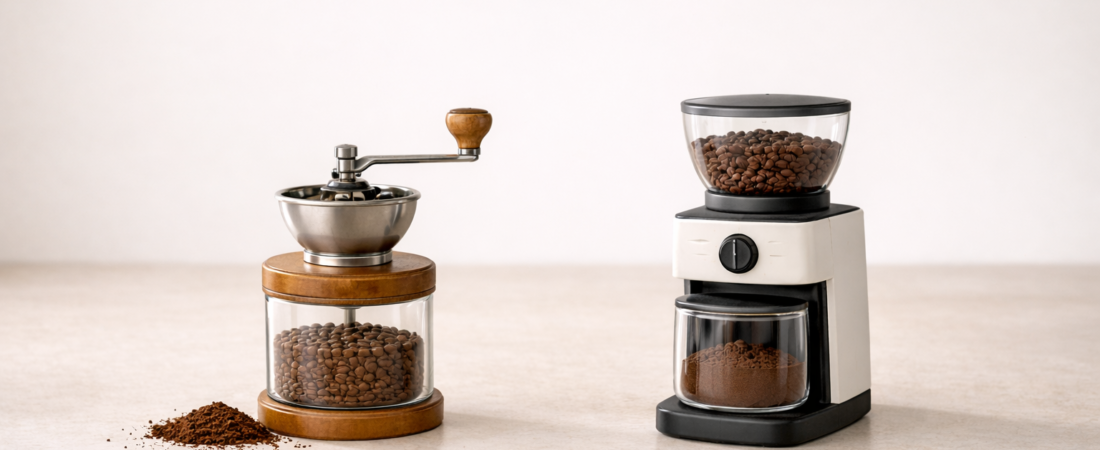
Manual vs electric coffee grinders for beginners is one of the most common decisions people face when starting to make coffee at home. If you’re choosing between a manual vs electric coffee grinder as a beginner, it’s easy to feel stuck.
Some guides insist hand grinders are slow and impractical.
Others jump straight to electric grinders that feel expensive or unnecessary.
And suddenly it feels like choosing the wrong grinder could waste money or make coffee harder than it needs to be.
The reality is simpler.
Both manual and electric coffee grinders can make great coffee at home. The right choice depends on how you brew, how often you make coffee, and how much effort you want to put in day to day.
This guide explains the real differences between manual and electric coffee grinders for beginners — so you can decide calmly, without overthinking or overspending.
The Real Difference (What Actually Matters)
The difference between manual and electric grinders is not about coffee quality first.
It’s about effort vs convenience.
- Manual grinders trade speed for control and value
- Electric grinders trade money for ease and time savings
Both can produce consistent grounds.
Neither is automatically better for beginners.
Manual Coffee Grinders — A Beginner’s Perspective
Manual grinders use a hand crank to grind coffee through burrs.
Why many beginners start with manual grinders
- Excellent grind consistency for the price
- Quiet and compact
- Simple to use and easy to understand
- Encourages learning grind size and brewing basics
Best suited for:
- 1–2 cups at a time
- Pour-over, AeroPress, French press (If you mainly brew with AeroPress, this beginner guide to AeroPress coffee grinders explains which manual and electric options work best for that method)
- People who don’t mind a short hands-on step
Trade-offs to be aware of:
- Grinding takes around 30–90 seconds
- Requires physical effort
- Not ideal for large batches
A common beginner surprise is that a good manual grinder often outperforms cheap electric grinders at the same price point. If you want to see beginner-friendly grinder options that work well for non-espresso brewing, this guide to best coffee grinders for beginners breaks it down clearly.
If this sounds like your style, this guide to the best manual coffee grinders for beginners walks through reliable, beginner-friendly options and what to look for.
Electric Coffee Grinders — A Beginner’s Perspective
Electric grinders use a motor to grind coffee automatically.
Why beginners choose electric grinders
- Faster and more convenient
- Better for daily routines
- Easier when brewing multiple cups
- No physical effort required
Best suited for:
- Daily coffee drinkers
- Shared households
- Drip machines and batch brewing
Trade-offs to consider:
- Good electric grinders cost more
- Very cheap models often grind unevenly
- Take up more counter space
For beginners, electric burr grinders designed for filter coffee are the safest choice. Espresso-focused grinders usually add cost and complexity without benefit early on.
If convenience matters most, this guide to the best electric coffee grinders for beginners explains which models suit daily brewing without adding unnecessary complexity.
Manual vs Electric Coffee Grinders for Beginners: Which Should You Choose?
Many beginners also start by setting a budget before choosing between manual and electric. If you’re trying to keep costs down, this guide to the best coffee grinders under $100 for beginners shows which manual and electric options make sense at that price point.
Use this simple decision guide:
Choose a manual grinder if:
- You brew 1–2 cups at a time
- You value quiet and portability
- You want strong performance on a budget
- You’re happy with a short hands-on routine
Choose an electric grinder if:
- You brew coffee every day
- You make multiple cups at once
- You want speed and ease
- You’re comfortable spending more for convenience
Many beginners start with manual grinders and move to electric later — once their routine is established.
There’s no wrong starting point. If you want specific recommendations, the manual grinder guide and electric grinder guide below break things down by budget and brewing style.
What About Coffee Quality?
Both manual and electric grinders can produce good coffee if the grind is consistent.
For beginners, grind consistency matters far more than brand, speed, or price.
Uneven grinding is one of the most common reasons coffee tastes:
- bitter
- sour
- harsh
- unbalanced
If grind size feels unfamiliar, this guide explains it clearly: Why Grind Size Matters (Beginner Explanation)
A Calm Recommendation for Beginners
If you’re unsure and want a low-stress choice:
- Start with manual if you want value and learning
- Start with electric if convenience fits your routine better
Both options can lead to excellent coffee.
What matters most is choosing a grinder that matches how you actually make coffee, not how you think you should make it.
A Final Reminder
You don’t need the perfect grinder to start.
A reasonable grinder will help you:
- understand grind size
- improve consistency
- build confidence
You can always upgrade later — once you know why you’re upgrading
What’s Next?
Once you’ve decided between manual and electric, the next step is choosing a beginner-friendly model that fits your budget.
👉 Best Coffee Grinders for Beginners (No Espresso)
👉 Best Beginner Coffee Grinders Under $150
These guides narrow your options to safe, beginner-tested picks — without unnecessary upgrades or pressure.