How long do coffee beans stay fresh? It’s one of the most common — and most confusing — questions beginners ask.
“How long do coffee beans actually stay fresh?”
You’ll hear all kinds of answers:
- “Only a few days”
- “Exactly two weeks”
- “They’re stale as soon as you open the bag”
- “Just freeze them and they last forever”
It’s no surprise beginners feel confused — and pressured — about getting this “right”.
Here’s the reassuring truth:
Coffee beans don’t suddenly go bad.
They gradually lose freshness over time, and how much that matters depends on how you brew and what you enjoy.
As a general rule, whole coffee beans stay fresh for several weeks when stored properly, with flavour fading gradually rather than disappearing overnight.
This guide explains what “fresh” really means, how long coffee beans stay good in real life, and how much you actually need to worry as a beginner.
What “fresh coffee” really means
When people talk about coffee beans being “fresh”, they’re usually talking about aroma and flavour, not safety.
Coffee beans don’t spoil the way milk does.
Instead, they slowly lose:
- aroma
- brightness
- complexity
This happens because roasted coffee releases gases and reacts with air over time — a normal process called degassing and oxidation.
So freshness isn’t a switch that flips from “good” to “bad”.
It’s a gradual fade.
How long coffee beans stay fresh (realistic timelines)
Instead of exact dates, it helps to think in ranges.
Whole coffee beans (unopened)
If kept sealed in their original bag:
- Best flavour: first few weeks after roasting
- Still enjoyable: for several weeks after that
Most beginners won’t notice a dramatic drop-off immediately.
Whole coffee beans (opened)
Once you open the bag and expose the beans to air:
- Best flavour: roughly the first 1–3 weeks
- Still fine for everyday home coffee: longer than many people expect
For beginners making coffee at home, beans rarely become “undrinkable” — they just become a bit flatter over time.
Ground coffee
Ground coffee loses freshness much faster because more surface area is exposed to air.
- Best flavour: within days of grinding
- Still usable: beyond that, but with less aroma
This is why grinding fresh is recommended — not because pre-ground coffee is bad, but because flavour fades faster.
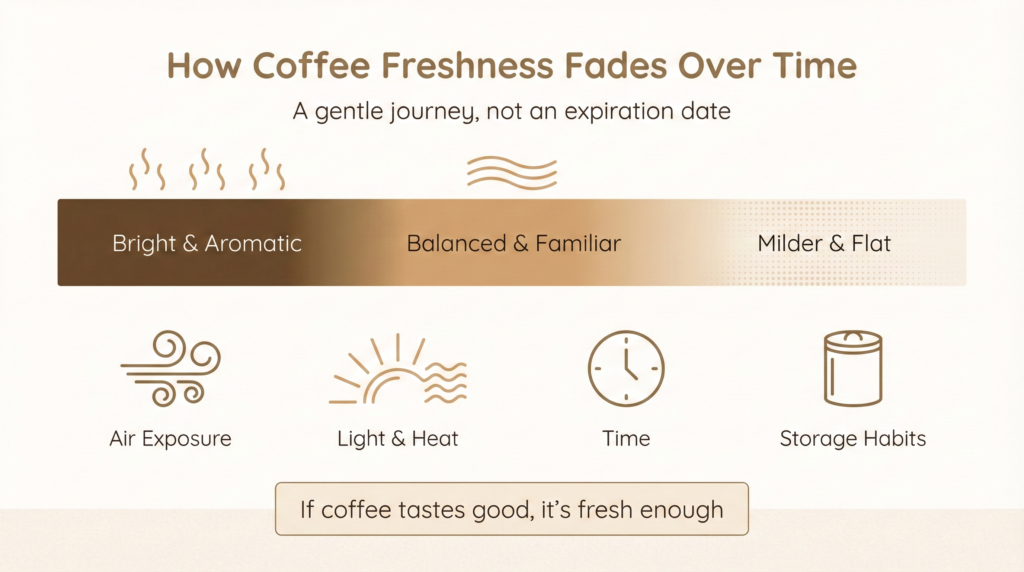
Freshness fades gradually — not suddenly.
What affects how long coffee stays fresh
Several factors influence how quickly beans lose freshness.
Air exposure
Air is the biggest factor.
The more often beans are exposed to air, the faster they lose aroma.
This is why resealing the bag or using an airtight container helps — not because beans go “bad”, but because it slows the process.
Light and heat
Light and heat accelerate flavour loss.
Keeping beans:
- away from direct sunlight
- away from heat sources
helps them stay enjoyable longer.
Time (inevitably)
Even with perfect storage, time still matters.
Freshness slowly fades — but that doesn’t mean your coffee suddenly becomes unpleasant.
The beginner mistake: worrying too much about exact timing
Many beginners think there’s a strict rule like:
“If my beans are older than X days, I’m doing it wrong.”
That kind of thinking creates unnecessary pressure.
In reality:
- most home brewers aren’t chasing tiny flavour differences
- consistency matters more than perfection
- enjoying your coffee matters most of all
The same thinking applies to measuring coffee — precision tools can help with consistency, but they aren’t required for good results at home. This guide explains whether you actually need a coffee scale as a beginner, and when it makes sense to use one.
If your coffee tastes good to you, it is good — regardless of the calendar.
Many flavour issues beginners blame on “old beans” are actually caused by grind size. This grind size troubleshooting guide explains the most common signs and fixes.
Do beginners need to chase ultra-fresh coffee?
For most beginners, the honest answer is no.
Ultra-fresh beans:
- can be harder to brew consistently
- sometimes taste sharp or uneven early on
- require more adjustment
For someone still learning, coffee that’s reasonably fresh and easy to brew often produces better results.
How to tell if coffee is past its best
Instead of tracking dates obsessively, it helps to pay attention to a few simple signs:
- a flatter or dull aroma
- noticeably weaker flavour than before
- little aroma released during brewing
Coffee that tastes harsh or overpowering is often blamed on bean freshness, but brewing issues are usually responsible. This guide on why coffee tastes too strong explains the most common causes in more detail.
If several of the signs above are present, the beans are likely past their peak — but still safe to drink.
And if the coffee still tastes good, there’s no problem to fix.
Simple storage tips (no special gear required)
You don’t need expensive containers or complicated systems.
For beginners, this is enough:
- Keep beans in their original bag if it reseals well
- Store them somewhere cool, dry, and out of light
- Avoid leaving the bag open unnecessarily
That alone handles most freshness concerns.
What this means in practice
Here’s the takeaway most beginners find helpful:
- Buy amounts that can be used within a few weeks
- Don’t stress about exact roast dates
- Focus on enjoying the coffee that’s already there
Freshness matters — but not enough to cause anxiety.
Choosing beans that are enjoyable matters more than chasing perfect freshness. This guide to coffee beans for beginners focuses on flavour, not rules.
FAQs
Can coffee beans go bad?
They don’t spoil easily, but they lose flavour over time.
Is it unsafe to drink older coffee?
No — older beans are usually safe, just less aromatic.
Should I throw beans away after a certain time?
Only if you no longer enjoy the taste.
Is freshness more important than grind size or brewing?
Not usually — grind size, consistency, and enjoyment usually matter more for beginners.
The calm perspective
Coffee culture often makes freshness sound fragile and unforgiving.
In reality, coffee is far more forgiving than it’s made out to be.
Good beans, stored sensibly, stay enjoyable long enough for normal home use — especially for beginners who are still discovering what they like.
You don’t need perfect timing.
You just need coffee that tastes good to you.