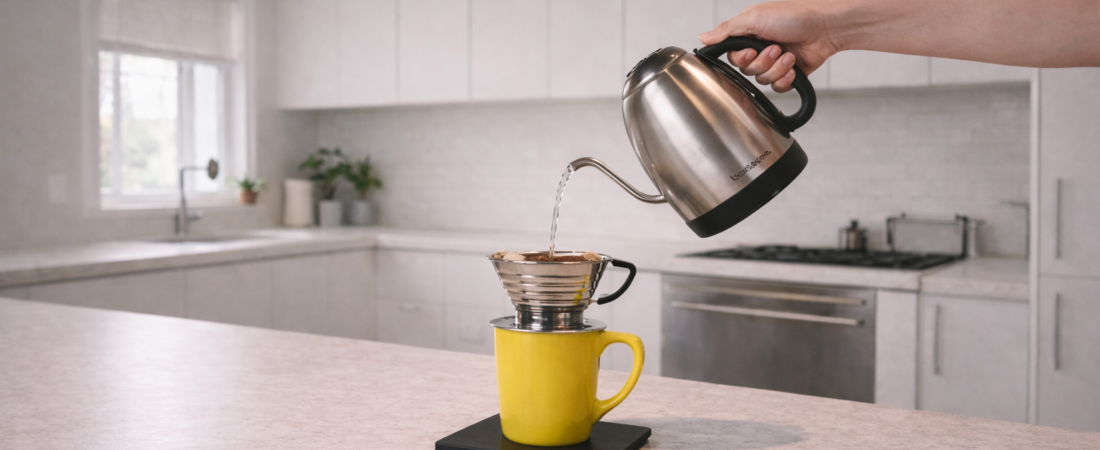
Do you need a gooseneck kettle to make good coffee at home?
If you’ve spent any time looking into home brewing, you’ve probably seen them everywhere. Long, elegant spouts. Clean, minimalist designs. They look precise — like something you’re supposed to own if you’re “serious” about coffee.
So it’s completely normal to wonder whether you actually need one, or whether it’s just another accessory that looks impressive but isn’t essential.
Here’s the honest answer.
Most beginners do not need a gooseneck kettle to make good coffee at home. In certain situations it can help — but it’s far from a requirement.
Let’s break it down calmly.
Do You Need a Gooseneck Kettle? The Short Answer
You don’t need a gooseneck kettle to make good coffee, and it won’t magically improve flavour. What it can do is make certain brewing methods easier and more consistent.
If your current setup works and your coffee tastes good, there’s no urgency to change anything.
That’s the starting point.
What a Gooseneck Kettle Actually Does
A gooseneck kettle doesn’t make water hotter, cleaner, or “better.” The difference is entirely in how the water pours.
Most regular kettles release water in a heavier, faster stream. That’s perfectly fine for many brewing methods. But if you’re trying to pour slowly and evenly over coffee grounds, that flow can feel difficult to control.
A gooseneck kettle has a long, narrow spout that produces a thinner, steadier stream. It gives you more control over:
- How fast you pour
- Where the water lands
- How evenly the grounds are saturated
That kind of control matters most for pour-over brewing. For immersion methods like French press, it makes very little difference.
When a Gooseneck Kettle Makes Sense
It’s worth considering one if a few things are true for you.
First, you brew pour-over regularly. If you use something like the Hario V60, Chemex, or Kalita Wave, pouring technique plays a bigger role. Uneven pouring can lead to uneven extraction, and a gooseneck kettle makes controlled pouring easier.
Still deciding which brewing method fits your routine? A comparison of beginner coffee brewing methods can make the differences clearer.
Second, you genuinely enjoy the brewing ritual. Some people like slowing down and being precise. Others just want coffee quickly before work. There’s nothing wrong with either approach — but a gooseneck kettle suits the first group better.
Third, you care about repeatability. If you’re trying to dial in a recipe and want to get similar results each time, better pouring control can help. It’s a small refinement, not a dramatic upgrade, but it can make things feel more consistent.
When You Can Comfortably Skip It
For many beginners, skipping a gooseneck kettle is completely fine.
Drip coffee makers already control water flow internally, so switching kettles won’t meaningfully change the outcome. And with French press or other immersion methods, once the water is added, extraction happens evenly on its own — pouring precision simply doesn’t play a major role.
Those exploring immersion brewing in more detail can see how it works in this beginner guide to choosing a French press.
Busy mornings are another good reason to keep things simple. When speed and ease matter more than ritual, a standard kettle is often the more practical choice.
It’s also worth remembering that the biggest improvements usually come from the basics — better beans, a more consistent grinder, and getting the coffee-to-water ratio right. Those upgrades have a far greater impact on flavour than changing kettles. For a clearer sense of what truly moves the needle, this breakdown of what coffee equipment actually improves flavour explains the priority order.
A Common Beginner Assumption
It’s easy to assume that buying a gooseneck kettle will automatically make coffee taste better. The design looks precise, and it’s often shown in carefully crafted pour-over videos, so it feels like an upgrade that must improve flavour.
In reality, what it improves is control — not the coffee itself. A gooseneck kettle helps you pour more slowly and evenly, which can make brewing feel calmer and more consistent. But it won’t fix beans that don’t suit your taste, make up for an inconsistent grinder, or turn a brewing method into something that fits your routine better.
It’s best thought of as a refinement tool. Helpful in the right context, but not a shortcut to better flavour.
Regular Kettle vs Gooseneck Kettle
A regular kettle is faster, more versatile, and already sitting in most kitchens. For many beginner brewing methods, it works perfectly well. It boils water, pours water, and doesn’t complicate the routine.
A gooseneck kettle, on the other hand, pours more slowly and with greater control. That precision is especially helpful for pour-over brewing, where even water distribution affects extraction. Outside of that context, the difference is far less noticeable.
Neither option is objectively “better.” They’re simply designed for different styles of brewing and different priorities.
Electric vs Stovetop (If You Decide to Get One)
If a gooseneck kettle feels like a good addition to your setup, the next decision is usually whether to choose an electric or stovetop model.
Electric versions are designed for convenience. Many include built-in temperature control, which can be helpful for those who like to fine-tune brewing recipes or repeat the same settings each time. A practical, beginner-friendly example is the Bonavita 1L Digital Variable Temperature Kettle, built to provide steady, controlled pouring with reliable temperature adjustment and minimal guesswork.
Stovetop models take a simpler approach. They focus purely on pour control without added electronics and are often more affordable. The Hario Buono Stovetop Kettle is a well-known example, appreciated for its straightforward design and consistent flow control.
Neither option is inherently better. Electric models prioritise convenience and precision, while stovetop kettles emphasise simplicity. The right choice depends on how much control you want built into the kettle itself — and how streamlined you prefer your brewing routine to be.
A Simple Way to Decide
Ask yourself:
“Would more control over how I pour water actually improve my daily coffee?”
That’s really what a gooseneck kettle offers — more control and consistency.
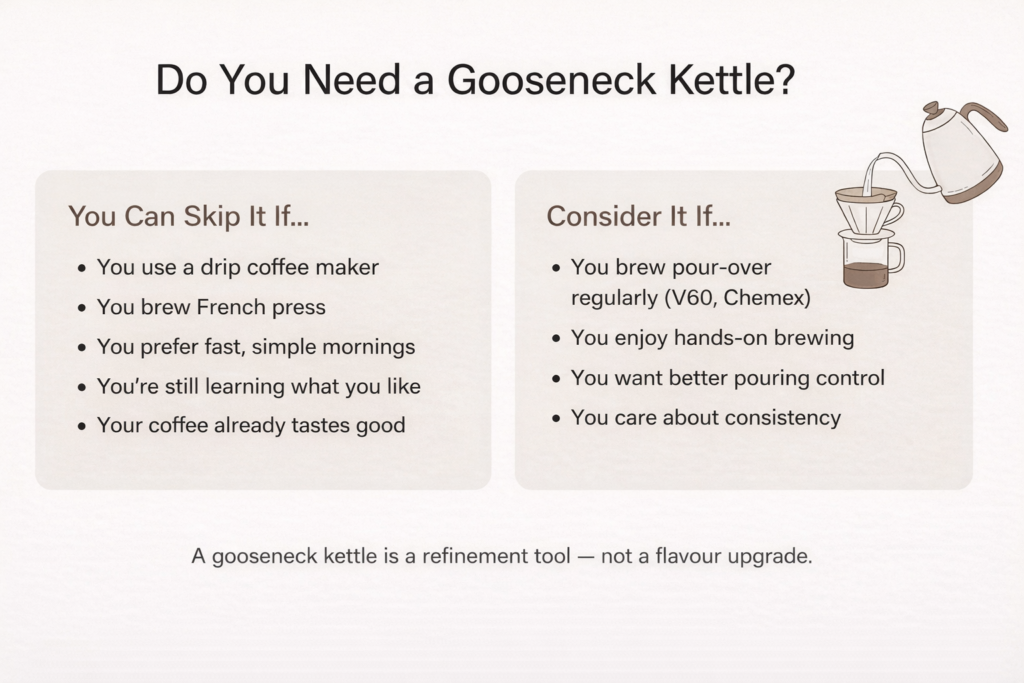
A gooseneck kettle is a refinement tool — not a flavour shortcut.
If the answer is no, it can confidently be skipped. Plenty of people make excellent coffee without one.
If the answer is yes — especially for regular pour-over brewing — then it may be worth considering.
That’s really all it comes down to.
Where It Fits in a Beginner Setup
A simple beginner coffee setup doesn’t need to be complicated.
At its core, it usually includes beans you genuinely enjoy, a brewing method that fits your daily routine, a grinder that produces consistent results, and a regular kettle. Those elements have the biggest impact on how your coffee tastes and how repeatable your results are.
A gooseneck kettle sits one level higher. It doesn’t change the fundamentals — it simply refines control once the basics are already working well. For most beginners, it’s an optional upgrade rather than a starting requirement.
Another piece of equipment that often raises similar questions is the coffee scale. If you’re still deciding whether one is necessary, this guide on Do You Need a Coffee Scale as a Beginner? explains when it actually makes sense to add one.
FAQs
Here are a few quick answers to common beginner questions.
Will a gooseneck kettle make my coffee taste better?
Not directly. A gooseneck kettle improves pouring control, which can help with consistency in pour-over brewing. But flavour is influenced far more by bean quality, grind consistency, and freshness. The kettle refines technique — it doesn’t replace the fundamentals.
Can I make pour-over without one?
Yes. Many people start with a regular kettle and make excellent pour-over coffee. A gooseneck simply makes the pouring process easier to control, especially when aiming for consistency. It’s helpful, but not essential.
Is a gooseneck kettle more important than better beans?
No. Beans matter far more. Fresh, well-sourced coffee will improve flavour much more noticeably than switching kettles. If improving taste is the priority, this article on How to Choose Coffee Beans Without Overthinking is a better place to start.