Coffee equipment that improves flavour isn’t always the equipment people assume.
If you’re making coffee at home and want it to taste better, it’s natural to start looking at upgrades.
Better grinders.
More precise kettles.
Nicer brewers.
Extra accessories.
But here’s the part beginners are rarely told clearly:
Not all coffee equipment improves flavour — even if it costs hundreds.
Some tools genuinely make a noticeable difference.
Others mainly improve convenience, consistency, or aesthetics.
This guide explains what equipment actually improves flavour, what helps indirectly, and what usually doesn’t matter for beginners — so you can upgrade with confidence instead of guesswork.
Coffee equipment that improves flavour vs consistency
Before we talk about specific equipment, it helps to separate two ideas:
- Flavour quality → how the coffee actually tastes
- Consistency → how repeatable that taste is
Some equipment improves flavour directly.
Some equipment improves consistency, which supports better flavour over time.
They’re not the same thing — and confusing them leads to unnecessary purchases.
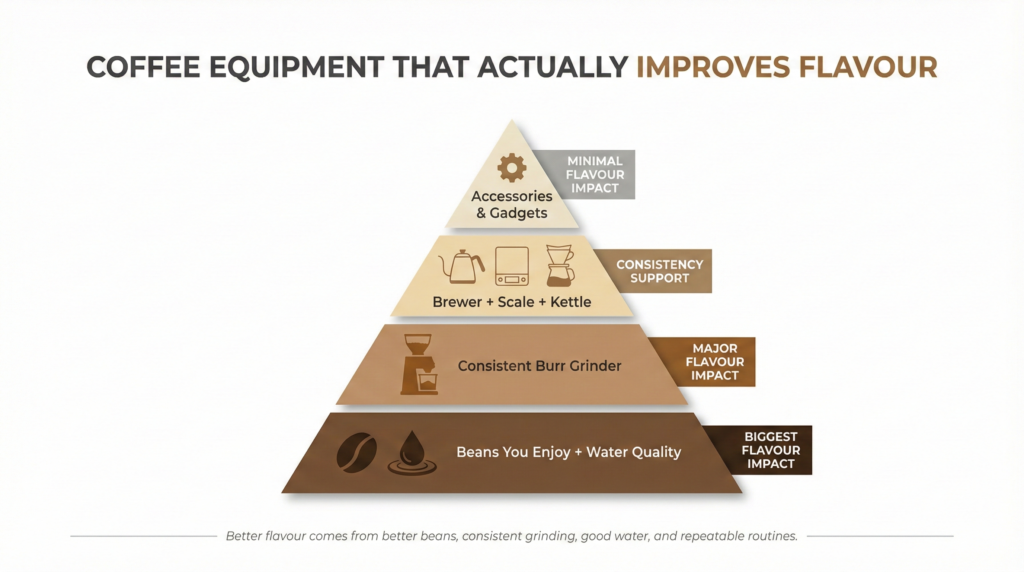
The equipment that improves flavour the most (in order)
For most beginners, these upgrades create the biggest improvement.
1️⃣ Coffee beans you actually enjoy
This is always the biggest lever — because beans determine the flavour profile before brewing even begins.
No piece of equipment can:
- remove bitterness you dislike
- turn flavours you don’t enjoy into ones you love
- override the character of the beans
If your coffee tastes unpleasant even on “good” days, the issue is usually the beans — not the gear.
A common beginner mistake is buying a better brewer or grinder while still using beans they don’t actually like.
For example, if you dislike very dark roasted smoky coffee, no amount of expensive equipment will magically turn it into sweet, fruity café-style coffee.
Finding beans that suit your taste is the most reliable way to improve flavour.
Not sure what beans to buy? Here’s a beginner-friendly guide to choosing coffee beans without overthinking.
2️⃣ A consistent grinder (not a fancy grinder)
After beans, grind consistency is the next biggest factor.
Uneven grinding leads to uneven extraction:
- some grounds over-extract (bitter and harsh)
- others under-extract (sour or weak)
This is why grinder upgrades often feel more “dramatic” than brewer upgrades.
A grinder that produces consistent particles improves flavour more than:
- upgrading your brewer
- adding accessories
- chasing precision tools
- buying expensive “upgrades” too early
Burr grinder vs blade grinder (why it matters)
If you’re using a blade grinder, your grind size will usually be inconsistent. That inconsistency makes it difficult to brew clean, balanced coffee — even with good beans.
A basic burr grinder gives you:
- more consistent grind size
- more control over brewing
- fewer harsh flavours
- better repeatability
You don’t need the most expensive grinder.
But you do want one that produces a consistent grind for your brewing method.
For most beginners, upgrading from a blade grinder to a decent burr grinder is one of the clearest “wow” improvements you can make.
If you want the full comparison, see this guide on blade grinder vs burr grinder for beginners.
3️⃣ Water quality (often ignored, but surprisingly important)
This one is easy to overlook, but it matters.
Coffee is mostly water — so the taste of your tap water shows up in the cup.
your coffee will taste harsh, metallic, overly chlorinated, or flat.
You don’t need to become a water chemistry expert, but if your water tastes unpleasant on its own, it’s worth testing:
- filtered water (jug filter is fine)
- bottled water (even just as a test)
- your local water quality report
For some people, improving water quality creates a bigger flavour improvement than upgrading any equipment.
Once your water tastes clean, the next big improvement is getting your coffee-to-water ratio right — this beginner water ratio guide makes it simple.
4️⃣ A brewing method you can repeat calmly
Flavour improves when your routine is repeatable.
That usually means:
- a method that fits your mornings
- a process you don’t rush
- equipment that doesn’t frustrate you
- a setup that feels “easy to do well”
If a brewer feels fiddly or stressful, flavour often suffers — not because the method is bad, but because consistency breaks down.
A “simple” method you can repeat daily often beats an advanced method you only get right once a week.
A real-world example (why this matters)
Let’s say you buy a pour-over dripper because everyone online says it’s the best.
But every morning you’re:
- rushing the pour
- forgetting your ratio
- guessing grind size
- brewing differently each time
Some days it tastes great.
Other days it tastes sour or bitter.
In that situation, a beginner-friendly brewer like an AeroPress, Clever Dripper, or French Press might taste better simply because it’s easier to repeat.
The best brewer is the one you can use consistently without stress.
If you’re not sure which one suits you, this guide compares the most beginner-friendly options: Beginner Coffee Brewing Methods Compared.
Quick summary: what improves flavour vs consistency?
Here’s the simplest way to think about coffee upgrades.
| Upgrade | Improves Flavour Directly? | Improves Consistency? | Worth it for Beginners? |
|---|---|---|---|
| Better beans | ✅ Huge | ✅ Yes | ✅ Yes |
| Burr grinder | ✅ Huge | ✅ Yes | ✅ Yes |
| Better water | ✅ Big | ✅ Yes | ✅ Yes |
| Coffee scale | ❌ Not directly | ✅ Yes | ✅ Yes |
| Gooseneck kettle | ❌ Not directly | ✅ Sometimes | ⚠️ Depends |
| Better brewer | ⚠️ Sometimes | ⚠️ Sometimes | ⚠️ Later |
| Fancy accessories | ❌ Usually no | ❌ Usually no | ❌ Not yet |
| Espresso gadgets | ⚠️ Sometimes | ⚠️ Yes | ❌ Not for most beginners |
This table alone can save beginners hundreds of dollars.
Equipment that improves consistency (indirect flavour support)
These tools don’t automatically make coffee taste better.
But they help you repeat good results, which is what most beginners actually need.
Coffee scales
A scale helps you:
- use similar coffee-to-water ratios each time
- adjust recipes in small, controlled steps
- stop guessing your dose
- troubleshoot flavour issues more clearly
It doesn’t add flavour magic.
It adds repeatability.
And repeatability is what turns “sometimes good coffee” into “good coffee most days.”
Not sure if a scale is necessary? Here’s a simple guide on whether you need a coffee scale as a beginner.
Gooseneck kettles
A gooseneck kettle gives you more control over pouring, which is useful for:
- V60
- Chemex
- Kalita Wave
- other pour-over brewers
It doesn’t improve flavour by itself, but it can reduce variability if your brewing method benefits from controlled pouring.
If you don’t brew pour-over often, you probably don’t need one yet.
This guide breaks down whether a gooseneck kettle is actually worth buying.
Better brewers (sometimes)
Upgrading a brewer can help if:
- your current brewer is inconsistent
- it produces uneven results
- it doesn’t suit your routine
- it’s difficult to clean or frustrating to use
But changing brewers without addressing beans, water, or grind quality often leads to disappointment.
A new brewer can improve the experience…
but it won’t fix the fundamentals.
A simple beginner setup that works (without overspending)
If you’re not sure what equipment combination makes sense, here are a few beginner setups that consistently produce good coffee.
These aren’t “perfect” setups — they’re realistic, repeatable setups.
Setup 1: The simplest “good coffee” upgrade
Best for: busy mornings, low effort, reliable results
- Fresh beans you enjoy
- Basic burr grinder
- French Press or Clever Dripper
- Kitchen scale (optional but helpful)
This setup gives strong flavour improvements with minimal technique.
Setup 2: The “clean flavour” setup (pour-over style)
Best for: lighter roasts, clearer taste, café-style coffee
- Fresh beans you enjoy
- Burr grinder with consistent grind size
- V60 / Kalita / Chemex-style dripper
- Gooseneck kettle (helpful but not mandatory)
- Scale (strongly recommended)
Pour-over can taste amazing, but consistency matters more.
Setup 3: The most forgiving beginner setup
Best for: beginners who want control without stress
- Fresh beans you enjoy
- Burr grinder
- AeroPress
- Scale (optional)
The AeroPress is forgiving, easy to repeat, and makes excellent coffee even with imperfect technique.
Setup 4: Espresso (only if you love espresso)
Best for: people who want espresso specifically
- Fresh beans (espresso-focused roasts)
- Espresso-capable burr grinder
- Espresso machine with stable temperature
- Patience (seriously)
Espresso is rewarding, but it’s the most expensive and technique-dependent path.
If espresso is your goal, it’s usually worth investing in the grinder first.
Equipment that improves experience (not flavour)
These upgrades make coffee more enjoyable, but they don’t usually change extraction.
- nicer mugs or glassware
- insulated travel cups
- carafes and servers
- coffee storage containers
- aesthetic tools and accessories
- cleaning brushes and rinse tools
- dosing cups and funnels
These can absolutely be worth it.
But it’s important to understand what you’re buying them for:
comfort, convenience, and enjoyment — not flavour.
And honestly, enjoyment still matters.
Coffee is a daily ritual, not a science project.
Equipment that rarely improves flavour for beginners
This is where many people overspend.
Advanced espresso tools
Espresso has a steep learning curve.
Precision tampers, distribution tools, puck screens, bottomless portafilters, specialty baskets…
These can matter later for experienced espresso hobbyists.
But for beginners, they often create:
- extra complexity
- extra cost
- extra confusion
Most beginners would get a bigger improvement by:
- using fresher beans
- dialling in grind size
- using better water
- practising consistent technique
Extreme precision gadgets
Ultra-precise scales, advanced temperature controllers, refractometers, brewing apps…
These are designed for enthusiasts.
They rarely solve beginner flavour problems, because beginner problems usually aren’t “precision” problems.
They’re usually:
- beans that don’t suit your taste
- stale coffee
- grind inconsistency
- incorrect ratio
- inconsistent brewing routine
Buying “the next upgrade” too soon
Many people fall into the trap of upgrading before they understand why.
This often leads to:
- minimal improvement
- confusion
- frustration
- wasted money
A new brewer feels exciting, but if the coffee still tastes bitter or sour, you’re back where you started.
Why beginners often upgrade the wrong thing
Most beginners follow this pattern:
- Coffee doesn’t taste great
- They assume gear is the problem
- They buy something new
- Flavour barely changes
- They assume they need even more gear
The missing step is diagnosis.
Without knowing whether the issue is:
- beans
- grind
- water
- consistency
- routine
Upgrades become guesswork.
A simple way to diagnose flavour problems
Instead of asking “what should I buy?”, ask these questions:
Do I like the flavour when it turns out well?
- No → beans are the priority
- Yes → consistency is the issue
If you dislike the flavour even on good days, buying gear won’t fix it.
Does my coffee taste different every day?
- Yes → grind consistency or routine
- No → your setup is probably fine
If you get wildly different results each day, your equipment might not be the problem — your repeatability is.
Does brewing feel stressful or fiddly?
- Yes → simplify before upgrading
- No → upgrades will be easier to evaluate
If the process feels stressful, it’s harder to build good habits.
Does my water taste good on its own?
- No → water may be holding your coffee back
- Yes → focus on beans + grind + routine
Many people spend money upgrading brewers while their water is still ruining the cup.
These questions point to the right solution more reliably than product research.
A calm upgrade order that actually works
For most beginners, this order produces the clearest improvements:
- Find beans you enjoy
- Stabilise grind consistency (burr grinder > blade grinder)
- Improve water quality if needed
- Choose a brewing method you can repeat
- Add tools that support consistency (scale, kettle if needed)
- Upgrade for comfort or enjoyment last
Each step builds on the previous one.
And most importantly:
each upgrade solves a real problem.
For a simple next step, here’s a beginner coffee setup checklist you can follow.
What this means in practice
You don’t need to chase equipment that:
- looks impressive
- is popular online
- promises dramatic improvements
Flavour improves when:
- your choices align with your taste
- your grind size is consistent
- your water supports extraction
- your routine is repeatable
Everything else is optional.
The calm recommendation
If flavour is your goal, focus less on buying and more on understanding.
Most meaningful improvements come from:
- better bean choices
- consistent grinding (a burr grinder matters more than most brewers)
- decent water
- calm, repeatable routines
Equipment should support those — not distract from them.
Good coffee doesn’t come from owning more tools.
It comes from making clearer decisions.
FAQs
What’s the single best equipment upgrade for flavour?
For most beginners, the best upgrade is either better beans or a more consistent burr grinder.
Does a better grinder matter more than a better coffee machine?
For most beginners, yes. A consistent grinder often improves flavour more than upgrading your brewer.
Does upgrading my brewer improve taste?
Sometimes — but only if the brewer is limiting consistency or doesn’t suit your routine.
If your beans and grind quality are poor, a new brewer usually won’t solve the problem.
Can a coffee scale really improve flavour?
A coffee scale improves consistency, not flavour directly.
But consistency helps you repeat good results and make controlled adjustments, which improves flavour over time.
Do expensive kettles improve coffee taste?
Not directly. A gooseneck kettle mainly improves pour control for pour-over brewing, which can reduce inconsistency.
Is expensive equipment worth it?
Only when it solves a specific problem you already understand.
If you’re still figuring out beans, grind size, or ratios, expensive upgrades often feel disappointing.
What’s the best upgrade if my coffee tastes bitter?
Bitterness is often caused by over-extraction, grind too fine, or beans that are roasted darker than your taste preference.
Start with beans, grind size, and water.
For a simple breakdown of the most common causes (and fixes), see this guide on why coffee tastes bitter.
What’s the best upgrade if my coffee tastes sour?
Sour coffee is often caused by under-extraction — grind too coarse, brewing too fast, or using too little coffee.
Start with grind size, ratio, and brew time.
This guide explains why coffee tastes sour and how to fix it step by step.
Should beginners avoid upgrades altogether?
No — just upgrade intentionally, one step at a time.
The best upgrades are the ones that solve problems you can clearly identify.