How Much Coffee to Use (Without Overthinking It)
Getting the coffee-to-water ratio right is one of the simplest ways to improve how your coffee tastes — but it’s also one of the most confusing topics for beginners.
You’ll often see ratios written as numbers and formulas, which can make brewing feel more complicated than it needs to be.
The truth is, you don’t need exact measurements to make good coffee at home.
This beginner water ratio guide explains how coffee ratios work in plain language, gives you simple starting points, and shows you how to adjust by taste — no calculators or precision required.
What a coffee water ratio actually means
A coffee water ratio is simply the relationship between how much coffee you use and how much water you brew with.
In simple terms:
- More coffee = stronger, bolder flavour
- Less coffee = lighter, milder flavour
There’s no single “perfect” ratio. The goal is to find a balance that tastes good to you and works with your brewing method.
Why beginners often struggle with ratios
Most beginners run into ratio problems because:
- recipes use confusing numbers
- different brew methods need different balances
- coffee strength is personal
- small changes can taste big
This leads to second-guessing — even when the coffee is actually fine.
A better approach is to start with a simple baseline and adjust slowly.
A simple starting point (no numbers required)
If you want an easy rule that works across most brew methods:
- Use one scoop or spoon of coffee per cup. This works well whether you’re using whole beans or pre-ground coffee at home.
- Adjust from there based on taste
This approach works especially well if you’re using scoops or pre-ground coffee and just want consistent results without weighing everything.
This is more than accurate enough for beginners — consistency matters far more than precision at this stage.
Once you’re comfortable, you can fine-tune based on flavour rather than measurements.
How to adjust your coffee ratio by taste
Instead of chasing exact ratios, use flavour as your guide. Understanding basic coffee flavour notes makes these adjustments much easier to recognise.
If your coffee tastes weak or watery
- Add a little more coffee
- Brew slightly longer (if possible)
If your coffee tastes bitter or harsh
- Use a little less coffee
- Check that your grind isn’t too fine
- If the flavour feels overpowering rather than balanced, this guide on why coffee tastes too strong explains the most common causes and simple fixes.
If your coffee tastes sour
- Use slightly more coffee
- Make sure your water is hot enough
Change one thing at a time so you can tell what made the difference.
Coffee ratios by brew method (beginner-friendly)
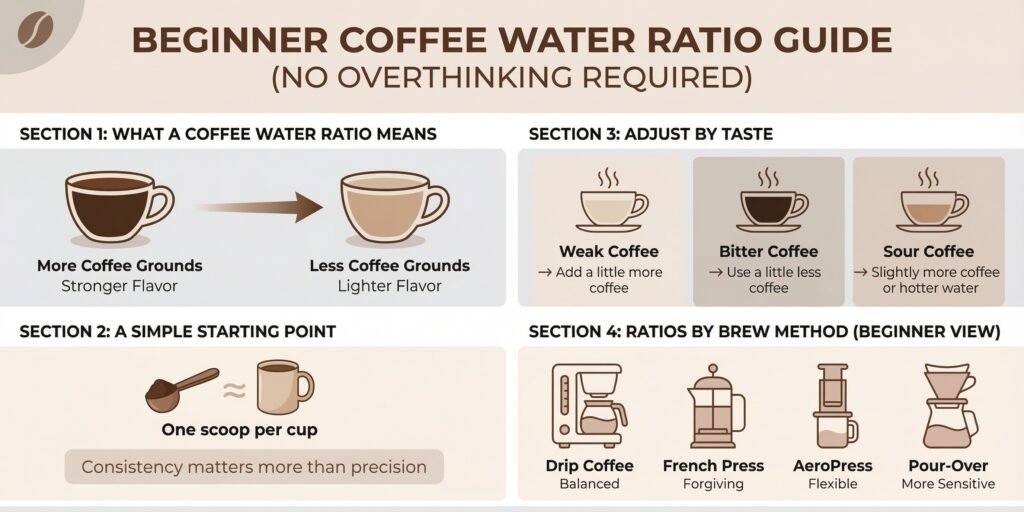
Think of these as orientation notes rather than rules — they explain why different brewing methods tend to taste different.
Different brewing methods naturally use different balances. These are simple starting points, not strict rules.
Drip coffee
Drip coffee works best with a balanced ratio that isn’t too strong or too weak.
Start with:
- a moderate amount of coffee
- enough water to brew a full cup or pot
If it tastes flat, add a bit more coffee next time. Many of these small adjustments are covered in more detail in our guide to easy drip coffee hacks.
French press
French press coffee uses immersion, which makes ratios more forgiving.
You can:
- use slightly more coffee
- adjust strength easily by taste
If your French press coffee tastes muddy or bitter, grind size usually matters more than ratio. A simple beginner French press recipe can help you dial this in before worrying about measurements.
AeroPress
AeroPress is flexible and forgiving.
You can:
- make stronger, more concentrated coffee
- dilute slightly with water if needed
This makes it ideal for experimenting without ruining a brew. Many people start with a beginner AeroPress recipe and adjust ratios later.
Pour-over
Pour-over methods are more sensitive to ratios and technique.
If you’re new:
- start with a balanced amount of coffee
- avoid chasing precision early on
Consistency matters more than exact numbers.
Do you need a scale to measure coffee ratios?
No — not when you’re starting.
A scale can help later if you enjoy experimenting, but it’s not required to make good coffee at home.
Many experienced home brewers still rely on scoops once they know what tastes right to them.
If your coffee tastes good, your ratio is good.
Common beginner mistakes with coffee ratios
- changing too many things at once
- assuming bitterness always means “too much coffee”
- chasing exact recipes instead of taste
- comparing home coffee to café coffee
Remember: café coffee is designed differently. Home coffee should taste right for you.
Final thoughts on coffee water ratios
Coffee ratios don’t need to be precise to be effective.
Start simple. Taste your coffee. Adjust slowly.
Once you understand how coffee and water interact, ratios stop feeling like rules — and start feeling like tools.
This guide is your reference point. You can come back to it whenever a brew tastes off, no matter which method you’re using.