Coffee gear beginners don’t need can be confusing when you’re just starting out. If you’re new to making coffee at home, it can feel like there’s a lot of gear you’re supposed to own.
Scrolling through coffee videos or browsing online shops, you’ll see grinders, scales, kettles, filters, tools, and accessories — all presented as “essential.”
The truth is simpler.
You don’t need most coffee gear to start making good coffee at home. In fact, buying too much too early often makes things more confusing, not better.
This guide explains which pieces of coffee gear beginners don’t need yet, so you can focus on what actually helps — and ignore the rest for now.
Why beginners often buy too much gear
Most people don’t overbuy coffee gear because they want to show off. They overbuy because they want reassurance.
When coffee tastes inconsistent, it’s easy to assume something is missing — another tool, a better gadget, a more advanced setup. Online content doesn’t always help, because much of it is created by enthusiasts who’ve been brewing for years.
What works for experienced brewers isn’t always necessary for beginners.
At the early stage, learning a few fundamentals matters far more than adding equipment — which is why having a beginner coffee brewing gear checklist can be more helpful than buying more tools.
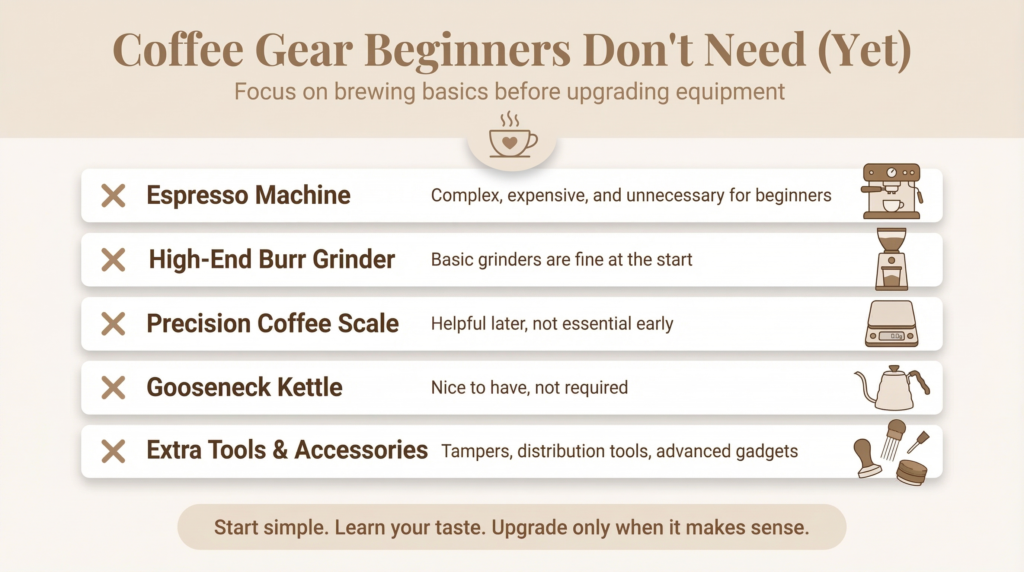
Coffee gear beginners don’t need (yet)
Precision scales with advanced features
Coffee scales can be useful, but many beginners assume they need one immediately — especially models with timers, flow rate tracking, or app connectivity.
In reality, early improvements in taste usually come from:
- using fresher coffee
- understanding grind size
- keeping your process consistent
You can do all of that without a specialised coffee scale. A simple kitchen scale — or even measuring by volume — is enough while you’re learning.
Advanced scales make more sense once you’re refining technique, not when you’re just starting.
Gooseneck kettles
Gooseneck kettles are often shown as “required” for pour-over brewing, but beginners don’t need to rush into buying one.
They help with precise pouring, but they don’t magically improve flavour on their own. Until you’re comfortable with your brew method, a regular kettle works just fine.
If you later enjoy pour-over and want more control, a gooseneck kettle becomes a nice upgrade — not a starting requirement.
Expensive grinders or pro-level machines
Seeing professional grinders and espresso machines online can make it feel like good coffee requires expensive gear.
It doesn’t.
Beginners don’t need:
- commercial-style grinders
- espresso machines with advanced settings
- café-level equipment
Those tools are designed for speed, volume, and fine control — things that matter more in cafés than at home.
At the beginning, understanding how grinding works matters more than owning the most advanced grinder — especially the difference between blade and burr grinders.
If you’re unsure whether a grinder is even necessary at this stage, this guide explains whether beginners really need one in the first place.
Multiple brew devices
Many people buy several brew methods at once — French press, pour-over, AeroPress, drip — thinking variety will help them learn faster.
Usually, it does the opposite.
Switching between methods too early makes it harder to understand what’s affecting flavour. Sticking with one method for a while helps you build confidence and consistency.
You can always explore other methods later, once the basics feel familiar.
Extra accessories and “coffee tools”
There are many small tools marketed to home brewers:
- distribution tools
- stirring needles
- specialty filters
- cleaning gadgets
- add-ons for add-ons
Most of these are designed to fine-tune an already solid process.
If you’re still learning how grind size, freshness, and brew time affect taste, these tools won’t solve the underlying issues — they just add complexity.
What actually helps at the beginner stage
Instead of focusing on gear, beginners get better results by focusing on:
- understanding grind size and why it affects flavour
- using reasonably fresh coffee
- keeping their process consistent
- learning one brew method at a time
Once those pieces are in place, upgrades become clearer — and more satisfying — because you can actually tell what difference they make.
If you want a simple reference while learning, this grind size chart shows what works for different brew methods.
Final takeaway
Good coffee doesn’t come from owning the most equipment. It comes from understanding a few simple fundamentals and giving yourself time to learn them.
If you’re just starting out, it’s okay to ignore most coffee gear recommendations for now. You’re not behind — you’re doing it the sensible way.
What’s next?
If you’re curious about what does make a noticeable difference once the basics are covered, this guide breaks it down clearly: