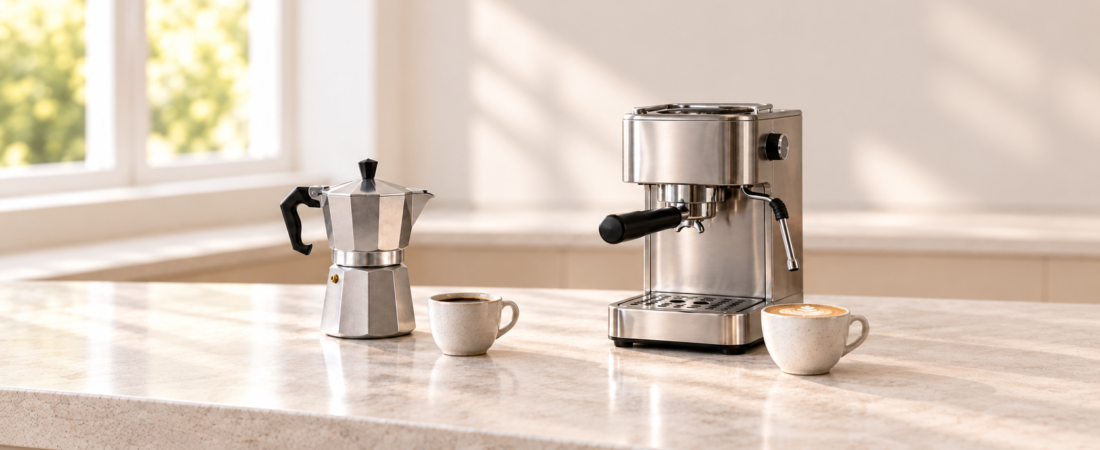
Espresso machine vs. moka pot —If you already own a moka pot and love the strong, bold coffee it makes, you might be wondering whether it’s worth stepping up to a real espresso machine. Both brew concentrated coffee, but they work in fundamentally different ways — and that difference shapes everything from taste and cost to how much counter space and patience you’ll need. This guide breaks down exactly how the two compare, so you can decide which one actually fits how you drink coffee.
Affiliate disclosure: This article contains affiliate links. If you buy through them, we may earn a small commission at no extra cost to you.
⭐ Quick Verdict
Choose a moka pot if you want rich, concentrated coffee with a small budget, minimal counter space, and a fairly simple routine.
Choose an espresso machine if you want true espresso, café-style lattes or cappuccinos, and more control — and you are comfortable paying more and spending time learning how to dial in your shots.
For most beginners who mainly drink strong black coffee, a moka pot is the better-value choice. If milk drinks or straight espresso are what you really want, an espresso machine is the better long-term buy.
👉 Check the current price of the Bialetti Moka Express 6-Cup
👉 Check the current price of the Breville Bambino Plus
👉 Check the current price of the Gaggia Classic Pro
⚠️ Before you buy: A traditional espresso machine usually needs an espresso-capable burr grinder. Include that in your budget unless you plan to use pre-ground coffee with a pressurized basket.
Espresso Machine vs. Moka Pot: A Quick Comparison
| Feature | Moka Pot | Espresso Machine |
|---|---|---|
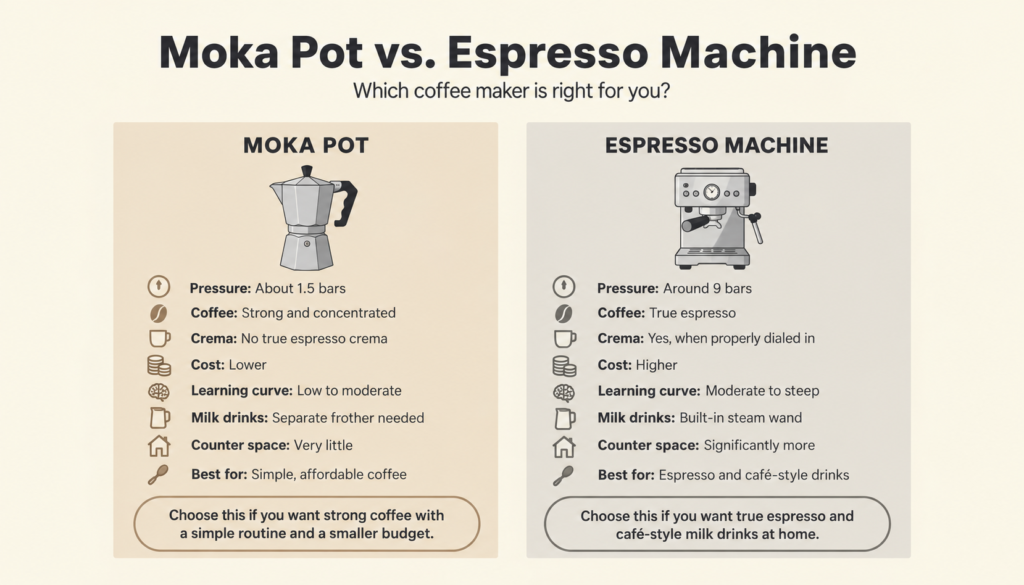
| Brewing pressure | About 1.5 bars | Commonly around 9 bars during extraction |
| Coffee produced | Strong, concentrated stovetop coffee | True espresso |
| Crema | Not true espresso crema | Possible with fresh coffee and a well-dialed-in shot |
| Typical cost | Low | Moderate to high, especially with a grinder |
| Learning curve | Low to moderate | Moderate to steep |
| Milk drinks | Possible with a separate frother | Yes, if the machine has a steam wand |
| Grinder demands | Fairly forgiving | Much more demanding |
| Daily cleanup | Rinse the parts once cool | Purge and wipe the wand; rinse the portafilter and basket |
| Counter space | Very little | Significantly more |
| Best for | Affordable, strong coffee | Espresso and café-style milk drinks |
The Main Difference Is Pressure
A moka pot and an espresso machine both make concentrated coffee, but they use very different levels of pressure.
A moka pot heats water in its lower chamber. As pressure builds, the water is pushed through the coffee and into the upper chamber. A standard moka pot operates at about 1.5 bars.
An espresso machine uses a pump or lever to force hot water through a compact bed of finely ground coffee. Espresso is commonly brewed at around 9 bars during extraction.
That difference changes the drink’s body, concentration, aroma, and texture. A moka pot does not make inferior espresso — it makes a different style of coffee.
How the Coffee Tastes
Moka pot coffee is bold, full-bodied, and more concentrated than drip or pour-over coffee. It can develop bitter or harsh flavors if you use too fine a grind, pack the basket, apply excessive heat, or leave the pot on the stove after it begins to sputter.
It works especially well for people who enjoy strong black coffee or add a modest amount of milk.
Espresso is more concentrated and typically has a syrupier texture. When prepared well, it can balance sweetness, acidity, and bitterness in a small serving. It also has crema — the foam that forms as pressurized coffee leaves the basket — although crema alone is not proof that a shot tastes good.
Espresso gives you more control, but it is less forgiving. Bean freshness, grind size, dose, yield, temperature, and technique can all affect the result.
Which Is Better for Lattes and Cappuccinos?
An espresso machine is the clear winner if you regularly drink lattes, cappuccinos, flat whites, or macchiatos.
Most semi-automatic espresso machines include a steam wand, allowing you to make both the espresso base and textured milk with one appliance. The Breville Bambino Plus also offers automatic milk texturing, which can make the transition easier for beginners.
You can still make an enjoyable moka pot latte by combining concentrated moka coffee with heated, frothed milk. It is a useful budget alternative, but it will not taste or feel exactly like a drink made with espresso and steamed microfoam.
The Real Cost of Each Setup
The moka pot is much cheaper to get started with. You need the pot, coffee, and a stove or compatible cooktop. A burr grinder improves freshness and consistency, but you can begin with suitable pre-ground coffee.
With an espresso machine, the advertised machine price may be only part of the total:
- an espresso-capable burr grinder
- a scale that reads in small increments
- a milk pitcher if one is not included
- cleaning products and, depending on your water, filters or descaler
Some beginner machines include pressurized baskets that work more forgivingly with pre-ground coffee. That lowers the initial barrier, but a capable grinder gives you much more control and is the better route if your goal is consistently good espresso.
Grinder Requirements
For a moka pot: use coffee that is finer than typical drip coffee but coarser than espresso. The exact setting varies by grinder and coffee, so adjust based on taste rather than trying to match a texture description perfectly. A standard burr grinder is usually sufficient. Do not tamp or compress the coffee in the basket; fill it loosely and level the top.
For an espresso machine: espresso needs a grinder that can make very small, repeatable adjustments at a fine setting. A small change can noticeably speed up or slow down the shot. If the grind is too coarse, water may pass through quickly and produce a thin, sour shot. If it is too fine, the shot may run extremely slowly or barely flow. This is why the grinder is just as important as the machine in a traditional espresso setup.
Which Is Easier to Use?
A moka pot has fewer variables, but it still rewards good technique. You need to use the right grind, fill the basket without tamping, control the heat, and remove the pot once brewing is complete.
An espresso machine asks more of you. With a traditional non-pressurized basket, you will need to:
- Grind and measure the coffee.
- Distribute and tamp it evenly.
- Pull the shot and assess its flow and yield.
- Adjust the grind when the coffee changes.
- Steam milk separately if making a milk drink.
The process becomes much quicker with practice, but beginners should expect some trial and error.
Brewing Time and Morning Routine
A moka pot commonly takes several minutes to brew, depending on its size, starting water temperature, and stove. It also needs watching near the end so you can remove it from the heat before the coffee overheats.
Espresso-machine heat-up time varies widely. Compact thermally heated models can be ready very quickly — the Breville Bambino Plus is advertised as ready in three seconds — while machines with larger boilers may need longer to heat fully. Pulling the shot itself is fast, but grinding, preparing the puck, steaming milk, and cleaning add time.
If you want the fewest steps, choose the moka pot. If you enjoy the ritual and control, espresso may feel more rewarding rather than more inconvenient.
Cleaning and Maintenance
Moka pot: after the pot has cooled, empty the basket and rinse the components according to the manufacturer’s care instructions. Let them dry before reassembling. Check the gasket and filter periodically and replace worn parts when needed.
Espresso machine: after each use, knock out the puck, rinse the basket and portafilter, and purge and wipe the steam wand. Depending on the machine, you may also need to backflush, replace water filters, clean the group head, and descale periodically.
Espresso ownership is not difficult, but it does require a more regular cleaning routine.
Durability
Moka pots are mechanically simple and can last for many years. The gasket and filter are inexpensive replaceable parts, so a well-maintained pot is a low-risk purchase.
Espresso machines contain pumps, valves, heating systems, seals, and electronics. Build quality and repairability vary considerably by model. A machine may last for years, but it carries more maintenance and repair risk than a moka pot.
Choose a Moka Pot If…
- You mainly want strong black coffee.
- You want to keep the initial cost low.
- You have limited counter space.
- You prefer a simple, low-maintenance brewer.
- You are happy using a separate frother for occasional milk drinks.
- You do not want espresso preparation to become a hobby.
The Bialetti Moka Express is the classic starting point. If you are deciding on a size, see our Bialetti 3-Cup vs. 6-Cup comparison
Choose an Espresso Machine If…
- You specifically want true espresso.
- You regularly buy lattes, cappuccinos, or flat whites.
- You want to steam and texture milk at home.
- You enjoy learning, experimenting, and adjusting variables.
- You have space for both a machine and grinder.
- You are comfortable with the higher total cost and maintenance.
For a compact, beginner-friendly option, consider the Breville Bambino Plus. If you prefer a more traditional, hands-on machine with a reputation for repairability and modification, look at the Gaggia Classic Pro.
Is There a Middle Ground?
Yes. An AeroPress can make a short, concentrated coffee with very little expense or counter space. It cannot produce traditional espresso pressure or steamed milk, but it offers more flexibility than a moka pot and is easier to clean.
Another middle-ground option is to keep your moka pot and add a separate milk frother. For someone who wants an occasional milky coffee without turning espresso into a new hobby, that may be the most sensible upgrade.
Frequently Asked Questions
Does a moka pot make real espresso? No. A moka pot brews under much lower pressure than an espresso machine, so it produces concentrated stovetop coffee rather than traditional espresso. The flavor can be strong and satisfying, but the extraction and texture are different.
Is moka pot coffee stronger than espresso? It depends on what you mean by “stronger.” Espresso is generally more concentrated, while a full serving of moka pot coffee may contain more total caffeine because you often drink a larger volume. The exact result depends on the coffee dose, serving size, and recipe.
Can I use espresso-ground coffee in a moka pot? Coffee ground for espresso is often too fine for a moka pot. It can slow the brew and contribute to bitterness. Use a grind slightly coarser than espresso and never tamp it into the basket.
Do I need a grinder for an espresso machine? Not always on day one. Many beginner machines include a pressurized basket that can be used with suitable pre-ground coffee. However, an espresso-capable burr grinder is the most important upgrade if you want to use fresh beans and dial in your shots.
Can I make a latte with a moka pot? Yes. Combine moka pot coffee with heated, frothed milk. It will not be identical to an espresso-based latte, but it can be delicious and much cheaper to make.
Is an espresso machine worth it if I only drink black coffee? It can be if you specifically enjoy straight espresso or Americanos and want to explore different beans and extraction styles. If you simply want a strong, convenient black coffee, a moka pot is usually better value.
Final Verdict
A moka pot is the smarter buy for strong coffee at a low cost. It is compact, durable, and forgiving enough for everyday use.
An espresso machine is worth the extra expense when you want espresso itself or frequently make café-style milk drinks. Just treat the machine, grinder, accessories, learning time, and maintenance as one complete purchase decision.
If you are still unsure, start with the drink you order most often. Strong black coffee points toward a moka pot; espresso, lattes, cappuccinos, and flat whites point toward an espresso machine.