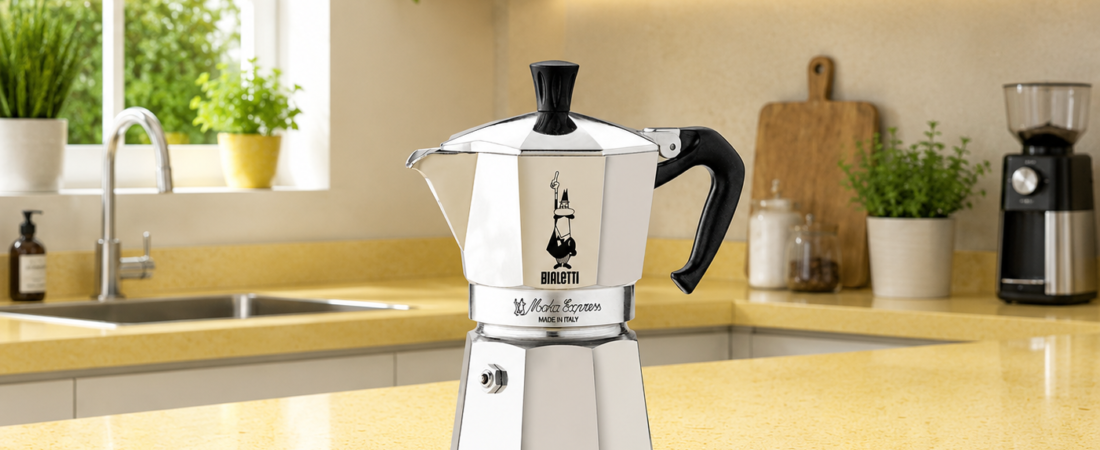
This Bialetti Moka Express review covers the most iconic moka pot in the world — the one that’s been in Italian kitchens since 1933 and still outsells every competitor today. But is it actually the best moka pot for beginners, or is it just trading on its reputation?
This article contains affiliate links. If you buy through them, I may earn a small commission at no extra cost to you.
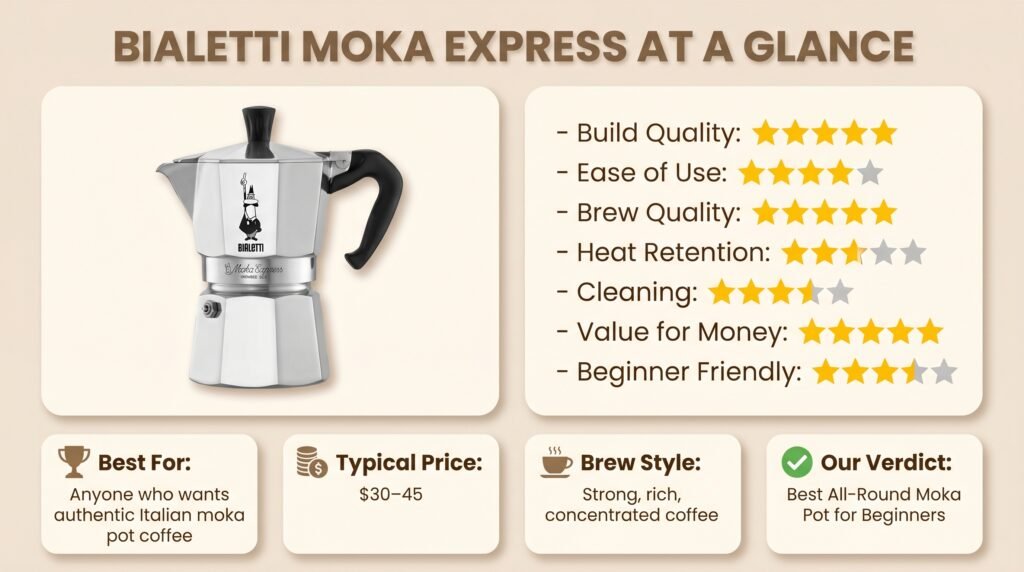
⭐ Quick Verdict: Bialetti Moka Express The most proven moka pot available. Authentic Italian quality, widely available replacement parts, and genuinely good coffee. The benchmark everything else is measured against.
Bialetti Moka Express at a Glance
Who the Bialetti Moka Express Is Best For
The Moka Express is the right choice if you:
- Want the most trusted and proven moka pot available
- Are new to moka pot brewing and want something reliable
- Want a pot that’s been refined over 90 years of production
- Value authentic Italian craftsmanship
- Want easily available replacement parts for long-term maintenance
The Moka Express is probably not the right fit if you:
- Have an induction hob — you’ll need a stainless steel model or an adapter
- Want something that keeps coffee hot for longer — it’s aluminium, not insulated
- Are after a moka pot with crema — look at the Bialetti Brikka instead
- Want a dishwasher-safe pot — the Moka Express must be handwashed
What Is the Bialetti Moka Express?
The Bialetti Moka Express is the original stovetop espresso maker, first produced in 1933 by Alfonso Bialetti in Italy. The design — the iconic octagonal aluminium body, the iconic moustached man logo, the three-part construction — has barely changed in over 90 years.
It works exactly as described in our Moka Pot Beginner Guide: water in the bottom chamber is heated on the stove, steam pressure forces hot water up through the coffee grounds in the filter basket, and concentrated coffee collects in the top chamber.
The Moka Express is made in Italy and comes in a wide range of sizes — from 1-cup to 18-cup — measured in espresso cups (50-60ml each), not standard mugs.
Build Quality
This is where the Bialetti Moka Express earns its reputation.
The octagonal aluminium body is precision-cast and robust. The handle is heat-resistant and comfortable. The patented safety valve on the bottom chamber is a genuine safety feature that makes it easy to clean and safe to use daily. Everything fits together precisely — the top chamber screws onto the bottom firmly with no wobble or leaking.
The aluminium construction means it’s lightweight but not flimsy. It’s the same material and manufacturing process used since 1933 — and the fact that people still brew with vintage Bialetti pots from the 1960s and 70s tells you everything you need to know about the durability.
The one genuine limitation is that aluminium can’t be used on induction hobs. If you have an induction stove, you’ll need the Bialetti Venus (stainless steel) or a separate induction adapter plate.
How the Coffee Tastes
Moka pot coffee from the Bialetti is rich, bold, and concentrated — significantly stronger than French press or drip coffee, though not technically espresso.
The first few brews from a new pot may have a slight metallic taste — this is normal with new aluminium. Run 2-3 cycles with plain water before your first real brew to season the pot. After that, the flavour is clean and the coffee is excellent.
The key variables that affect taste — grind size, heat level, and water temperature — are covered in detail in our Moka Pot Beginner Guide. Get those right and the Bialetti will produce consistently good, strong coffee every morning.
One thing to note: moka pot coffee doesn’t have true crema — the thick foam you get from an espresso machine. If crema is important to you, the Bialetti Brikka is designed specifically to produce it, though it costs more and has a steeper learning curve.
Ease of Use
The Moka Express has a slight learning curve compared to a French press — there are more variables to control (heat level, water temperature, timing) and the consequences of getting it wrong (bitter, burnt coffee) are more noticeable.
That said, most people nail a decent cup by their second or third brew. The process becomes quick and intuitive once you’ve done it a few times:
- Fill bottom chamber with hot water to below the safety valve
- Fill filter basket level with medium-fine grounds — don’t tamp
- Screw the top on firmly
- Heat on medium-low with lid open
- Remove from heat as soon as gurgling starts
- Pour immediately
The most common beginner mistakes — using cold water, using too high heat, tamping the grounds — are easy to avoid once you know about them. Our Moka Pot Beginner Guide covers all of them in detail.
Cleaning and Maintenance
The Moka Express must be handwashed — no dishwasher. This is non-negotiable. Dishwashing strips the natural seasoning that builds up inside the aluminium over time and damages the rubber gasket.
After each brew:
- Allow the pot to cool completely before disassembling
- Rinse all three parts with warm water — no soap
- Let all parts air dry fully before reassembling
The gasket: The rubber gasket between the top and bottom chambers needs replacing periodically — typically every 1-2 years with daily use. When it starts to feel hard or cracked, or the pot begins to leak during brewing, replace it. Replacement gaskets and filters are inexpensive and widely available on Amazon — search “Bialetti replacement gasket” and filter for your cup size.
This is one of the Bialetti’s genuine strengths — replacement parts are easy to find and cheap, which means a well-maintained Moka Express can last decades.
Sizing Guide
Bialetti Moka Express sizes are measured in espresso cups (50-60ml each) — not standard coffee mugs.
| Size | Volume | Makes | Best For |
|---|---|---|---|
| 1-cup | ~60ml | 1 espresso shot | Single shot only |
| 3-cup | ~130ml | 1 standard mug | Solo brewers |
| 6-cup | ~270ml | 2 standard mugs | One or two people |
| 9-cup | ~420ml | 3 standard mugs | Two to three people |
| 12-cup | ~670ml | 4+ standard mugs | Larger households |
For most beginners brewing for one, the 3-cup is the right starting point. For two people or anyone who drinks two mugs in the morning, the 6-cup is the better choice.
Bialetti Moka Express vs Other Moka Pots
| Feature | Moka Express | Brikka | Generic Moka Pot |
|---|---|---|---|
| Price | ~$30–45 | ~$50–70 | ~$15–25 |
| Crema | No | Yes | No |
| Build Quality | Excellent | Excellent | Varies |
| Replacement Parts | Easy to find | Easy to find | Often unavailable |
| Induction compatible | No (aluminium) | No (aluminium) | Varies |
| Beginner Friendly | ⭐⭐⭐⭐⭐ | ⭐⭐⭐☆☆ | ⭐⭐⭐☆☆ |
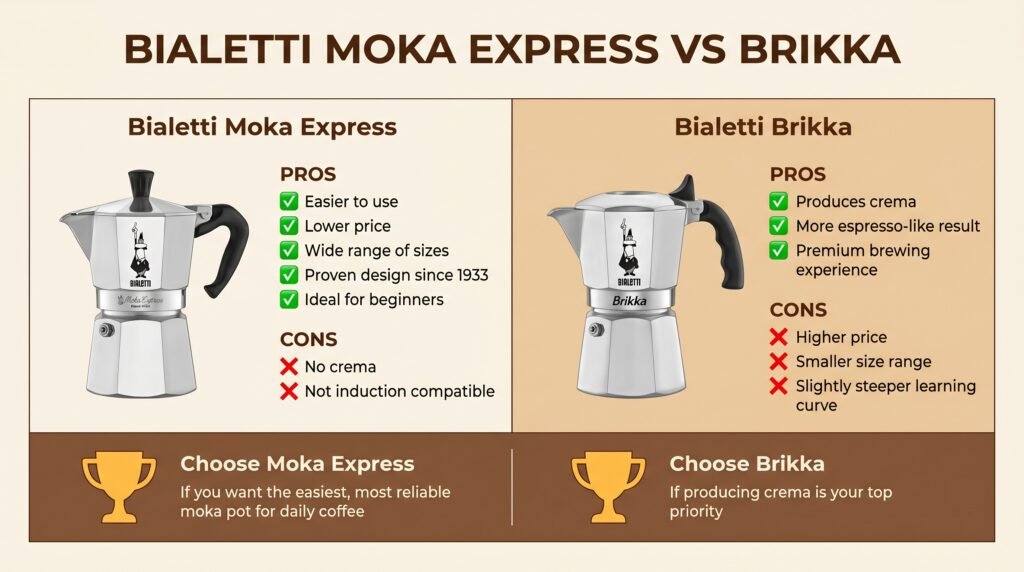
Bialetti Moka Express vs Bialetti Brikka The Brikka is Bialetti’s premium model — it has a special pressure valve that produces a layer of crema on top of the coffee, closer to real espresso. It costs more, has a slightly steeper learning curve, and is only available in 2-cup and 4-cup sizes. For beginners, the Moka Express is the better starting point. The Brikka is worth considering if you specifically want crema.
Bialetti Moka Express vs generic moka pots The Moka Express costs slightly more than unbranded alternatives — typically $30-45 vs $15-25 for a generic pot. The difference is build quality, manufacturing precision, and replacement parts availability. Cheap moka pots often have poor-fitting gaskets, inconsistent pressure, and no accessible replacement parts. For the extra $10-15, the Bialetti is worth it.
Bialetti Moka Express vs Bialetti Venus (induction) The Venus is the stainless steel version of the Moka Express — designed for induction hobs. If you have induction, get the Venus. If you have gas or electric, the original Moka Express is the better choice — aluminium heats more evenly on traditional stoves.
Pros and Cons
Pros:
- The most trusted and proven moka pot available
- Made in Italy — authentic quality since 1933
- Wide range of sizes — 1-cup to 18-cup
- Replacement gaskets and filters widely available and inexpensive
- Patented safety valve for easy cleaning and safe use
- Lightweight and compact
- Brews rich, strong, full-flavoured coffee
- Very affordable for the quality
Cons:
- Not suitable for induction hobs (aluminium)
- Not dishwasher safe — handwash only
- Slight learning curve compared to French press
- No crema — look at the Brikka if crema matters
- New pots may have slight metallic taste until seasoned
- Coffee cools quickly — no insulation
Bialetti Moka Express Review: Is It Worth It?
Yes — for most beginners who want to try moka pot brewing, the Bialetti Moka Express is the easiest and most reliable recommendation available.
It’s been the benchmark for stovetop espresso for over 90 years. The design is proven, the quality is consistent, replacement parts are cheap and accessible, and the coffee it produces is genuinely excellent when brewed correctly.
At $30-45 depending on size, it’s more affordable than most alternatives that try to compete with it. For anyone who wants strong, Italian-style coffee at home without spending hundreds on an espresso machine, the Moka Express remains one of the best value purchases in home coffee brewing.
👉 Bialetti Moka Express 3-cup (~$30) — Check price & availability
👉 Bialetti Moka Express 6-cup (~$40) — Check price & availability
Frequently Asked Questions
Is the Bialetti Moka Express good for beginners? Yes — it’s one of the most recommended moka pots for beginners. It has a slight learning curve compared to a French press, but most people get a good cup within a few brews. Our Moka Pot Beginner Guide covers everything you need to know before your first brew.
What size Bialetti Moka Express should I buy? The 3-cup is right for most solo brewers — it makes roughly one standard mug of strong coffee. The 6-cup is better for two people or anyone who drinks two mugs in the morning. Sizes are measured in espresso cups (50-60ml each), not standard mugs.
Does the Bialetti Moka Express work on induction? Not directly — aluminium isn’t magnetic and won’t work on induction hobs. You can use a separate induction adapter plate (sold separately) or switch to the Bialetti Venus which is the stainless steel induction-compatible version.
Why does my Bialetti taste metallic? This is normal with a new aluminium pot. Run 2-3 brew cycles with plain water before your first real brew to season the pot. The metallic taste disappears after a few uses.
How often should I replace the Bialetti gasket? With daily use, check the gasket every 6-12 months. Replace it when it feels hard, cracked, or when you notice leaking during brewing. Replacement gaskets are inexpensive — search “Bialetti replacement gasket” on Amazon and match your cup size.
Is the Bialetti Moka Express dishwasher safe? No — handwash only with warm water, no soap. Dishwashing strips the natural seasoning and damages the gasket. Rinse it after each use, let it air dry, and it will last for years.
What’s the difference between the Bialetti Moka Express and the Brikka? The Moka Express is the classic model — straightforward, reliable, widely available. The Brikka has a special pressure valve that produces crema on top of the coffee, similar to espresso. The Brikka costs more and has a steeper learning curve. For beginners, start with the Moka Express.
Continue Learning
- Moka Pot Beginner Guide → how to brew your first cup and avoid the most common mistakes
- Best Moka Pot for Beginners → how the Bialetti compares to other moka pots at this price
- Best Coffee Beans for Beginners → which beans work best in a moka pot
- Best Beginner Coffee Grinders Under $150 → getting the grind right makes the biggest difference to moka pot flavour
- Why Does My Coffee Taste Bitter? → troubleshooting guide if your moka pot coffee tastes off
- Best Moka Pot Under $50 → looking to spend less? Our top budget-specific picks
- Moka Pot vs French Press → not sure moka pot is right for you? See the full comparison
- AeroPress vs Moka Pot → how moka pot compares to another popular method