Not sure how to choose a French press? You’re not alone — knowing how to choose a French press that actually suits your routine can feel surprisingly complicated. This guide cuts through the options and gives you simple, honest beginner picks — no overwhelming jargon, no confusion. If you already know you want something affordable, our Best French Press Under $50 for Beginners guide has five specific picks ready to go.
The short answer: When choosing a French press, focus on three things — size, material, and ease of use. A medium-sized glass or stainless steel press with a smooth plunger is the right starting point for most beginners. Avoid oversized presses and ignore marketing features you won’t use.
This article contains affiliate links. If you buy through them, I may earn a small commission at no extra cost to you.
⭐ Best Pick for Most Beginners
If you want a simple, no-confusion choice, the Bodum Chambord French Press is the easiest place to start. It’s reliable, widely available, and easy to find — which makes it a very safe first choice.
- Easy to use with consistent results
- Simple, durable design
- Works well with standard coarse ground coffee
If you don’t want to overthink your first setup, this is the easiest place to start:
👉 Check latest price and availability
Best French Press for Beginners (By Type)
Here’s a quick comparison of the most beginner-friendly options:
| Option | Best For | Material | Key Benefit | Limitation |
|---|---|---|---|---|
| Bodum Chambord | Everyday use | Glass | Simple, reliable, classic design | Can break |
| Mueller Living Stainless Steel | Heat retention | Stainless steel | Double-wall insulation, keeps coffee warm longer | Heavier |
| ESPRO P0 / P3 | Cleaner coffee | Glass + filter | Less sediment | More expensive |
| SterlingPro Stainless Steel | Heat retention | Stainless steel | Keeps coffee warm longer | Heavier |
| Bodum Brazil | Budget | Plastic + glass | Affordable and simple | Less durable |
Which French Press Should You Choose?
Not everyone needs the same type of French press. If you’re still figuring out how to choose a French press, here’s a simple way based on what matters most to you
- Choose Bodum Chambord if you want a reliable, everyday option
- Choose Mueller Living Stainless Steel if you want double-wall insulation at a good price
- Choose SterlingPro Stainless Steel if durability and heat retention matter more
- Choose ESPRO P0 if you prefer a cleaner cup with less sediment. For a full breakdown of the P3 specifically, see our ESPRO P3 Review.
- Choose Bodum Brazil if you’re just starting and want a budget option
For most beginners, a medium-sized, simple French press is the easiest place to start.
Why French Press Is a Great Choice for Beginners
French press is often recommended to beginners for a simple reason: it’s one of the easiest ways to make good coffee at home.
There are no paper filters to buy, no complicated technique to master, and no machine to learn. Coffee grounds steep in hot water for a few minutes, then the plunger separates the brew. It’s simple, forgiving, and surprisingly satisfying. But once shopping begins, that simplicity disappears fast.
If you’re not sure how to choose a French press, the decision usually comes down to a few practical things: size, material, insulation, and how easy it feels to use day to day. Glass or stainless steel? Small or large? Cheap or expensive? Double-walled? Travel-friendly? “Professional”?
This guide explains how to choose the best French press for beginners — not the fanciest model, and not the most expensive one, but the one that fits real life and makes brewing feel easy.
Understanding how to choose a French press that fits your lifestyle is the first step to enjoying it consistently.
How to Choose a French Press: A Simple Step-by-Step Decision
Choosing a French press doesn’t need to be complicated. Work through these four questions and you’ll have a clear answer.
Step 1 — How much coffee do you drink each morning?
This determines what size to buy — and it’s the decision most beginners get wrong.
- One large mug → 3-cup (12oz/350ml)
- Two mugs, or one very large mug → 4-cup (17oz/500ml)
- Two people, or you drink a lot → 8-cup (34oz/1L)
Don’t buy larger than you need. A press that’s too big is awkward to use daily and harder to clean.
Step 2 — Do you care about heat retention?
- No — glass is fine and usually cheaper
- Yes — choose stainless steel or double-wall insulated
Glass presses lose heat in about 20-30 minutes. A stainless steel press keeps coffee warm for 60+ minutes. If you drink slowly or get distracted in the morning, stainless steel is worth it.
Step 3 — Does sediment bother you?
- No — any standard French press works fine
- Yes — choose the ESPRO P3 which uses a double micro-filter to produce a nearly sediment-free cup
Sediment at the bottom of your cup is normal for French press. Most people don’t mind it. If it’s the reason you’ve avoided French press before, the ESPRO P3 solves it.
Step 4 — What’s your budget?
- Under $20 → Bodum Brazil
- $30-40 → Bodum Chambord (glass) or Secura (stainless steel)
- Around $40 → ESPRO P3(cleanest cup)
That’s it. Answer those four questions and the right press becomes obvious.
Why French Press Is Beginner-Friendly
French press works well for beginners because it removes a lot of pressure.
It’s forgiving
Small differences in brew time or grind size rarely ruin the coffee. Even without perfect technique, French press still produces a drinkable cup.
It’s flexible
Coffee can be made stronger or weaker easily, without needing special tools or precise measurements.
It’s low-commitment
No filters, no pods, no electricity required. It’s a simple brewer that can sit in the cupboard until it’s needed.
It teaches you what coffee tastes like
French press produces a fuller-bodied cup than paper-filter methods. That makes it easier to notice things like strength, bitterness, and mouthfeel — which helps beginners learn what they enjoy.
If you’re new to the method, this step-by-step guide shows exactly how to use a French press from start to finish — so you can get consistent results right away.
What Beginners Should Look For in a French Press
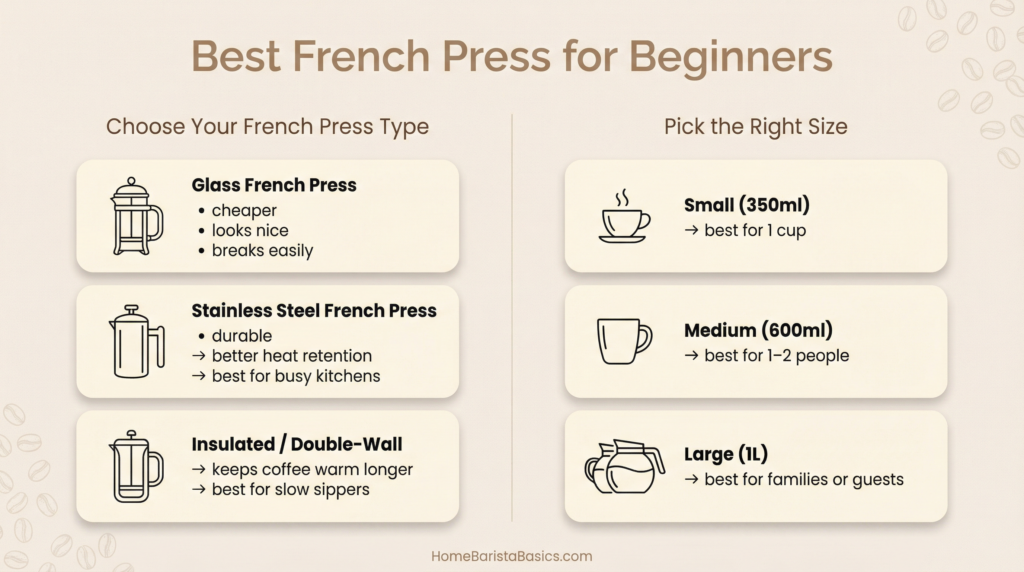
Knowing how to choose a French press comes down to a few practical features that matter far more than brand names. Not all French presses are equally beginner-friendly — size, material, and ease of use make a bigger difference than specs or price tags.
French press is also a great starting point when comparing different beginner methods — if you’re unsure how it compares to other options, this guide to beginner coffee brewing methods breaks it down clearly.
1. The Right Size for Real Life
This is the most common beginner mistake.
Many people buy a large French press “just in case,” then rarely use it because it feels heavy, awkward, and annoying to clean.
A better approach is to match size to routine:
- For 1 cup most mornings: 350ml–500ml
- For 2 cups (or a large mug): 600ml–800ml
- For 2+ people regularly: 1L or larger
If you only brew for yourself, our Best French Press for One Person guide covers the right size and best models for solo brewing.
Bigger isn’t better — bigger is often just harder to use consistently.
2. A Material That Fits Your Lifestyle
French presses come in three common materials: glass, stainless steel, and plastic.
Glass French presses
Pros
- You can see the brewing process
- Often cheaper
- Classic look
Cons
- Breaks easily (especially in busy kitchens)
- Loses heat quickly unless insulated
Glass can work well, but many beginners end up breaking their first one.
Stainless steel French presses
Pros
- Very durable
- Retains heat better
- Safer around kids and crowded benches
Cons
- Usually more expensive
- You can’t see the coffee brewing
For most beginners, stainless steel is the more “stress-free” option.
Plastic French presses
Plastic models are usually designed for travel or durability.
They can be practical, but many cheaper plastic presses feel flimsy and don’t seal as well as steel models.
3. Insulation (More Useful Than It Sounds)
Double-walled or insulated French presses help more than most beginners realise.
They:
- keep coffee warmer for longer
- reduce the urge to microwave coffee (which often makes it taste worse)
- give more flexibility if mornings are busy
Insulation is especially useful for slow drinkers.
4. A Smooth, Stable Plunger
The plunger should feel:
- smooth
- straight
- not wobbly
A flimsy plunger makes pressing awkward and can cause spills, which is one of the fastest ways to make a beginner stop using French press altogether.
A stable plunger feels simple and satisfying.
5. Easy Cleaning (A Bigger Deal Than It Seems)
French press cleanup is simple in theory — but design matters.
Beginner-friendly presses usually:
- disassemble easily
- don’t trap grounds in small crevices
- rinse clean quickly
If a press is annoying to clean, it gets used less. That matters more than fancy features.
What Beginners Can Safely Ignore
French press marketing often makes simple things sound complicated.
Early on, these features usually don’t matter:
- “professional” branding
- ultra-fine mesh claims
- special coatings
- complex multi-filter systems
- extra accessories you’ll never use
For beginners, simplicity beats clever design almost every time.
Best Overall French Press for Beginners
Reliable, durable, easy to use
For most beginners, the safest French press choice is one that feels simple, works reliably every time, and doesn’t require any learning curve just to make a decent cup.
The Bodum Chambord French Press is one of the most beginner-friendly options because it balances ease of use, comfort, and everyday practicality. It’s a classic design that has stayed popular for a reason — it simply works.
Why beginners like it
- practical size for daily brewing
- sturdy frame that protects the glass
- simple design with minimal fuss
- comfortable pressing action
- easy to rinse and clean quickly
One honest limitation
Because it uses a glass carafe, it isn’t the most durable option for busy kitchens or households where it might get knocked over.
✅ Best for: everyday home use without overthinking
🔗 Bodum Chambord French Press (Check current price)
Best French Press for Small Apartments
Compact, lightweight, easy to store
A compact French press is ideal when counter space is limited. The ESPRO P0 Ultralight French Press is a great beginner option because it’s slim, lightweight, and easy to store — while still making a clean, full-bodied cup.
Why beginners like it
- slim design that fits easily in cupboards
- lightweight and easy to handle
- insulated build helps coffee stay warmer longer
- produces a cleaner cup than many basic glass presses
One limitation
The tall travel-style shape isn’t ideal for brewing larger batches for multiple people.
✅ Best for: apartments, studios, shared kitchens
🔗ESPRO P0 Ultralight French Press (Check current price)
Best Insulated French Press for Beginners
Keeps coffee warm without reheating
An insulated French press is ideal for slower mornings or households where coffee isn’t finished immediately. It keeps the brew hot longer, which makes the whole routine feel more forgiving — especially for beginners.
The SterlingPro Double Wall Stainless Steel French Press (34oz) is a strong beginner choice because it holds heat well, feels durable, and doesn’t require extra effort or special technique.
Why beginners like it
- coffee stays warm longer without reheating
- stainless steel build feels sturdy and long-lasting
- great size for 1–2 mugs without being bulky
- simple design with easy daily use
One limitation
Usually heavier than glass French presses.
✅ Best for: relaxed routines and slow sipping
🔗 Check current price for the SterlingPro Double Wall French Press (34oz)
For a budget stainless steel alternative, our Secura French Press Review covers whether it’s worth choosing over glass.
Best Budget French Press for Beginners
Affordable, simple, functional
A budget French press is ideal for beginners who want to try the method without spending much. It keeps things simple, makes surprisingly good coffee, and is easy to replace later if upgrading becomes worthwhile. If you’re comparing affordable options, our Best French Press Under $50 for Beginners guide covers beginner-friendly picks that balance price, durability, and ease of use.
Bodum Brazil French Press (Budget Pick)
The Bodum Brazil is one of the most beginner-friendly budget French presses because it’s lightweight, easy to use, and still brews a full-bodied cup without needing any fancy features.
Why beginners like it
- low cost without feeling flimsy
- simple design with no learning curve
- lightweight and easy to store
- great for first-time French press brewing
One honest limitation
Not as durable long-term as stainless steel models.
✅ Best for: first-time French press users
🔗 Check current price for the Bodum Brazil French Press (34oz)
Beginner Mistakes With French Press (And How to Avoid Them)
Once you know how to choose a French press, avoiding these common mistakes will help you get the best results.
Grinding too fine
French press works best with a coarse grind. Too fine and the coffee often tastes bitter, muddy, or gritty. Grind size matters more than most beginners expect — especially for French press — and this guide explains it simply: Best Coffee Grinder for French Press Beginners.
If you’re looking for a more general option, this guide to best coffee grinders for beginners covers simple, reliable choices.
Letting coffee sit too long
Once pressed, coffee continues extracting. Pouring coffee out after pressing helps prevent it from turning bitter over time.
Buying a press that’s too large
Large presses look impressive but are often inconvenient. Smaller presses get used more consistently.
Expecting café-style clarity
French press coffee is fuller-bodied and contains more oils and texture than paper-filter coffee. That’s normal and part of the style.
French Press vs Other Beginner Brewing Methods
Knowing how to choose a French press is useful, but it helps to understand how it compares to other beginner methods too.
French press vs drip coffee
- French press: fuller body, more texture
- Drip coffee: cleaner cup, less sediment
Both are beginner-friendly — they simply produce different styles of coffee.
For a cleaner, lighter cup, drip coffee is often the easiest alternative — see: Best Drip Coffee Makers for Beginners.
French press vs pour-over
- French press: simpler and more forgiving
- Pour-over: more control, more involvement
French press suits beginners who want ease and routine rather than technique.
A Simple Beginner French Press Setup
Once you know how to choose a French press, a full setup isn’t required.
At minimum:
- a French press
- beans you enjoy — if you’re unsure what to choose, this guide to best coffee beans for French press explains it simply
- hot water
Optional additions:
- a grinder (useful for consistency)
- a scale (optional)
For a full beginner setup (without buying unnecessary gear), see this simple checklist: Beginner Coffee Brewing Gear Checklist. Once you have the basics, the next step is learning the process — this step-by-step guide shows exactly how to use a French press from start to finish.
The Calm Recommendation
When thinking about how to choose a French press, the best option for beginners is the one that:
- matches how much coffee is actually brewed
- feels durable and easy to use
- fits the kitchen and routine
- gets used regularly without effort
The goal isn’t finding the “perfect” French press.
The goal is finding one that makes brewing feel simple.
French press is a great way to learn what coffee tastes like — without pressure, complexity, or expensive gear.
Best French Press for Beginners (FAQs)
Is French press good for beginners?
Yes. It’s one of the most forgiving and accessible brewing methods, and it requires very little equipment.
Does French press make stronger coffee?
French press coffee often tastes stronger because it has more body and oils, but strength is easy to adjust by changing the coffee-to-water ratio.
Do beginners need a scale for French press?
A scale isn’t required, but it can make results more consistent over time — this explains when it actually matters: Do You Need a Coffee Scale as a Beginner?
Is French press messy?
It can be slightly messy at first, but choosing the right size and cleaning promptly makes it easy. A smaller press is often easier to manage for beginners. French press is one of the simplest ways to start brewing well at home — and once you find the right one, it’s a routine that sticks.
How to choose a French press as a complete beginner?
Start with size and material — choose a medium-sized press in glass or stainless steel, keep it simple, and avoid overthinking features you won’t use. A reliable, affordable option like the Bodum Chambord is a great first choice for most beginners. Not sure which material makes more sense? Read our Glass vs Stainless Steel French Press guide.
If you’re still unsure how to choose a French press that’s right for your setup, leave a comment below with how many cups you make and your budget — I’m happy to help you narrow it down.