This isn’t about blaming cheap gear
Many beginners start with a cheap coffee grinder — and that makes complete sense.
Cheap grinders are:
- Easy to find
- Easy to afford
- Often marketed as “good enough”
When coffee doesn’t taste right, beginners often assume:
- They’re doing something wrong
- Their beans are bad
- Coffee is just “supposed” to taste bitter
In reality, the grinder is often the limiting factor — not effort or ability.
This article explains why very cheap coffee grinders tend to produce bad coffee, without shaming budget choices or pushing expensive upgrades.
What “Cheap” Usually Means in Coffee Grinders
In this context, “cheap” doesn’t just mean low price.
It usually means grinders that:
- Use spinning blades instead of burrs
- Offer little or no real grind adjustment
- Prioritise speed over consistency
- Are designed more like kitchen appliances than coffee tools
These grinders aren’t designed to help beginners learn how coffee extraction works.
The Core Problem: Uneven Grind Size
Coffee extraction depends on surface area.
When grind size is uneven:
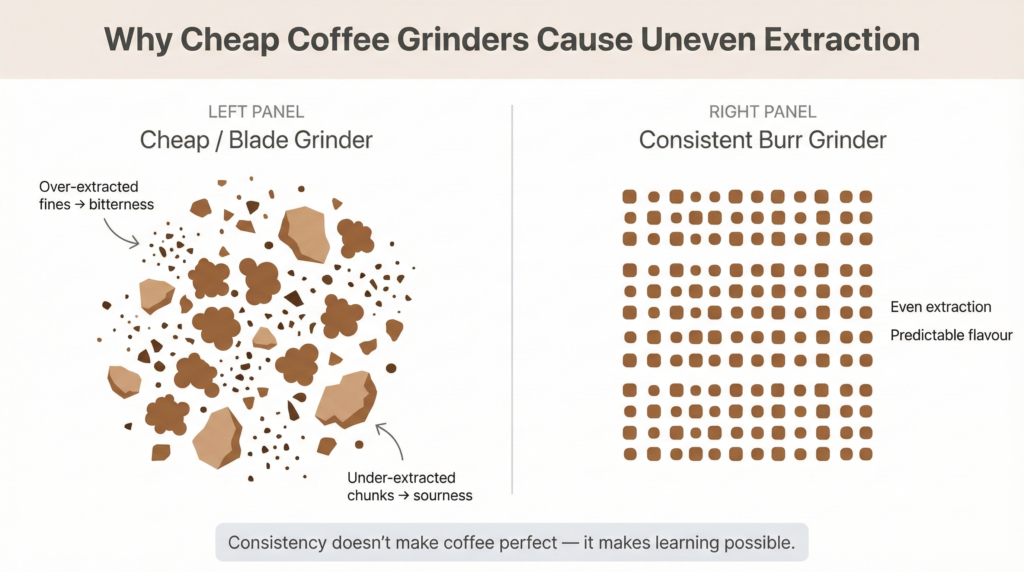
- Fine particles extract too quickly → bitterness
- Large particles extract too slowly → sourness
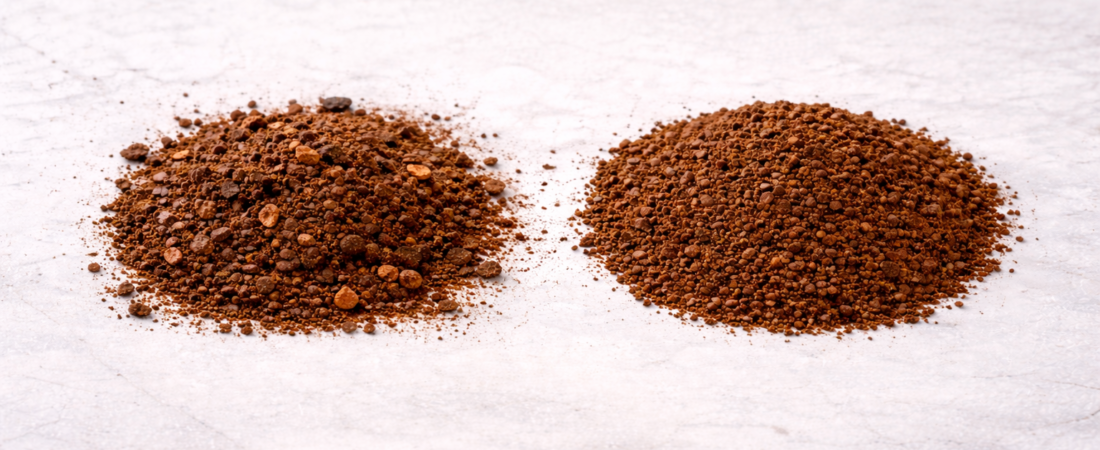
Very cheap grinders tend to create a mix of dust-like powder, medium grounds, and large chunks — all in the same batch. If you want to see exactly how grind size affects bitterness, sourness, and strength — and how to fix it step by step — this grind size troubleshooting guide explains it clearly.
This is most common with blade-based designs, which explains why burr grinders behave so differently from blade grinders.
Why Blade Grinders Are Especially Problematic
Blade grinders don’t “grind” coffee — they chop it.
The longer you run them:
- The finer some particles get
- While others remain large
This makes grind size:
- Inconsistent
- Unpredictable
- Difficult to repeat
That’s why beginner troubleshooting often feels impossible with blade grinders — changes don’t behave logically.
Cheap Grinders Remove the Learning Feedback Loop
One of the biggest hidden problems with very cheap grinders is that they block learning.
Beginners need to see:
- “When I grind finer, coffee tastes stronger”
- “When I grind coarser, coffee tastes weaker”
With uneven grind size, those cause-and-effect relationships disappear.
This leads to:
- Guessing instead of adjusting
- Frustration instead of improvement
- Blaming technique instead of equipment
This is why many beginners end up with coffee that tastes harsh or overpowering — even when everything else seems right. If that’s happening, this explanation of why coffee tastes too strong can help pinpoint the cause.
Why Cheap Grinders Make All Brew Methods Harder
Even forgiving brew methods struggle with poor grind quality.
With French press, fine dust causes bitterness and sludge, while large chunks under-extract — which is why grind consistency matters so much for beginners.
With pour-over, uneven grind size leads to stalled brews, channeling, and hollow or sharp flavours.
With AeroPress, inconsistent particle size makes strength and flavour hard to repeat from one brew to the next.
The grinder affects everything that comes after.
Why Cheap Grinders Often Feel “Good Enough” at First
Many beginners feel satisfied initially — then disappointed later.
This usually happens because:
- Expectations are low at first
- Any fresh grinding feels like an upgrade
- Learning increases faster than equipment capability
As skills improve, limitations become obvious.
That delay doesn’t mean the grinder suddenly got worse — it means you got better.
Cheap vs Affordable: An Important Distinction
Not all low-cost grinders are a problem.
There’s a big difference between:
- Cheap grinders → inconsistent, non-adjustable
- Affordable burr grinders → predictable, learnable
Affordable burr grinders are designed to:
- Produce repeatable results
- Support learning
- Improve flavour without precision obsession
That’s why many beginners find that a small step up to a consistent burr grinder under $100 makes learning and improvement far easier — without jumping into expensive gear.
This is why “cheap” and “budget” aren’t the same thing.
Why Spending a Little More Often Saves Money
Ironically, very cheap grinders often lead to:
- Buying replacement gear sooner
- Wasted beans during troubleshooting
- Frustration-driven upgrades
Spending slightly more on a beginner-safe burr grinder often:
- Reduces wasted coffee
- Shortens the learning curve
- Prevents regret
This is why many beginners end up upgrading sooner than expected — not because they failed, but because the grinder limited progress and created unnecessary frustration that later turns into grinder regret.
What a Better Beginner Grinder Actually Fixes
Upgrading from a very cheap grinder usually improves:
- Consistency
- Predictability
- Clarity of flavour
- Confidence in adjustments
It doesn’t make coffee “perfect” — it makes improvement possible. This doesn’t mean you’ve wasted money or done anything wrong.
Do You Need to Upgrade Immediately?
Not necessarily.
If you:
- Brew casually
- Are still learning ratios and timing
- Are happy experimenting
You can keep learning — just be aware of the grinder’s limits.
When frustration outweighs curiosity, that’s often the right moment to upgrade — not because you need better coffee, but because you’re ready to learn more consistently.
A Simple Way to Think About Grinder Quality
Instead of asking:
“Is this grinder cheap or expensive?”
Ask:
“Does this grinder let me see and taste what I’m changing?”
If the answer is no, improvement will always feel random.
Final Takeaway
Cheap coffee grinders don’t create bad coffee because beginners lack skill.
They create bad coffee because they:
- Produce uneven grounds
- Block learning
- Make troubleshooting impossible
A simple, consistent grinder doesn’t just improve flavour — it restores cause and effect.
And once that’s in place, everything else in coffee becomes easier to understand.
Where this article fits
This page:
- Justifies every grinder recommendation on your site
- Protects beginner trust
- Reduces regret
- Strengthens conversion elsewhere without selling
It’s a quiet authority piece — and those age extremely well.